|
List Price: $35.95
Your Price: $29.95

|
by Stan Grayson
- Paperback
- Published June 1999
Special Price for Volume I & II Set: $44.95
Both books measure 8½" x 11" trim size! Volume I contains 224 pages and 101 illustrations. Volume II contains 192 pages and 89 illustrations.
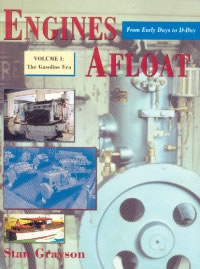
From the first motor launches, gold cup racers and fishing boats to World War II landing craft — here is the true story of internal combustion on the water! This fascinating two-volume book presents the only comprehensive history of the U.S. marine engine industry. Engines Afloat offers a unique blend of biography, history, and technical explanations with the kind of storytelling for which its author is so well-known. The time frame is 1884-1944.
Content
-
Pioneers: Regan in San Francisco, Sintz in Ohio and Michigan, the Palmers in Connecticut, Daimler, Otto, Steinway in New York, and others. It was the pioneers who developed commercially viable four-cycle and two-cycle engines that could be applied to turning a boat's propeller. This is the story of the men, their inventions, and their companies.
-
Production: By 1898, it had become clear that the internal combustion engine would change most aspects of life and commerce, ashore and afloat. The handful of pioneer companies were soon joined by dozens and later hundreds of others. In those early days, many wondered whether it would be the marine engine or the automobile that would have the most impact and offer investors the most reward. This chapter explores the many connections between early car companies and marine engine companies and includes profiles of numerous marine engine builders throughout the country.
-
California: Although Midwest, East Coast, and European developments have generally been the focus of most engine research and history, the West Coast companies played a major role. Now, that role has been recognized in a chapter that includes the men and machines of Union, Standard, Hall-Scott and others.
-
Gray: When author Stan Grayson began his research for this book, he looked for one company that might encompass the entire story of the U.S. marine engine industry. He found it in the many previously disconnected aspects Gray Motor Company's history. Through extensive research, the author has linked the many chapters of the Gray story together to present a portrait of a company that remains among the best-known of all marine engine builders.
-
Faster: While early marine engines were robust and heavy machines designed for the ceaseless work of driving a boat, a few men dreamed of building engines that possessed much improved power-to-weight ratios. This chapter explores two key pioneers. It chronicles the rise and fall of Van Blerck in Michigan and Sterling in Buffalo, New York, and their development of the high speed, lightweight marine engine.
-
Technology: Although it is now natural to take for granted the convenience represented by a modern engine, each step towards such machines represented a step into the unknown. Ignition, timing, carburetion, the layout of valves or ports, the two-cycle vs. four-cycle — all these had to be explored along the way. This chapter describes such engines as the early Standard, the first Lenoir and Daimlers, the famous T-heads, OHV, and more.
There's More!
Both volumes of Engines Afloat include an appendix and a useful Index. In Volume I, the Appendix includes a most unusual glossary of terms so that readers will be able to identify how the first generation of engine designers defined the machines they were building. Volume II includes fascinating operating instructions relating to Kahlenberg and Hicks engines.
Both books measure a big 8½" x 11" trim size! Volume One contains 224 pages and 101 illustrations. Volume Two contains 192 pages and 89 illustrations.
Photos


|

