Logo

Rough and stalling idle. Repeatedly stalls when prop is engaged.

BoatCurious

New member
Volvo penta 5.0 motor (in 1996 Sunbird Corsair)

First time out for second season of ownership. No problems last year with fresh tuneup from dealer Nguyen purchased from buyer (other than seemed hard to start). When cold at put in, it started fine and purred like a kitten. Ran it 3 miles at moderate throttle. Ran great under throttle.

Then… Stalled when putting it in neutral to anchor. Did not want to start. After about 10 tries or so it would fire and briefly idle roughly. Often stalling. When the propeller was engaged, it repeatedly stalls.

Holley carb. #71 idle jets at .9 turns out both sides.

Obviously, could be the fuel water filter. Ordered a new one. Also, gas was treated, but from last year and need to add new ethanol, free gas. However, wondering about the jetting and any other possible suspects?

Any thoughts would be greatly appreciated!
 
Volvo penta 5.0 motor (in 1996 Sunbird Corsair)

First time out for second season of ownership. No problems last year with fresh tuneup from dealer Nguyen purchased from buyer (other than seemed hard to start). When cold at put in, it started fine and purred like a kitten. Ran it 3 miles at moderate throttle. Ran great under throttle.

Then… Stalled when putting it in neutral to anchor. Did not want to start. After about 10 tries or so it would fire and briefly idle roughly. Often stalling. When the propeller was engaged, it repeatedly stalls.

Holley carb. #71 idle jets at .9 turns out both sides.

Obviously, could be the fuel water filter. Ordered a new one. Also, gas was treated, but from last year and need to add new ethanol, free gas. However, wondering about the jetting and any other possible suspects?

Any thoughts would be greatly appreciated!
Take a fuel sample. Loosen the fuel fill cap- if it wants to run, it could be a clogged vent line. If possible, use a fuel tank for an outboard and if it runs better, find out why.

How did you set the idle screws at point 9 turns, by eye?

Has anything else changed since last year?
 
Take a fuel sample. Loosen the fuel fill cap- if it wants to run, it could be a clogged vent line. If possible, use a fuel tank for an outboard and if it runs better, find out why.

How did you set the idle screws at point 9 turns, by eye?

Has anything else changed since last year?
Volvo penta 5.0 motor (in 1996 Sunbird Corsair)

First time out for second season of ownership. No problems last year with fresh tuneup from dealer Nguyen purchased from buyer (other than seemed hard to start). When cold at put in, it started fine and purred like a kitten. Ran it 3 miles at moderate throttle. Ran great under throttle.

Then… Stalled when putting it in neutral to anchor. Did not want to start. After about 10 tries or so it would fire and briefly idle roughly. Often stalling. When the propeller was engaged, it repeatedly stalls.

Holley carb. #71 idle jets at .9 turns out both sides.

Obviously, could be the fuel water filter. Ordered a new one. Also, gas was treated, but from last year and need to add new ethanol, free gas. However, wondering about the jetting and any other possible suspects?

Any thoughts would be greatly appreciated!

Take a fuel sample. Loosen the fuel fill cap- if it wants to run, it could be a clogged vent line. If possible, use a fuel tank for an outboard and if it runs better, find out why.

How did you set the idle screws at point 9 turns, by eye?

Has anything else changed since last year?
Thanks Jimn. Did not think of possible venting issues or opening fuel cap!

To answer your Q: No idea how, when or who set idle jet screws at 0.9 out. Bought the boat last summer and that’s how they were set. Have not yet checked these screw settings with a vacuum gauge. Frankly, was happy to finally limp it home in a HUGE thunderstorm before I pulled it out of the water. I then yanked the carb as I thought idle jets might have been clogged (they weren’t).

Most advice I’ve seen from various YouTube tuners recommend 1.25 out as a starting point. That’s a good deal richer than it is now. Also, I have no idea what’s a good (or the stock) idle jet size. Is #71 worth keeping in, and if not, any suggestions?

Wondering if it’s too lean at idle and when it goes on throttle, and switches to main jet (which is richer), it drowns and cuts out? If so, I could set the idle jet screws at 1.25 (or 1.5?) out, and/or jet one or two richer on the idle jet?

BUT…. Looking at this from the other point of view, if idle jet is too rich (good for cold engine starting), when it warms up, it might be drowning bogging because it wants to be leaner when warm. (And there was a surprising amount of carbon inside the intakes)

For those into jetting, I use the boat at Raystown Lake, PA, which is 786’ above sea level.

I have the carb apart right now, so easy to make adjustments if need be.
 
Also wondering if float might be too high and dumping too much fuel when going on the throttle circuit. Sure wish there was a glass sight window into the float bowl. 🤔
 
Seriously - if you adopted a bit more discipline, you will likely get to the desired end state faster and with a few more dollars in your pocket...

Diagnose the problem vs guessing at it and throwing parts or adjustments at it.....and keep a maintenance log of what happened, what you did and things that were newly discovered. it will pay you dividends as long as you have the boat.

Have you checked to make sure the choke is opened once the engine is warmed up?

have you checked to see if the fuel pump diaphragm has ruptured?
 
Did a quick search on a sight glass bowl. Uncle Tony’s Garage had some good logic why they can be misleading. Easier to tune one with a drain screw. He says to adjust float down to start then raise until gas trickles out. Then raise it one “face of the nut” further ( or 1/6th of a turn). Who knew?
 
Seriously - if you adopted a bit more discipline, you will likely get to the desired end state faster and with a few more dollars in your pocket...

Diagnose the problem vs guessing at it and throwing parts or adjustments at it.....and keep a maintenance log of what happened, what you did and things that were newly discovered. it will pay you dividends as long as you have the boat.

Have you checked to make sure the choke is opened once the engine is warmed up?

have you checked to see if the fuel pump diaphragm has ruptured?
Really am trying to do what you’re suggesting! :)

The only known difference from last year (when it sorta worked from idle to throttle, but not exceptionally well) is that it sat over the winter outside at the dealer’s lot after they drained it.

I like your suggestions. Thanks! Will check to be sure choke is opened when warm. Not sure how to check fuel pump diaphragm but can research. Any tips?
 
What was your highest manifold vacuum reading at idle, while in gear?

After reading what you’ve described, I’d start by checking the accelerator pump circuit first, to make sure it’s giving a good, immediate fuel squirt as soon as the throttle moves. If that’s working correctly, my next suspect would be the power valve. It could be blown or simply rated too low for your engine.
If you remove the front fuel bowl, you’ll see the power valve in the metering block. It will have a vacuum rating (4.5, 6.5, 8.5, etc.) is stamped on the gold-colored face.
As a general rule when tuning a Holley, the choice of power valve should be determined by taking about half of your engines manifold vacuum reading — at idle while the engine is warmed up— and in forward gear. These changes made a huge difference on my 1996 Volvo Penta 7.4L DP Monterey 265. I was having symptoms of:
• Rough idle.
• Engine would stumble or stall when shifting from neutral into gear.
• Severe hesitation or bog when accelerating from idle. (If I could somehow get above the 1800-2,300 rpm without stalling, it would run great all the way to wide-open throttle.
Also a couple of other tips and things that helped me:
• I went one step stiffer on the Holley vacuum secondary spring. If you don’t already have one, I’d recommend buying Holley’s Vacuum Secondary Spring Kit. And While you’re at it, get the ‘Quick Change Secondary Spring/Diaphragm Cover’. That is worth every penny—it makes fine tuning the carb so much easier.
• I did swap out my accelerator pumps plastic ‘cam’ from a red color (or possibly could have been pink) to the dark blue cam. That moved more of the pump shot squirt towards the beginning of the throttle movement, which really helped eliminate the off-idle bog.
————————————————————

Hopefully some of this points you, (or whom ever is reading it) in the right direction and helps to solve your engines performance. It can be hard to diagnose these issues, every engine combination is a little different, but your symptoms sound somewhat similar to what I had fought with on my boat.
Good luck, and let us know by posting what you find. It may end up helping the next person who runs into the same issue.
 
What was your highest manifold vacuum reading at idle, while in gear?

After reading what you’ve described, I’d start by checking the accelerator pump circuit first, to make sure it’s giving a good, immediate fuel squirt as soon as the throttle moves. If that’s working correctly, my next suspect would be the power valve. It could be blown or simply rated too low for your engine.
If you remove the front fuel bowl, you’ll see the power valve in the metering block. It will have a vacuum rating (4.5, 6.5, 8.5, etc.) is stamped on the gold-colored face.
As a general rule when tuning a Holley, the choice of power valve should be determined by taking about half of your engines manifold vacuum reading — at idle while the engine is warmed up— and in forward gear. These changes made a huge difference on my 1996 Volvo Penta 7.4L DP Monterey 265. I was having symptoms of:
• Rough idle.
• Engine would stumble or stall when shifting from neutral into gear.
• Severe hesitation or bog when accelerating from idle. (If I could somehow get above the 1800-2,300 rpm without stalling, it would run great all the way to wide-open throttle.
Also a couple of other tips and things that helped me:
• I went one step stiffer on the Holley vacuum secondary spring. If you don’t already have one, I’d recommend buying Holley’s Vacuum Secondary Spring Kit. And While you’re at it, get the ‘Quick Change Secondary Spring/Diaphragm Cover’. That is worth every penny—it makes fine tuning the carb so much easier.
• I did swap out my accelerator pumps plastic ‘cam’ from a red color (or possibly could have been pink) to the dark blue cam. That moved more of the pump shot squirt towards the beginning of the throttle movement, which really helped eliminate the off-idle bog.
————————————————————

Hopefully some of this points you, (or whom ever is reading it) in the right direction and helps to solve your engines performance. It can be hard to diagnose these issues, every engine combination is a little different, but your symptoms sound somewhat similar to what I had fought with on my boat.
Good luck, and let us know by posting what you find. It may end up helping the next person who runs into the same issue.
REALLY appreciate your sharing these insights in such detail! Sounds like similar symptoms on my end.

Have not yet run it after cleaning out carb. The one finding is that while idle jets were not clogged, it seemed the passages were semi-blocked. This would create ultra lean condition when trying to start, possibly explaining hard start.

Yes, same red spring on my power valve. Weak closure of choke plate so I twisted the power valve housing 4 index marks CCW to create better closure (richer condition). Setting mixture screws at 1.25 out to initiate testing.

Not sure of power valve size but am investigating.
 
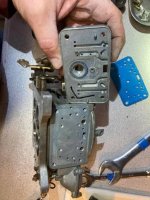
Any suggestions how to separate the fuel deck from the main carb body?

This carb has clearly not been apart in 30 years. Got the fuel bowl section off with some gentle tapping and I assume the fuel deck comes off… SOMEHOW?!?! Gentle tapping does NADA. Gentle use of a chisel next up?
 
Any suggestions how to separate the fuel deck from the main carb body?

This carb has clearly not been apart in 30 years. Got the fuel bowl section off with some gentle tapping and I assume the fuel deck comes off… SOMEHOW?!?! Gentle tapping does NADA. Gentle use of a chisel next up?
Are you talking about the metering block? (See Pic attached for an example)
 

Attachments

  • IMG_0733.jpeg
    IMG_0733.jpeg
    49 KB · Views: 4
Put some ATF trans oil or spray penetrating oil on the seal, all the way around for 30m or let it sit over night is better. (Worst case-submerge the metering block into ATF overnight).
Then try putting two bowl bolts into (do not thread them) metering block and use that as leverage, if you need more pressure. Very very very! gently apply pressure on the top of the metering block with a flathead, but DO NOT pry on the face of the mating flanges where it needs to seal.
Work it a little bit on each side with light pressure. It’ll just pop off eventually, keep the gasket wet with a little ATF or penetrating oil between the carb body and the metering block. Sometimes the gasket dried and adheres to the mating surfaces. (Be sure to thoroughly clean the carb before reassembling)

Take it slow. Let it oil soak into the old dried gaskets are and be patient. Try not to gouge the flanges or split the carb main body.

*When you get it apart—Pay close attention to your gaskets direction as it lays on the metering block and the bowls accelerator pump has a small hole that needs to line up correctly. Use the old gasket to match with a new one in the rebuild kit. There will be lots of holes that have to lay a certain way.
 
Last edited:
Will try soaking the gasket in ATF and/or penetrating oil. Definitely like the idea of gently using the screws to lever the fuel deck loose rather than tapping or a chisel! Gotta release when it’s got some lubricant worked into it, right?!?! :)
 
Back
Top