MarineEngine.com does not offer troubleshooting assistance or repair advice by email or by telephone.
You are invited to join our public Boat Repair Forum to seek assistance from other members.
You may also visit the Boat Motor Manuals section of our site to obtain a service manual.
Make sure you have power going to the tach (usually fed by the keyswitch - purple wire).
Make sure the "signal" wire is connected (grey wire).
Make sure the Tach has a connected ground wire (black wire).
Make sure the Tach is set to the correct number of poles (if it's an aftermarket/multi-model tach).
If everything looks good under the dash and you confirm it has power and ground then you have to start tracing the tach wire back through the harness to the motor and make sure nothing is broken, chaffed, pinched etc. The easy way would be to simply check for continuity between the engine and the wire at the gauge (you can with an ohm meter if you have leads that will stretch far enough - just looking for no or near no resistance).
If all that checks out you probably have a bad gauge.

Make sure you have power going to the tach (usually fed by the keyswitch - purple wire).
Make sure the "signal" wire is connected (grey wire).
Make sure the Tach has a connected ground wire (black wire).
Make sure the Tach is set to the correct number of poles (if it's an aftermarket/multi-model tach).
If everything looks good under the dash and you confirm it has power and ground then you have to start tracing the tach wire back through the harness to the motor and make sure nothing is broken, chaffed, pinched etc. The easy way would be to simply check for continuity between the engine and the wire at the gauge (you can with an ohm meter if you have leads that will stretch far enough - just looking for no or near no resistance).
If all that checks out you probably have a bad gauge.
that happened to me too haven’t fixed it yet
Me too!
Jeff
I had to remove one of the magnets from my flywheel. Would that cause my RPM gauge not to work?The gauge is measuring how many times per minute that magnets on the flywheel pass the poles (windings) on the stator.
As the magnets on the flywheel pass the stator (bobbins) that feed the rectifier (which converts the AC produced by the stator to DC to charge your battery) you can think of the transition from one bobbin to the other as a "click" (best way I can think to explain it).
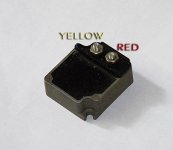
The signal wire that feeds the tach is connected to one of the posts on the rectifier. Those "clicks" are transmitted to the gauge. The gauge counts them. So if there is eight (poles) there will be 8 clicks for each full rotation of the flywheel (1 revolution). So for every 8 clicks the gauge (counts) "per minute" the gauge displays it as a RPM. (That is a rather simplistic explanation which while not exact should give you an idea of what is happening).
So your tach is really just a "counter" - counts clicks per minute, divides them by your pole setting on the gauge and displays them via the needle. No special sensors etc on this type of ignition.