Logo

5.7 mercruiser carb question

kzimin

New member
Hello everyone,
I have a 5.7 Mercruiser 350 with a 2 bbl carb making 250 hp (according to the HP label on intake)
I live in Alaska and when I bring my bayliner down to the water I am always having trouble warming up the motor. Sometimes it takes 20 -30 mins to get the motor "warmed" up enough that will let me idle. I have been told that this is just a reality of operating a Merc carb in cold Alaska. This season some salt water got in through the exhaust manifold and seized the motor. Ive decided to rebuild it. I am very happy with the motor, only problem I hate is the long warm up times. it can be a real pain at the boat lauch, especially for people waiting for me. I think this maybe an opportunity to upgrade the intake and carb to hopefully something that wont take so long to warm up enough to idle properly. I have thought about doing a EFI conversion but really prefer carbs and hope I can find a intake/carb that will solve the warm up issue. Please any ideas are appreciated. I dont mind staying with the 2 bbl carb if someone knows what the problems is. Thanks
 
If you have a TKS two barrel carb they are a very weird animal.....specs say 6-10 minute warm up......and if ambient is very cold, it may take longer......
 
If you’re seeing low engine temp on the temp gauge you may be having a sticky thermostat situation caused by a bit of rust flaking or a grain of sand holding the thermostat open a bit. In that case the engine won’t reach normal temp unless the boat is run up on plane. I’ve had this happen several times and I keep spare stats on the boat so I can swap them out. I tried a 140 stat (due to running in salt water) and during the cooler part of our season it took a long time to warm up vs the OEM 160 stat. In Alaska even in salt water I’d use a 160 stat abs change it whenever it starts running too cool. Cold running doesn’t allow fuel to atomize properly and the engine won’t run right because fuel will condense in the cold intake manifold. I’m not familiar with how the Mercarb works but in your climate you need an auto choke that works well. My Quadrajet has the well type choke and if the engine doesn’t warm up the choke won’t open fully either. With electric chokes they will open but if the engine is running too cold due to a sticky stat it still won’t run right.
Putting EFI on a marine engine sounds good but it’s expensive and can be troublesome to fine tune.
I think you’d be better off with a 4 bbl manifold and an Edelbrock 1409 with auto choke.
 
The MERC 2 BBL ( usually a TKS ) warm up are tied to the water jacket temp and the ambient air temp. Here on the Jersey shore even in mid summer, I have plenty of time after the engine first starts to take my electronics out of the cuddy and install them and have the GPS "find"its satellites before the engine fully warms up and the idle drops to 650...the safe speed for my Volvo drive to shift. The carb has NOTHING to do with how long it takes for the engine to fully warm up. Mine is FWC so it will warm up slightly faster than a RWC engine.
 
The MERC 2 BBL ( usually a TKS ) warm up are tied to the water jacket temp and the ambient air temp. Here on the Jersey shore even in mid summer, I have plenty of time after the engine first starts to take my electronics out of the cuddy and install them and have the GPS "find"its satellites before the engine fully warms up and the idle drops to 650...the safe speed for my Volvo drive to shift. The carb has NOTHING to do with how long it takes for the engine to fully warm up. Mine is FWC so it will warm up slightly faster than a RWC engine.

Yes that may be true, BUT, the TKS service manual states under "normal" operating conditions, 6-10 minutes to wait for normal idle. And YES, if engine is not warming up in that time due to some engine temp control issue then it could take much longer for carb to settle into normal idle.
 
If you’re seeing low engine temp on the temp gauge you may be having a sticky thermostat situation caused by a bit of rust flaking or a grain of sand holding the thermostat open a bit. In that case the engine won’t reach normal temp unless the boat is run up on plane. I’ve had this happen several times and I keep spare stats on the boat so I can swap them out. I tried a 140 stat (due to running in salt water) and during the cooler part of our season it took a long time to warm up vs the OEM 160 stat. In Alaska even in salt water I’d use a 160 stat abs change it whenever it starts running too cool. Cold running doesn’t allow fuel to atomize properly and the engine won’t run right because fuel will condense in the cold intake manifold. I’m not familiar with how the Mercarb works but in your climate you need an auto choke that works well. My Quadrajet has the well type choke and if the engine doesn’t warm up the choke won’t open fully either. With electric chokes they will open but if the engine is running too cold due to a sticky stat it still won’t run right.
Putting EFI on a marine engine sounds good but it’s expensive and can be troublesome to fine tune.
I think you’d be better off with a 4 bbl manifold and an Edelbrock 1409 with auto choke.
Thermostats don't necessarily need chunks of rust, they can corrode on their own and seize. When you say 'atomize', you're referring to the fuel that enters the combustion chamber, right?
 
Yes that may be true, BUT, the TKS service manual states under "normal" operating conditions, 6-10 minutes to wait for normal idle. And YES, if engine is not warming up in that time due to some engine temp control issue then it could take much longer for carb to settle into normal idle.
Does TKS still require that the throttle be opened more than the typical high idle of years past?
 
Thermostats don't necessarily need chunks of rust, they can corrode on their own and seize. When you say 'atomize', you're referring to the fuel that enters the combustion chamber, right?
I have found that the ones I use for my OMC/Volvo design do not corrode but due to the way cast iron corrodes, there will always be some rust bits and flakes, if you're in salt water. If running in shallow water even bits of sand will get stuck.
Atomization of the fuel occurs in the carb, and then the atomized mixture gets sucked into the intake manifold and then into the cyls. When the intake manifold is cold, some fuel condenses out of the mixture and then you have mostly some cyls running too lean and some might be too rich. When the engine reaches normal temp, the intake is heated by the water passage in the front (on V6s and V8s) so that doesn't happen. In addition the pre-Vortec engines had an exhaust crossover to heat the area of the intake under the carb, this was to prevent carb icing in an automotive application and also to heat the well type (divorced) choke spring.
The condensing of fuel out of the mixture onto a cold intake manifold is why you need a choke on a carbed engine to enrich the mixture till the engine & intake manifold warms up.
As my old 4.3 4bbl is warming up I can feel a definite difference in how smoothly it runs as soon as the temp rises from about 140-160*F.
The one difference between automotive auto chokes and marine auto chokes is that marine auto chokes (at least every one I have seen) do not use a fast idle cam like on an auto application, this is why you wind up running the boat in neutral to warm up but have to manually set the fast idle so it doesn't stall. I warm mine up to at least 120-140* before shifting into gear.
I remember my carbed cars with auto chokes usually ran at 1500 rpm on fast idle, then as it warmed the choke started opening and the steps on the fast idle cam allowed the engine to gradually run slower till it was fully warmed up.
 
The MERC 2 BBL ( usually a TKS ) warm up are tied to the water jacket temp and the ambient air temp. Here on the Jersey shore even in mid summer, I have plenty of time after the engine first starts to take my electronics out of the cuddy and install them and have the GPS "find"its satellites before the engine fully warms up and the idle drops to 650...the safe speed for my Volvo drive to shift. The carb has NOTHING to do with how long it takes for the engine to fully warm up. Mine is FWC so it will warm up slightly faster than a RWC engine.
On engines with the manifold heated choke, it's actually the other way round, the choke only opens as much as the engine is warming up. If the stat is held open a bit the engine will never warm up till you get on plane and the old style well choke won't open fully either.
On engines with electric chokes, they will open even if the engine is not at operating temp because the choke heater is on a timer of sorts, it is totally independent of engine temp.
With all this, I'd almost rather have a manual choke! The problem is finding one with a long enough cable for a marine application.
 
On engines with the manifold heated choke, it's actually the other way round, the choke only opens as much as the engine is warming up. If the stat is held open a bit the engine will never warm up till you get on plane and the old style well choke won't open fully either.
On engines with electric chokes, they will open even if the engine is not at operating temp because the choke heater is on a timer of sorts, it is totally independent of engine temp.
With all this, I'd almost rather have a manual choke! The problem is finding one with a long enough cable for a marine application.
I installed a mechanical choke on a friends' deck boat because it was very hard to start. Once that was on, it starts easily and runs better when cold, for obvious reasons. OTOH, the thermostat IS supposed to be serviced occasionally, so maybe it's just time.
 
I have found that the ones I use for my OMC/Volvo design do not corrode but due to the way cast iron corrodes, there will always be some rust bits and flakes, if you're in salt water. If running in shallow water even bits of sand will get stuck.
Atomization of the fuel occurs in the carb, and then the atomized mixture gets sucked into the intake manifold and then into the cyls. When the intake manifold is cold, some fuel condenses out of the mixture and then you have mostly some cyls running too lean and some might be too rich. When the engine reaches normal temp, the intake is heated by the water passage in the front (on V6s and V8s) so that doesn't happen. In addition the pre-Vortec engines had an exhaust crossover to heat the area of the intake under the carb, this was to prevent carb icing in an automotive application and also to heat the well type (divorced) choke spring.
The condensing of fuel out of the mixture onto a cold intake manifold is why you need a choke on a carbed engine to enrich the mixture till the engine & intake manifold warms up.
As my old 4.3 4bbl is warming up I can feel a definite difference in how smoothly it runs as soon as the temp rises from about 140-160*F.
The one difference between automotive auto chokes and marine auto chokes is that marine auto chokes (at least every one I have seen) do not use a fast idle cam like on an auto application, this is why you wind up running the boat in neutral to warm up but have to manually set the fast idle so it doesn't stall. I warm mine up to at least 120-140* before shifting into gear.
I remember my carbed cars with auto chokes usually ran at 1500 rpm on fast idle, then as it warmed the choke started opening and the steps on the fast idle cam allowed the engine to gradually run slower till it was fully warmed up.

I'm fairly certain the TKS came about because people were killing their engines by starting and going WOT without waiting for them to warm to normal operating temperature. Fuel injected ski boat manufacturers started adding a warm up sequence to the ECM's program- RPM was limited until it was warm enough to run at high RPM and people hated it, but they didn't understand why it was done. They (ski boat owners) don't care, they just want to go fast on their schedule.
 
I'll second the vote for a 1409 with electric choke and 4 barrel intake. This is a very effective combo, and it can be adjusted so that the choke opens a bit sooner/later. Yes it's gonna be an expensive solution.
If, as noted, the engine hasn't warmed enough when the choke opens, it's a matter of readjusting the choke until you have it dialed in. ez pz.
A manual choke is great but if you forget it's closed, you run it super rich and it'll foul the plugs eventually.
Aftermarket marine intake is quite dear:
And carb:
 
I'll second the vote for a 1409 with electric choke and 4 barrel intake. This is a very effective combo, and it can be adjusted so that the choke opens a bit sooner/later. Yes it's gonna be an expensive solution.
If, as noted, the engine hasn't warmed enough when the choke opens, it's a matter of readjusting the choke until you have it dialed in. ez pz.
A manual choke is great but if you forget it's closed, you run it super rich and it'll foul the plugs eventually.
Aftermarket marine intake is quite dear:
And carb:
Thank you for the suggestion. I think im going to have the motor rebuild and give this option a try. The mechanic that I have doing the rebuild recommended similar solutions. Said that a different intake and carb could be the solution, as there are intakes that allow warmer air to pass through so that there is less chance of cold intake situations and less warm up times. I hope that the bigger 4 barrel will also give a modest amount of HP increase, as I dont think a few more HP is a bad thing. appreciation all the suggestions. I will keep the original intake and carb incase I need/want to go back. Not totally unhappy with the way things are, and the old saying if it isnt broke dont fix it is very true, however i would like less warm up times.
 
As you can see from the responses no one knows what you have. One guy mentioned TKS and most ran with that until another mentioned something else. If we knew what you had (serial number) we all could have a better idea of issues
 
The MERC 2 BBL ( usually a TKS ) warm up are tied to the water jacket temp and the ambient air temp. Here on the Jersey shore even in mid summer, I have plenty of time after the engine first starts to take my electronics out of the cuddy and install them and have the GPS "find"its satellites before the engine fully warms up and the idle drops to 650...the safe speed for my Volvo drive to shift. The carb has NOTHING to do with how long it takes for the engine to fully warm up. Mine is FWC so it will warm up slightly faster than a RWC engine.
The choke, regardless of the technology involved, controls the mixture IN RESPONSE to the ENGINE's TEMPERATURE. The Engine's temperature is a function of ambient temp, cooling water temp and flow and extracted HP. If you want the engine to warm up faster, ESPECIALLY on a RWC engine, install a ball valve on the raw water inlet to the engine ( again as noted in other comments) depending on location of RW pump... and when you start the engine partially (or mostly) close the valve.... just be sure that once the engine is warmed up that you OPEN the valve fully before shifting into gear..
 
Well type (divorced) and hot air chokes do respond to actual engine temp, but the electric chokes used on Edelbrock and Holley carbs, do not as far as I know, they are set on a timed choke heater unit...unless the electric choke has a sensor on the intake that picks up temp, then they open based on a timed heater set up.
 
So i have a 5.7 merc. 250 hp (basically a small block chevy), 2 bbl carb with a electric choke that opens slowing and does not depend on temp, just time. I have a 160 degree thermostat that i have changed and it did not change the warm up times. Im not sure what TKS is vs RWC? Is there a intake that has has channels in it that allow for more heat to be involved with the intake? I was told by my mechanic doing the rebuild that he recommends a different intake that will likely solve the long warm up times. also a different carb of course. Thats why I think the 1409 carb and the performer intake are basically what my mechanic was talking about. Motor is still in the boat, having my local shop pull it in a week or so, going to take off all the accessories then bring it to the mechanci to do the rebuild. I do think I will speak with him about that carb and intake.
 
TKS = Turn key start. There is NO choke. It looks like a small tube like solenoid with a two wire plug connection at top/side of carb.
You say you have a MERC CARB. We need more to determine if this is what it really is. You say you have an electric choke. What makies you think its that? What you need to understand, There has never really been a 350/5.7 ltr. with a TWO barrel carb rated at 250HP. If this is actually 250 HP then it may be a newer version and if newer may have the TKS typ carb. BUT WITH OUT MORE SPECIFICATION we cannot say. TKS and Mercarbs look identical to someone who doesnt know the differences.
Can you adjust the Choke to make it stay closed longer or open quicker? If so the you do have a electric choke. If there is no way to adjust what you say is the choke then this may be the TKS type system.

FWC= Fresh water cooled (This is a closed cooling system with heat exchanger)

RWC= Only raw water is used to cool engine (95% of the time used in fresh water environments only due to salt water corroding engine water components)

If your engine takes to long to warm up then you have a water flow issue meaning, water is bypassing the thermostat somehow and not allowing the thermostat to properly control engine temp. Within 10 -20 minutes or so any engine should be warmed up if not completely. The thermostat should stay CLOSED until the temp of stat is reached and then opens to control the set point temp.

The heat cross over is there on all small blocks. What allows or does not allow this to work is the intake manifold gasket. Either there are holes that allow the heat or the area is blocked off by way of the gasket. This heated crossover is used for a couple reasons. 1< is to heat up a Mechanical choke that depends on the heat to heat up the Bi-metal spring that opens the choke and 2. To heat carb to operating temps in colder environments.

You still are not giving the needed details of you engine.

A. What year is this engine/Boat assuming the engine is original? A serial number would be very helpful!!!
B. What outdrive do you have? Alpha or Bravo?
C. Is your engine fresh water cooled or is it closed cooling (with a heat exchanger)
D. Can you take a photo of Carb?
E Can you take a photo of your Thermostat housing? This will allow to identify internal components and possibly a problem issue.
F. Replacement of the intake manifold gasket (if needed) to allow heat to get to carb base, In my opinion has Zero to do with your issues at this point.
 
We're getting closer, but still like pulling teeth
The 250hp comment is leaning me more toward Manual 17 (1993-97, 350 mag) and most likely has the 6 port thermostat housing. Later models had the 4 port housing and were EFI

Electric choke so going from a 2bbl to a 1409 4bbl they both have electric chokes. If the motor has good compression in all cylinders, good ignition system, timing and idle speed is correct (650-700rpm, would set closer to 700), then the motor should idle even when cold

Agree with others with it taking 20-30 minutes to warm up then need to look at the T-stat housing.

During your rebuild you could change to 4 port housing and if you have enough room I would convert to closed cooling.
 
Agreed not sure what he is working on, sounds like choke if it has one is misadjustee, carb needs rebuild and or tuning and also probably thermostat maybe stuck open .

Yes if rebuilding the engine and you want some more ponies the 1409 works great. Either way you will need to learn how to tune it
 
The boat is in 2001 bayliner, i believe the motor has been rebuild since new but should be same motor as new.
Its a bravo 2 outdrive
Motor is CLOSED COOLING so might make a difference
brand new t stat at 160 deg.

carb is brand new, just got rebuild by a respected carb shop in lake havasuu area.
went through the merc cruiser manual to tune and adjust it according to that.

My mechanic (not the one doing the rebuild) has told me many times that "you just need to let it warm up"
The mechanic doing the rebuild recommended a different intake and carb, expalined that will likely solve the problem. I have heard the 2 bbl carbs are finicky, especially in cold alaska weather.


sorry cant get any pics to upload
 
My opinion is, Changing to a 4 bbl carb and intake will ONLY give you a marginal increase in top end power.
I dont feel it will improve warm up time at all. With a closed cooling system and a 160* stat, in very cold weather the boat should take about the same time a carbed auto/truck would take on land. 10-20 minutes to reach full operating temps. Here in NewEngland, Temps recently dropped to high 30's at night. I went out at 6:00 AM and it took my 2014 CM truck a solid 15 minutes before I was getting good heat inside the truck. Now during summer months when ambient temps are 65-75 in the mornings, it takes about 10 minutes to reach operating temps.

So basically I dont see any issues here. If your engine runs rich longer than you think it should with an electric choke, then it may be defective (bi-metal spring) or in need of adjustment. They are fairly basic, (loosen 3 screws and turn CW or CCW).

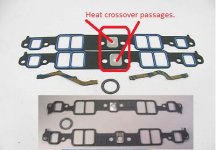
You said the engine was or is getting rebuilt, Can you confirm the intake manifold gasket was installed with the heat crossover passages OPEN? See image below. Typically they have a thin Steel plate incorporated into the gasket with a hole in it as shown. This allows heat to cross over and warm carb.

Some gasket sets have NO crossover passages or have a block off steel plate to close off the cross over. You may want to inquire about this.
 

Attachments

  • s-l400.jpg
    s-l400.jpg
    32.8 KB · Views: 31
Honestly I think for carbed engines that operate in cooler climates the heated crossover of the pre Vortec intake is better that the Vortec intake with no exhaust crossover.
Being a 2001 if that’s the original engine it should be a Vortec (1996 and up).
 
So i have a 5.7 merc. 250 hp (basically a small block chevy), 2 bbl carb with a electric choke that opens slowing and does not depend on temp, just time. I have a 160 degree thermostat that i have changed and it did not change the warm up times. Im not sure what TKS is vs RWC? Is there a intake that has has channels in it that allow for more heat to be involved with the intake? I was told by my mechanic doing the rebuild that he recommends a different intake that will likely solve the long warm up times. also a different carb of course. Thats why I think the 1409 carb and the performer intake are basically what my mechanic was talking about. Motor is still in the boat, having my local shop pull it in a week or so, going to take off all the accessories then bring it to the mechanci to do the rebuild. I do think I will speak with him about that carb and intake.
If water gets into one or more cylinders, it won't rotate because water can't be compressed, so you would need to remove the spark plugs in order to be able to crank it. Unless it was actually running and not just at shut down, it probably didn't damage the engine significantly. This is called 'hydro-lock', which is a common term for 'hydraulic lock'. Did your mechanic do this, or just say that the engine needs to be rebuilt?

As kghost posted, marine intake gaskets are different from car gaskets- FelPro is one company that makes marine gaskets.
 
The boat is in 2001 bayliner, i believe the motor has been rebuild since new but should be same motor as new.
Its a bravo 2 outdrive
Motor is CLOSED COOLING so might make a difference
brand new t stat at 160 deg.

carb is brand new, just got rebuild by a respected carb shop in lake havasuu area.
went through the merc cruiser manual to tune and adjust it according to that.

My mechanic (not the one doing the rebuild) has told me many times that "you just need to let it warm up"
The mechanic doing the rebuild recommended a different intake and carb, expalined that will likely solve the problem. I have heard the 2 bbl carbs are finicky, especially in cold alaska weather.


sorry cant get any pics to upload
Does it run ok after it is fully up to operating temp? Have you tried adjusting the choke richer to see if that improves cold weather performance so you can at least get away from the launch and let it continue warm up. Might also try fattening up the idle mix screw to see if that helps, it is not unusual to have to set it richer in colder conditions.

If it were mine I would do the engine rebuild see how if you can set the idle mix and choke to be liveable, then swap it out for a 4 bbl if you cant make it work. To me saying 2bbls are finicky is what some one who cant get to the root cause says. The mercarb you have (assuming it is stock carb) is a descendant of the rochester 2 jet that was only on like a million GM vehicles for 40 years in all types of weather conditions from hot to alaska... so it can work in cold weather.

I believe the stock intake from merc had a heat tube from the starboard side exhaust manifold to the intake . this is like a 3/8" tube, not sure if it is open to the water jacket or the exhaust but this should help in warming under the carb its #4 in the drawing linked


is this hooked up and does it get hot or is it clogged? That may help and note that none of the 4 bbl manifolds have this as vortec heads dont have the cross over.
 
A lot of hot rodders will often block off those crossovers on pre-Vortec engines or use an intake that doesn't have a cross over because they want the fuel to be as cool as possible, which is fine for warm weather or drag racing, but for a cool running (compared to auto applications) marine engine the exhaust crossover was actually a pretty good idea.
The other thing you can research (since you're in cold water all the time Alaska) is if you can use a higher temp stat with the closed cooling system.
The Mercarb as others have said is a slightly modified Rochester 2bbl carb, I had one on our '72 Chevy Impala, and that carb was saddled with the stupid EPA limiter caps so the idle mix was set very lean and while it always started, it stalled often when cold. I think but am not sure the Mercarb might only have one mixture screw, or they may be blocked off by an aluminum plug. In any case, I have found that doing it both ways, you get a smoother running engine if you adjust both the idle speed and idle mixture with the boat in the water, vs on land, due to the effect of the back pressure of water on the exhaust system.
 
A lot of hot rodders will often block off those crossovers on pre-Vortec engines or use an intake that doesn't have a cross over because they want the fuel to be as cool as possible, which is fine for warm weather or drag racing, but for a cool running (compared to auto applications) marine engine the exhaust crossover was actually a pretty good idea.
I blocked off the heat riser on my 65 GTO thinking it was an upgrade , ended up taking the block offs out as it took forever to warm up in mildly cold weather. Was a big waste of time.
 
Back
Top