Logo

1991 Mercruiser 7.4L Alternator/ wiring issues.

91stingray

Contributing Member
I was having issues with my old alternator getting hot while not under any load, it was getting to over 300*f. So I purchased a brand new mando 65amp alternator identical to the one that was on the engine. I also replaced the battery cables and grounds with 2 gauge and 4 gauge wire from a marine parts store, amd cleaned up the ground contact points on the engine. Both batteries are fully charged at 12.6-12.7v and the new alternator is charging at 14.3-14.4v. The problem im having is the alternator is still getting up to 180*-200*f at idle and no load on the electrical other than the ignition. Any ideas why it's getting so hot or is that normal for an alternator?
 
just for shts and glles add a ammeter inline with the alt output .Batteries might be junk and have a extremely high charge rate or the "sense lead" of the alt is bad and its not seeing the battery voltage
 
just for shts and glles add a ammeter inline with the alt output .Batteries might be junk and have a extremely high charge rate or the "sense lead" of the alt is bad and its not seeing the battery voltage
is there a way test the amp output without cutting any wires? it also appears that the orange output wire and ground from the alternator is only a 10 gauge wire. Seems a little thin, but it's also a low amperage alternator. It's actually only 55 amp not 65. I don't think the batteries are bad they take and hold charge. even after sitting for a week they still show 12.7
 
yes, its called a clamp on amp meter....

The wire size is adequate for the application.

Have you checked to make sure the alternator has a good ground???

Are you sure the alternator is original? The Delco 10SI replacements are known to need more maintenance...
 
yes, its called a clamp on amp meter....

The wire size is adequate for the application.

Have you checked to make sure the alternator has a good ground???

Are you sure the alternator is original? The Delco 10SI replacements are known to need more maintenance...
Do i just clamp the meter to the output cable of the alternator? And I did forget to clean the ground for the alternator since it's on the starter side of the engine. everything I cleaned and replaced is on the alternator side. I wanted to replace the 4 gauge wire going from the battery selector to the starter but the parts store didn't have anything long enough that was 4 gauge in stock. But i inspected the connections on the starter post and they looked clean, but I'm going to disconnect them and clean them up anyway and make sure it's tight. I just ran out of time yesterday. The new alternator I purchased is what is sold for this engine through mercruiser parts.com
 
if the meter is capable and setup correctly, yes - clamp it on and it will show you what current is flowwing thru the wire.

On your new battery cables - do yourself a favor and get marine grade wire... The big box marine store will make cables for the cost of the parts.. If one isn't available, a good welding supply shop likely has the materials. The marine grade wire has finer strands and it tinned and will last much longer as well as install easier..

you can add a dedicated ground wire for the alternator - #10 wire would be adequate.
 
if the meter is capable and setup correctly, yes - clamp it on and it will show you what current is flowwing thru the wire.

On your new battery cables - do yourself a favor and get marine grade wire... The big box marine store will make cables for the cost of the parts.. If one isn't available, a good welding supply shop likely has the materials. The marine grade wire has finer strands and it tinned and will last much longer as well as install easier..

you can add a dedicated ground wire for the alternator - #10 wire would be adequate.
unfortunately i don't have a west marine anywhere near by but the local marina has a fairly well stocked parts department which is where i got the pre-assembled 3 foot length battery cables that I used, I'm assuming it's marine grade, it has tinned lugs and sealed pretty well. He just didn't have any 4 gauge bulk wire in stock so he couldn't make me a long one to go from the battery switch to the starter.

Aside from that what kind of amp reading should I expect from the alternator at idle with no load on the electrical system other than the ignition coil and gauges?
 
depends on the battery's state of charge....it will start out maybe 20-30 amps and then taper back down as the battery is recharged (as judged by the sense terminal input)...with just the engine running, only the ignition should be drawning current - i would think somewhere around 5 amps would be the upper bound once the battery is 'full'...
 
I was having issues with my old alternator getting hot while not under any load, it was getting to over 300*f. So I purchased a brand new mando 65amp alternator identical to the one that was on the engine. I also replaced the battery cables and grounds with 2 gauge and 4 gauge wire from a marine parts store, amd cleaned up the ground contact points on the engine. Both batteries are fully charged at 12.6-12.7v and the new alternator is charging at 14.3-14.4v. The problem im having is the alternator is still getting up to 180*-200*f at idle and no load on the electrical other than the ignition. Any ideas why it's getting so hot or is that normal for an alternator?

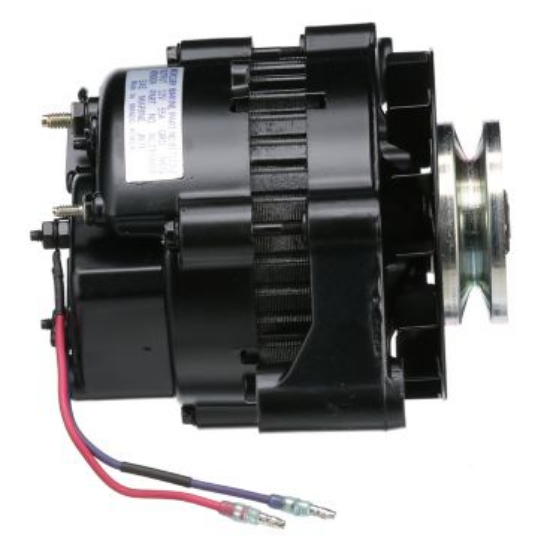
Where are you located? Find a good auto electric shop and have them test your new alternator and while you're at it, ask how much they would charge to rebuild your old one- many can be upgraded.

To be honest, I would doubt the OEM alternator was only good for 65A- when Iwas trained for Mastercraft service, the base alternator for a 350 Chevy engine was about 95Amps because just the ECM and associated electricals without ANY accessories drew close to 50A and if you look at the main breaker, it's usually rated at 50A for each engine. If your engine doesn't have fuel injection, it wouldn't need more than the 95A of the alternator used for EFI, but it's always better to have more, than trying to make it with less.

If it looked like this, it can be rebuilt for about 115Amps.
 

Attachments

  • ALt front.jpg
    ALt front.jpg
    156.6 KB · Views: 42
  • Alternator back.jpg
    Alternator back.jpg
    189.7 KB · Views: 40
A 1991 engine will have a carb, so the ECU discussion really doesn't apply. doubling the power generation capability usually means wiring will need upgrades as well...It may be better to have more but why pay extra for it if it isn't needed??
 
A 1991 engine will have a carb, so the ECU discussion really doesn't apply. doubling the power generation capability usually means wiring will need upgrades as well...It may be better to have more but why pay extra for it if it isn't needed??
I really need to have more coffee before I post this stuff- Now, I see 1991.... DOH!

But the OP wrote that wires were upgraded- either way, that alternator could have been rebuilt, probably for less than the new one and it would have been plug n play.

How many boat owners try to add accessories without upgrading wires, batteries, etc? Plenty. That's the main reason I recommend going a bit larger, unless they really want to add more draw. I don't see 65A as anything near high output and in many ways, I don't see it as adequate. I have also seen the work done by some boat dealers and I can tell you that it's not all spiffy and like new from the factory- many dealers are too cheap to pay enough to attract better service techs and the weakest link for most is the electrical repairs.
 
Agreed that the alternator could have been rebuilt...hard part is finding a good local shop to do it...used to be a dozen within a 50 mile circle...now there are two and they know it...

Also agree there is a very large amount of "low standards" wiring done on boats...many don't understand paying a little more for appropriate materials will save them much more in the long run...
 
I really need to have more coffee before I post this stuff- Now, I see 1991.... DOH!

But the OP wrote that wires were upgraded- either way, that alternator could have been rebuilt, probably for less than the new one and it would have been plug n play.

How many boat owners try to add accessories without upgrading wires, batteries, etc? Plenty. That's the main reason I recommend going a bit larger, unless they really want to add more draw. I don't see 65A as anything near high output and in many ways, I don't see it as adequate. I have also seen the work done by some boat dealers and I can tell you that it's not all spiffy and like new from the factory- many dealers are too cheap to pay enough to attract better service techs and the weakest link for most is the electrical repairs.
It's just a 23' stingray 698svx runabout with a small cuddy. It's a cool little boat, just wish it had more dead rise and stand-up bolster seats. The only upgrades I plan on doing is a single 5 channel amplifier, 4 new speakers and a subwoofer. nothing crazy, Looking to stay under 800 watts.
 
It's just a 23' stingray 698svx runabout with a small cuddy. It's a cool little boat, just wish it had more dead rise and stand-up bolster seats. The only upgrades I plan on doing is a single 5 channel amplifier, 4 new speakers and a subwoofer. nothing crazy, Looking to stay under 800 watts.
Run Amp off a 900-1000 cca deep cycle battery not the cranking battery.

I use two 1000 cca deep cycle batteries and a 625 cca cranking battery and I have Alt output direct to a 75 Amp Voltage isolator. I use good but used 1600 strand welding cable to amp. And to amp batteries from Voltage isolator, I also use good copper ring terminals on all connections

By using a voltage Isolator, Both batteries charge but dont "talk" to each other. So if cranking battery has issues it wont affect amp battery and vise a versa.

Another thought would be is use a two channel amp and have two 4 ohm speakers on each side and connect each side (individually) in parrallel Then the amp will see a 2 ohm load and out put more wattage...
 
Last edited:
FWIW, two four ohm speakers need to be in parallel to offer a 2 ohm load; in series, they will offer 8 ohms....
 
FWIW, two four ohm speakers need to be in parallel to offer a 2 ohm load; in series, they will offer 8 ohms....
Mark,
Yes, Isolator, couldnt remember the proper name and Yes again, couldnt remember if series or parrallel.

I use only two speakers in my system.
 
Run Amp off a 900-1000 cca deep cycle battery not the cranking battery.

I use two 1000 cca deep cycle batteries and a 625 cca cranking battery and I have Alt output direct to a 75 Amp Voltage isolator. I use good but used 1600 strand welding cable to amp. And to amp batteries from Voltage isolator, I also use good copper ring terminals on all connections

By using a voltage Isolator, Both batteries charge but dont "talk" to each other. So if cranking battery has issues it wont affect amp battery and vise a versa.

Another thought would be is use a two channel amp and have two 4 ohm speakers on each side and connect each side (individually) in parrallel Then the amp will see a 2 ohm load and out put more wattage...
But with a 2 Ohm load, the amplifier will still need more current to develop the higher power output.
 
Thanks For that input..... I guess you havent had your coffee yet
Not sure I understand why you posted this- if the speakers are wired in parallel, the load will be 2 Ohms (assumng they're 4 Ohms each) and the amplifier will output more power. Unless a power amp has a regulated power supply, it will draw more with 2 Ohm loads than 4 Ohm and this all applies when sizing batteries, alternators and cables, as you know.

BTW, you're the one who missed on the series/parallel wiring, so, coffee anyone?
 
I was having issues with my old alternator getting hot while not under any load, it was getting to over 300*f. So I purchased a brand new mando 65amp alternator identical to the one that was on the engine. I also replaced the battery cables and grounds with 2 gauge and 4 gauge wire from a marine parts store, amd cleaned up the ground contact points on the engine. Both batteries are fully charged at 12.6-12.7v and the new alternator is charging at 14.3-14.4v. The problem im having is the alternator is still getting up to 180*-200*f at idle and no load on the electrical other than the ignition. Any ideas why it's getting so hot or is that normal for an alternator?
You can purchase a SHUNT measuring device from EBAY or Amazon. About $30.00 This is basically a very low resistance resistor that goes in series with the load. This uit comes with a long wire allowing you to route to your dash. This was you will be able to the exact current being drawn real time. I have these installed in my car as well. This way when the car is off, I can also see leakage. This allows me to know how long the car can sit with no start.
 
Back
Top