Logo

3.0 OMC Inboard bogs please help

centerfire

New member
I have a 3.0 omc in my boat I just can not make run right!
Idles good just won’t rev it just bogs!
New plugs wires cap rotor points and condenser.
New fuel pump.
Timing has been set.
Rebuilt the carb nothing changed since the throttle plate shaft was a bit worn I decided that was it and put a new carb on. The carb is a gm one not a Chinese Amazon one!
By passed all ignition wiring and tried it’s still the same!
Was running it and had my wife driving and I was messing with.
Found when I put my thumb over the carburetor bowl vent it will review up and I get high speed but it won’t idle till I remove my thumb. The vent I cover on the carb is circled in my picture.
I suspect a vacume leak. Went all around the manifold and carb with brake clean but couldn’t find nothing.
Removed the intake suspecting a bad gasket or cracked manifold but can’t find nothing!
Does anyone have any ideas! Please help!!
 

Attachments

  • Carb.PNG
    Carb.PNG
    968.3 KB · Views: 23
*So you are on carb #2 with same results?
*Are both the correct carbs or did you grab a donor carb from someone's try this pile?
*Is this boat new to you?
*You purchased it with the issue?
FYI, a vacuum leak typically creates an idle issue because vacuum is high with throttles closed and runs near normal at higher RPM when throttles are open.
*No blockage in the exhaust passages?
*Boat is correctly propped?
 
I have had the boat for about 10 years
Same prop as ever
It is a new carb and the same issue. Nothing changed at all.
New carb is the correct part number
 
Have you done a compression test?

Putting your thumb over the bowl vent will probably cause the carb to run lean. With bowl not being able to vent it will take more fuel pressure to fill the bowl, just thinking out loud.
 
Putting your thumb over the bowl vent will probably cause the carb to run lean. With bowl not being able to vent it will take more fuel pressure to fill the bowl, just thinking out loud.
I'm trying to wrap my head around what plugging the vent will do.
With the engine running wouldn't 5 psi or so of fuel pump outlet pressure be pressurizing the carb & causing it to run rich? Basically masking a lean condition when thumb is not running interference.

You say new fuel pump, so I assume the filter must have been part of the pump & new at the time.

Fuel tank not venting or anti-syphon valve bad?
 
I'm trying to wrap my head around what plugging the vent will do.
With the engine running wouldn't 5 psi or so of fuel pump outlet pressure be pressurizing the carb & causing it to run rich? Basically masking a lean condition when thumb is not running interference.
Again, just trying to think what if's

Close the fuel bowl, so no air can escape, barometric pressure is 14.7 psi at sea level. Fuel pump is producing 5 psi so what happens if the bowl vent is closed? I don't know, but think the bowl will start reducing the amount of fuel in bowl. The motor is creating a vacuum created by the motor running.
 
I'm thinking pressurizing the carb will push fuel through the venturi increasing the fuel discharged at any given manifold/venturi vacuum instead of allowing for the normal difference in pressures to suck fuel as normally happens. BUT maybe I'm wrong?
 
The base timing is set to spec of +1degree
Not sure if the centrifugal advance is working but it doesn’t even try to rev until I plug that bowl vent on the carb
 
Yes ESA is electric shift assist. I'm no Cobra expert so I won't begin to give advise other than to put a timing light on it. It may not be getting any timing advance. Check timing while driving under load.
 
It's some kind of a fuel issue, not enough fuel, to much fuel, float not set correctly. New fuel pump but what is the pressure?
 
5.5 psi and about a liter/ quart in 15 seconds
Understand fuel pressure is good, but we don't know if all the fuel is making it into the motor thru the carb, or if the ignition is advancing

Rebuilt the carb but maybe the main fuel channel is still a little clogged. Did you run a small wire thru each channel in the carb?
 
Your 5.5 PSI is OK but why did you go electric vs the original style? What safety system have you added to be sure the pump doesn't continue to run & flood the manifold or bilge with fuel if engine dies & the pump continues to run?
 
Ok, here is what we DON'T know:
Year of boat/motor or OMC engine model number. Obviously 1998 or earlier (so minimum of 28 years old). So I am unable to check any parts or service manual references.

What we DO know:
Has ESA so 1978 or newer. Could be Mechanical shift Stringer or Cobra. Has conventional (points/condenser) distributor system. Has 2 barrel Rochester carb. Both simple & reliable.

Now in post #2 I asked if there is any blockage in exhaust system. I can't find a response from you. If Cobra, have you verified the exhaust shutter valve isn't broken off & jammed in the exhaust pipe or bellows causing an obstruction? No rodent built a nice nest over the winter?

In post #13 you say:
"The base timing is set to spec of +1degree Not sure if the centrifugal advance is working but it doesn’t even try to rev until I plug that bowl vent on the carb"

Maybe I'm too old & senile but I don't know what +1degree means. Is that 1 degree BTDC or ATDC?
Those inline engines typically had a timing spec of about 6 degrees BTDC at 650 RPM. So either way 1 degree seems wrong to me. Check owners manual or service manual for exact #. The mechanical advance within the distributor added in the remaining ADVANCE as RPM increases. Usually max timing is mid 20s BTDC range. It is designed into the weights & cams of the distributor taking initial timing into consideration.
Also, you must set dwell before timing. Timing is the last. Changing dwell 1 degree will change timing 2 degrees. Changing timing will not affect dwell.

I appreciate your frustration of loosing 2 years useage and spending money with no results.

Question: When it "bogs" is it smooth & unresponsive or is the engine shaking like it's misfiring? Does it backfire thru the carb if you open the throttle quickly? Backfire is usually caused by retarded timing or lean mixture.

A good tune-up was probably money well spent but the carburetor & fuel pump most likely not.

I'm not sure of where your "base timing of +1 degree" came from. Regardless go back & verify dwell, initial timing spec & see if timing advances during engine operation. If your timing is stuck at 1 degree (regardless if BTDC or ATDC, that's only 2 degrees difference) it will be a pig.
 
Ok, here is what we DON'T know:
Year of boat/motor or OMC engine model number. Obviously 1998 or earlier (so minimum of 28 years old). So I am unable to check any parts or service manual references.

What we DO know:
Has ESA so 1978 or newer. Could be Mechanical shift Stringer or Cobra. Has conventional (points/condenser) distributor system. Has 2 barrel Rochester carb. Both simple & reliable.

Now in post #2 I asked if there is any blockage in exhaust system. I can't find a response from you. If Cobra, have you verified the exhaust shutter valve isn't broken off & jammed in the exhaust pipe or bellows causing an obstruction? No rodent built a nice nest over the winter?

In post #13 you say:
"The base timing is set to spec of +1degree Not sure if the centrifugal advance is working but it doesn’t even try to rev until I plug that bowl vent on the carb"

Maybe I'm too old & senile but I don't know what +1degree means. Is that 1 degree BTDC or ATDC?
Those inline engines typically had a timing spec of about 6 degrees BTDC at 650 RPM. So either way 1 degree seems wrong to me. Check owners manual or service manual for exact #. The mechanical advance within the distributor added in the remaining ADVANCE as RPM increases. Usually max timing is mid 20s BTDC range. It is designed into the weights & cams of the distributor taking initial timing into consideration.
Also, you must set dwell before timing. Timing is the last. Changing dwell 1 degree will change timing 2 degrees. Changing timing will not affect dwell.

I appreciate your frustration of loosing 2 years useage and spending money with no results.

Question: When it "bogs" is it smooth & unresponsive or is the engine shaking like it's misfiring? Does it backfire thru the carb if you open the throttle quickly? Backfire is usually caused by retarded timing or lean mixture.

A good tune-up was probably money well spent but the carburetor & fuel pump most likely not.

I'm not sure of where your "base timing of +1 degree" came from. Regardless go back & verify dwell, initial timing spec & see if timing advances during engine operation. If your timing is stuck at 1 degree (regardless if BTDC or ATDC, that's only 2 degrees difference) it will be a pig.
Thank you for taking the time to help me!!
It is a 1989
Engine model # 302AMRMED
Mechanical shift
Removed the intake manifold to check for a bad gasket or crack causing an intake leak, found nothing.
Went down the exhaust with a camera to the bellows boot can not see a restriction.
The exhaust shutter valve is not there. I am wondering if it was removed by the previous owner. Will it work without it?
My timing spec comes from my seloc manual for omc inboards. In the tune up specs
It says:1*(degree) after top dead center(ATDC) for 86-88 octane I’m running regular at 87 octane.
4* BTDC with 89 octane
So I set it for 87 octane
Have used premium fuel at 91 and set it to 4*BTDC and it’s no different
Does the same!
I completely drained the fuel this year and put fresh in.
I don’t agree with timing after top dead center have never seen an engine with a spec like that! I googled it tonight and it says 4* BTDC
I’ll try setting dwell and timing tomorrow and see what happens. Although I have moved the timing around with no change.
Will verify the mechanical advance is working.
When it bogs it’s smooth and unresponsive.
It had an electric fuel pump when I got it so just continue with that.
As far as money well spent well um is it ever!
It’s a 1989 forester 175 it’s in nice shape.
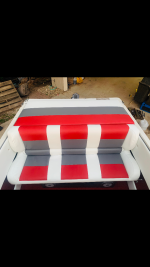
I have re done all the upholstery. My mom did upholstery all her life and done this before she retired about 7 years ago. Red silver and white! All seats and panels re done! It’s pretty nice! Who ever worked on the carb last put it together with a couple wood screws! And the throttle shaft was worn so I decided to replace instead of re build but surprisingly it worked as good as this one!
Thanks again for your help!

 

Attachments

  • IMG_2075.png
    IMG_2075.png
    790.5 KB · Views: 5
The exhaust shutter missing isn't a big deal unless you take a big wave on/over the transom or it dies at high RPM & rolls backwards.
Now if it is stuck somewhere & causing a restriction then it may be causing an issue. You went down the exhaust as in from the manifold? It could be somewhere in the bellows or outdrive. But if I recall, OMC bellows have slots for some pressure relief.
My guess is it broke or melted off at some prior time.
I assume you are in MN or WI since they were built in Wyoming, MN & most dealers seemed to upper Midwest.
 
Understand fuel pressure is good, but we don't know if all the fuel is making it into the motor thru the carb, or if the ignition is advancing

Rebuilt the carb but maybe the main fuel channel is still a little clogged. Did you run a small wire thru each channel in the carb?
Rebuilt the carb then installed a new one with no change
 
The exhaust shutter missing isn't a big deal unless you take a big wave on/over the transom or it dies at high RPM & rolls backwards.
Now if it is stuck somewhere & causing a restriction then it may be causing an issue. You went down the exhaust as in from the manifold? It could be somewhere in the bellows or outdrive. But if I recall, OMC bellows have slots for some pressure relief.
My guess is it broke or melted off at some prior time.
I assume you are in MN or WI since they were built in Wyoming, MN & most dealers seemed to upper Midwest.
I have the manifold off and went down after the elbow and yes the bellows boot does have slots so I’m pretty sure it’s not a restriction.
I am up in Saskatchewan Canada.
I have come across a few of these boats for sale up here but there aren’t many!
 
Rebuilt the carb then installed a new one with no change
I'm trying to wrap my head around what plugging the vent will do.
With the engine running wouldn't 5 psi or so of fuel pump outlet pressure be pressurizing the carb & causing it to run rich? Basically masking a lean condition when thumb is not running interference.

You say new fuel pump, so I assume the filter must have been part of the pump & new at the time.

Fuel tank not venting or anti-syphon valve bad?
Tank vent is good and anti syphon valve is new
 
Ok I got out the OEM service manual:
*Set initial timing to 4 deg BTDC at 600 RPM.
*Mechanical advance is another 28 degrees @ 2100 RPM & above for a total of 32 degrees above 2100 RPM. When trying to run the boat in the water to check for timing advance you are looking for approximate values. I wouldn't get too concerned to the exact degree. And to be truthful, your timing indicator on the engine doesn't go past maybe 12. You will need to do your best to estimate what you are getting.
*Regarding the ESA, it "pulses the ignition by intermittently grounding the distributor side of the coil"
You will (should) find one black wire to the distributor & 2 gray wires on the coil negative terminal. 1 gray goes to the tachometer & 1 to the ESA module. Disconnect both gray wires (both so you don't have to follow wires to their source). This will inop your tach & the ESA system. NOTE: shifting will become difficult. Do this test away from docks & traffic. Attempt to see if boat has proper performance with wires disconnected. If power is restored, ESA, shift cable or cable adjustment is at fault.
I know you say performance improved by covering the carb vent. I can't explain that from Wisconsin.
You also said you bypassed all ignition wiring with no help. I assume you mean putting 12 volts positive direct to coil thus eliminating boat & engine wiring, key switch & ballast wire. But it would not deactivate the ESA system.
 
I'm not a fan of Seloc or Clymer manuals BUT factory have errors too.
Typically OMC manuals were printed in the year prior to the engine model year.
For example, I have a 1987 printed book that covers 1988 engines & a 1989 printed book that covers 1990 engines. I don't have an actual book for 1989.
The 1990 book says that the 3L uses the Delco electronic distributor & the shunt must be used to set timing. However according to the parts catalog there are some 1990 "a" model engines that use the conventional distributor. I assume these were early build models until inventory was gone. Problem is even with an OEM book there is no reference to dwell & timing for conventional ignition engines. And while it says a shunt is required for electronic ignition it never says how to use the shunt.
Go figure......
 
Back
Top