Logo

1997 454XL (Throttle Body Fuel Injected)

bill_mc

New member
1997 Silverton 372
Cold: Both motors start in seconds and idle perfect.
Taxi out of the marina @1000 rpm- runs perfect
Leave the gap....run up to 3400 rpm and both run perfect.

Problem:
But In 15 minutes the stbd motor will then hiccup and drop 200 rpm for a second and return to 3400 rpm. (the Port motor runs perfect).
5 minutes later it happens again and soon it drops 400 RPM for a few seconds and them back to 3400 rpm.
Minutes later it drops 600 PRM...then returns....soon it drops 1,000 rpm and then returns to 3400 rpm. I then return the throttle to idle and it runs perfect. Then I shut it off.
I ride on the port motor...while I let the stbd mor rest for 15 minutes... and then re-start. It idles perfect again. I run it up to 3,400 rpm and runs great again...for ten minutes and the problem starts all over again. (current fuel supply: port motor drinks off the port tank, stbd motor drinks off the stbd tank)

I have added a "screw on" type fuel filter / water separator to each engine- I cut the line between the fuel tank and the motor and installed the in-line filter there.

All new fuel filters were installed.... the new can filter, the OEM 110 micron screen filter, the OEM Racor paper element filter, and the OEM metal can type filter at the top, next to the throttle body.
Same S%^& ...No performance change

Historical info
Bought the boat 5 yrs. ago. It was neglected and had some crystalized brownish deposits in the starboard tank only...rotted ethanol? Had a lot of early history of clogged fuel filters while underway. So I have added a large100 micron inline "can type" mesh filter between the tank and the engine. Often found this filter full of brown debris. I blew it out into a bucket, reinstalled it and ran good again. Since then, I ran lots of gas through it and changed a lot of clogged filters but the tank seems pretty clean now and no longer see that brown stuff. So one theory: I am wondering if the fuel pump has been historically over-heated by having to "pull" so much fuel through clogged filters. (again, when I turn off the motor for 15 minutes and re-start it runs good...for 10 minutes. I am thinking that maybe the 15-minute shutdown allows the fuel pump to cool down some and then run good. Then 10 minutes later it quickly heats up and becomes erratic again. At idle the demand is very low and the pump can handle it fine. In my line of work I was always taught to "push" a liquid through a filter...rather than "pull it" through a filter.

Thinking there might be a fuel supply issue, like a clogged anti syphon valve in the starboard tank....I changed the fuel supply valves so both engines are now drinking off of only the "good" port fuel tank. but no change, - same problems as above.
At idle: 20 psi fuel pressure at throttle body.

Question - Could this be a non-fuel related issue? Could it be some throttle body issue, or some other electrical, ...ignition, or sensor issue? Could it be a bad throttle position sensor? A clogged injector?

I generally don't like to just throw new parts at a problem but seems reasonable now to replace the fuel pump...lots of $$$, and the pump access sucks as I have to move sofa furniture and take the floor off.

I am in Wisconsin, and it is in winter layup now. So would appreciate any thoughts or directions on where to go next...

Thanks,
Bill
 
I'd suggest you need to check the fuel pressure across the RPM band, not just at idle....a bad connector at the fuel pump can drive one crazy with intermittent operation.

The other thing is to verify the cause is not due to lack of (consistent) spark....the Delco EST distributors have a pickup coil, under the rotor, and they are known to fail giving symptoms similar to what you have described. So just opt to replace the distributors with any significant age to eliminate issues tied to the distributor...You can send a PM and I can point you to a few sources for an economical replacement.
 
Any idea what is the actual Pierburg part number for the Crusader part manual # 47039 fuel pump?

One posting said it was stamped 7.21659.02.0, another post says Pierburg 7.21659.70.0 is an exact match. I cannot find 7.21659.02.0 at all.
I have found a Pierburg 7.21659.70.0 and it is listed at 94 psi.
 
my 'notes' have this - THT posting says '659.02.0' part was superceded to '659.02.0' per Pierburg.

That suggests sending Pierburg an email and see what comes back...If the replacement is very costly, there are other options out there, if needed...
 
Pierburg replied- they did not have that information as to what pump Crusader was using back in 1997.
When I take the current pump out I will check it for identification stamping
 
1997 Silverton 372
Cold: Both motors start in seconds and idle perfect.
Taxi out of the marina @1000 rpm- runs perfect
Leave the gap....run up to 3400 rpm and both run perfect.

Problem:
But In 15 minutes the stbd motor will then hiccup and drop 200 rpm for a second and return to 3400 rpm. (the Port motor runs perfect).
5 minutes later it happens again and soon it drops 400 RPM for a few seconds and them back to 3400 rpm.
Minutes later it drops 600 PRM...then returns....soon it drops 1,000 rpm and then returns to 3400 rpm. I then return the throttle to idle and it runs perfect. Then I shut it off.
I ride on the port motor...while I let the stbd mor rest for 15 minutes... and then re-start. It idles perfect again. I run it up to 3,400 rpm and runs great again...for ten minutes and the problem starts all over again. (current fuel supply: port motor drinks off the port tank, stbd motor drinks off the stbd tank)

I have added a "screw on" type fuel filter / water separator to each engine- I cut the line between the fuel tank and the motor and installed the in-line filter there.

All new fuel filters were installed.... the new can filter, the OEM 110 micron screen filter, the OEM Racor paper element filter, and the OEM metal can type filter at the top, next to the throttle body.
Same S%^& ...No performance change

Historical info
Bought the boat 5 yrs. ago. It was neglected and had some crystalized brownish deposits in the starboard tank only...rotted ethanol? Had a lot of early history of clogged fuel filters while underway. So I have added a large100 micron inline "can type" mesh filter between the tank and the engine. Often found this filter full of brown debris. I blew it out into a bucket, reinstalled it and ran good again. Since then, I ran lots of gas through it and changed a lot of clogged filters but the tank seems pretty clean now and no longer see that brown stuff. So one theory: I am wondering if the fuel pump has been historically over-heated by having to "pull" so much fuel through clogged filters. (again, when I turn off the motor for 15 minutes and re-start it runs good...for 10 minutes. I am thinking that maybe the 15-minute shutdown allows the fuel pump to cool down some and then run good. Then 10 minutes later it quickly heats up and becomes erratic again. At idle the demand is very low and the pump can handle it fine. In my line of work I was always taught to "push" a liquid through a filter...rather than "pull it" through a filter.

Thinking there might be a fuel supply issue, like a clogged anti syphon valve in the starboard tank....I changed the fuel supply valves so both engines are now drinking off of only the "good" port fuel tank. but no change, - same problems as above.
At idle: 20 psi fuel pressure at throttle body.

Question - Could this be a non-fuel related issue? Could it be some throttle body issue, or some other electrical, ...ignition, or sensor issue? Could it be a bad throttle position sensor? A clogged injector?

I generally don't like to just throw new parts at a problem but seems reasonable now to replace the fuel pump...lots of $$$, and the pump access sucks as I have to move sofa furniture and take the floor off.

I am in Wisconsin, and it is in winter layup now. So would appreciate any thoughts or directions on where to go next...

Thanks,
Bill
You added filters- did you replace the old ones?

"Rotted Ethanol"? What is that?

Gasoline becomes dark and is often called 'varnish'- that's probably what you saw in the filter. BTW- 110 micron particles are huge when compared to most filters. The in-tank pumps used for some fuel injected engines have 5 micron filters. If your engine is injected, you may need to clean the injectors and make sure the fuel system is clean.

If you have TBI (the typical 'looks like a carb' type), look at the fuel spray 'cone' using a timing light by starting the engine, aiming the light at the injector spray and pressing the trigger- it creates a 'stop action view' and if you see gaps in the 'fuel cone', the injector(s) need to be cleaned.

Are you in the MKE area?

A bad TPS sensor could cause a problem, but you should be able to get a 21 or 22 code- if the engine has a diagnostic port, it's probably rectangular with letters next to each wire. This can be used to find codes.

However, when the engine is running (not idling), the MAP sensor has more effect. If you see a 33 or 34 code, the problem may be related to the MAP sensor.
 
You added filters- did you replace the old ones?

"Rotted Ethanol"? What is that?

Gasoline becomes dark and is often called 'varnish'- that's probably what you saw in the filter. BTW- 110 micron particles are huge when compared to most filters. The in-tank pumps used for some fuel injected engines have 5 micron filters. If your engine is injected, you may need to clean the injectors and make sure the fuel system is clean.

If you have TBI (the typical 'looks like a carb' type), look at the fuel spray 'cone' using a timing light by starting the engine, aiming the light at the injector spray and pressing the trigger- it creates a 'stop action view' and if you see gaps in the 'fuel cone', the injector(s) need to be cleaned.

Are you in the MKE area?

A bad TPS sensor could cause a problem, but you should be able to get a 21 or 22 code- if the engine has a diagnostic port, it's probably rectangular with letters next to each wire. This can be used to find codes.

However, when the engine is running (not idling), the MAP sensor has more effect. If you see a 33 or 34 code, the problem may be related to the MAP sensor.
To add- I did see that you changed the old filters, but if one is located AT the tank, it may have been missed.
 
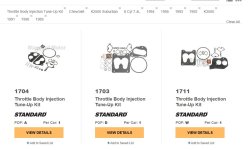
Does anyone know what is the correct gasket rebuild kit for a for 1997 454 Xli: I'd like to clean up my TBI's over the winter. I believe it is Kit 1703 based on the attached files. I thought this might relevant to this thread.
 

Attachments

  • Standard Kits 10-28 105048.jpg
    Standard Kits 10-28 105048.jpg
    81.3 KB · Views: 73
  • Kit 1703  2024-10-28 105213.jpg
    Kit 1703 2024-10-28 105213.jpg
    119.4 KB · Views: 52
It may be...the TBI's were short-lived in their marine use....I usually get the GM number off of the casting and find service parts that way.

FWIW, the biggest issue with refurbing a TBI unit is getting the injectors checked/serviced/replaced. There are a couple shops that advertise on the WWW that specialize in TBI parts and I'd start with one of them for that area.
 
Thanks I will start by recording the GM casting # on the TBI

I used this kit here to rebuild mine, but I bought it through O'Rielly Auto Parts. It was $17 when I bought it, with a "lifetime warranty" (I did warranty it out once, but they were reluctant... I brought a bunch of small torn gasket pieces up there, and said I needed to warranty the gasket kit, they gave it to me... the fuel pressure regulator tore somehow, necessitating a new gasket kit.).

I bought mine 3-4 years ago, not sure if they've gone up in price. I bought it for a 1988-1993 2500 series GMC 454 Truck, and I have found that all parts have crossed over well. Sometimes I've had to use an older model year to get certain parts. I have damn everything to built at least three of these things... :ROFLMAO:

Note, when you buy these "rebuild kits" they do not come with a new fuel pressure regulator spring, and yours may be roached, mine sure was. I had to get through Nappa. Bring your old one and they should be able to match it up. You can also buy them on Amazon. I bought a higher PSI spring to try, but haven't installed it. If yours isn't leaking, there really isn't a reason to disconnect the bottom part of the TBI, there isn't anything to change down there, except for the base gasket. You can buy the "TBI tune up" kit, and you'll get everything you need.

The part I'm having the most trouble locating for my setup, is the proper VDO sending unit for the oil pressure gauge. It's a reverse Ohm sending unit, and it's not the std reverse Ohm. I may end up changing out my gauge:

Walker Products 08018023:

 
Thank you for the information. I'm going to get the casting number off the TBI to be sure. I think the the standard kit I've identified is equivalent to your Walker Kit #.
 
For Future Reference: From my port 1997 454 XLi TBI GM casting and part numbers: 17093193 , M1186: I was able to confirm that following TBI gasket tune up kits are compatible:
From previous post: confirming Walker Part# 18023 and Standard Part# 1703
 
For Future Reference: From my port 1997 454 XLi TBI GM casting and part numbers: 17093193 , M1186: I was able to confirm that following TBI gasket tune up kits are compatible:
From previous post: confirming Walker Part# 18023 and Standard Part# 1703

If you need a pierberg pump, I have one. It was a spare for a boat that I no longer have. The pump has a rubber boot over it, I can't get a part # off of it.
 
Thanks...let me know your price for the pump!

Thanks for the above suggestion, Mark....you got me thinking and I took the distributor apart to look at the pickup coil. I was under the impression the coil is "good" or "not good" but not intermittent. So after taking the distributor cap off, I found the distributor round base plate where the distributor cap seals to be excessively corroded. There are two "vent holes" in this base plate with little screens. Initially I could not even see the screen holes because of the excess powdery corrosion. I actually only found the holes after scrapping and cleaning. I want to replace the pickup coil and the ignition control module. Could the plugged screen holes have caused the ignition control module to heat up and fail intermittently? Again, my initial problem statement is that after running 20 minutes the motor would run very poor. I would shut it off and investigate fuel filter issues...and after that investigation time, filter replacement, etc. the motor ran good again. Could this shutting down time have allowed the ignition control module time to cool and then resume good operation until overheating again...since15 minutes later the motor will run poorly again.

Question: Can I use a NAPA supplied ignition control module for a same year GM 454 FI truck application, or do I need a specific Marine GM ignition control module?
 
The holes are there for ventilation not heat removal. the heat from the module is removed via the heat sink which is why the compound is required when the module is installed.

The coils have been known to fail intermittently...I have never seen an EST module fail in a thermally sensitive manner but given they are electronic, I'd say it is very possible but probably only for a finite time.

You can use anybody's module if the ECU controls the ignition timing...If the module runs in a stand alone manner, you should check to make sure that the curve programmed into the module matches the original one...I have no idea where NAPA sources their modules so can't say if it is a viable alternative or not...
 
Not sure what makes up a "spark suppression" feature.

The current distributor I have is the original 1997 -OEM Crusader, so can I assume this "marine" distributor is "Spark Suppression" Complient?

All I am wanting to do is replace the ICM (Ignition Control Module). I cleaned up the corroded module mounting surface and the two vent screens. (screens were totally packed with corrosion) in preparation for applying the thermal transfer grease and mounting the ICU.

Regarding supply of the ICM. My legacy parts book says the correct ICM is part number R116014. The current ignition control module does not have a stamped part number, but it does have a GM logo on it.

I can make up an auto to search....1995 GM Suburban 7.4L (454) motor. (Same distributor as the Crusader). That car had an identical looking ICU as OEM.
I can find some new non-GM modules that refence it as a replacement for a significant number of older GM part numbers (such as R116014). (I did find a used R116014 one on-line for $130.)
 
The screens just stop any flame that may occur..as long as they are intact, it's not an issue.

You can try the auto flavor modules...just make sure they give you a reasonable timing curve (timing vs RPM) and you should be ok...the key is preventing too much total advance...
 
Not sure what makes up a "spark suppression" feature.

The current distributor I have is the original 1997 -OEM Crusader, so can I assume this "marine" distributor is "Spark Suppression" Complient?

All I am wanting to do is replace the ICM (Ignition Control Module). I cleaned up the corroded module mounting surface and the two vent screens. (screens were totally packed with corrosion) in preparation for applying the thermal transfer grease and mounting the ICU.

Regarding supply of the ICM. My legacy parts book says the correct ICM is part number R116014. The current ignition control module does not have a stamped part number, but it does have a GM logo on it.

I can make up an auto to search....1995 GM Suburban 7.4L (454) motor. (Same distributor as the Crusader). That car had an identical looking ICU as OEM.
I can find some new non-GM modules that refence it as a replacement for a significant number of older GM part numbers (such as R116014). (I did find a used R116014 one on-line for $130.)
USCG has regulations for electrical components and they aren't lenient when they see automotive parts in marine applications that apply- any device that can produce spark needs to be able to prevent it igniting combustible vapors.
 
Along with starters and other motors, consider the ATC vs ATO fuses- ATO ARE NOT to be used in marine applications- the element in an ATO is open to the air and ATC is closed, so the spark when it fails won't ignite the combustible vapors.
 
I found my problem.
I pulled the distributor out to check and replace the Ignition control module, and the coil. With the distributor out in-hand I rotated the bottom gear that engages the crankshaft. I should say I "tried" to rotate the distributor shaft. It was very tight and the bushings were almost seized up. I replaced the entire distributor and now runs great. The new distributor shaft rotates effortlessly. The heat generated by rotating this seized shaft caused the ignition control module mounted on the distributor shaft to heat up and fail.
The internal vertical distributor shaft has a groove machined into the outside diameter. The groove is more like a barber shop spiral. Oil splashes onto the spiral groove and is lifted up the shaft as it rotates to lubricate the top bushing. I showed my distributor to one of the many Lake Michigan charter captains here. He shook his head and told me that the intermittent problem happens all the time to us. He said as a charter boat, these motors run at idle from the slip to the gap in the marina...run 10 minutes at power to get to the fishing point, then go back to idle for 4 hours of fishing trolling, then 10 minutes of full power back to the gap, then back to idle returning to the slip. This lack of higher rpm prevents the oil from getting to the top bushing in the distributor. The captain said he has numerous distributors at the ready for this same problem....and rebuild them in the off season.
 
My guess is you can replace the distribuor cheaper than you can buy the service parts for...

I'd use the work malfunction (vs fail) when describing the ICM function in your case...

Thanks for closing the loop on this one...
 
Back
Top