Logo

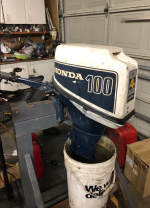
Early Honda B100 10 Horse Rough running

sam751

New member
Hi everyone. I have what appears to be a late 70's early model honda 10 hp with the points ignition as opposed to the cdi ignition. It is only wanting to idle but inconsistently able to reach max rpm if I ease into the throttle. If I try to throttle it too quickly from idle, it will bog and usually. When I manage to pass the roughness by easing the throttle and get the rpms up, the transition becomes smooth until I let it idle back for 5 seconds. Then it will sputter again when I want to accelerate. Sometimes it is hard to start and backfires out of the carb when I give it throttle when trying to start. It can idle relatively smooth but cuts out sometimes.

The engine appears to have silicone used as the intake and water plate gaskets. I just ordered the proper gaskets. I am suspecting either a vacuum leak or valves out of adjustment.

Things I have done:
1. Used 2 different carbs with the same result. Cleaned current one multiple times thoroughly and even taken apart and place in an ultra sonic cleaner. No change
2. Replaced point and condenser which restored spark. Gapped to 0.014 in at widest opening
3. Time the engine so that when the flywheel letter T aligns with the rear post of the pull starter mount, the dimple on the cam pull matches with the engine block
4. Compression tested which read about 120 psi on both cylinders.
5. Replaced Impeller. Pumps good water
 
Hi,
Those old girls are sweet, simple engines but this type of problem can be frustrating I know.
Just a few thoughts and a couple of questions....

First, I completely agree with you getting the gaskets replaced. Good move.
Also agree with checking/adjusting valves....specification for BOTH intake and exhaust valves is 0.002" to 0.004" OR...
...as near to 0.003" as you can get.

You didn't mention spark plugs.
Those SHOULD BE NGK DR 5HS gapped to 0.024" to 0.028". Don't use Denso plugs because, for some reason, the NGK plugs just seem to be better. And that opinion is shared by others that I would consider much more savvy and experienced than me.

Compression spec. for the B100 is 151 psi so your 120 should be plenty good enough, especially if they're both close to one another.

And, my notes list point gap at 0.012" to 0.016" so you've got that right at 0.014" But....trying a bit to the tight side and then to the loose has sometimes helped me get engines dialed in before so don't hesitate to try.

This engine uses a mechanical advance mechanism...("spark advancer" in Hondaspeak)... underneath the camshaft sprocket and it can get dirt and moisture on it that could cause it to hang up. Make sure to have a look at that. Make sure it's clean and the weights spring back when pulled outward. Make sure to lube the weight pivots.

Ignition timing is 15° to 35° BTDC and is initially set with the "F" stamped in the flywheel aligned with the same mark on the pull start support that you aligned the "T" with to establish valve timing TDC.

Other things that come to mind are the basics you've likely already covered but I often forget. Like the fuel tank vent. They get plugged or vibrate closed.

Fuel hose quick coupler. They wear out and don't fully push open or completely latch.

The old diaphragm in the fuel pump could be stretched or deformed. They are no longer available so that could be a challenge.

And, there's more but that's all I have for now.

Always happy to discuss the topic with you and there's a few here that know way more than me so, hopefully, they'll chime in with their wisdom.

Good luck and I hope you get it sorted out because these are great OLD beasts!
 
Thanks for the info! It seems like a sweet old engine and really wants to go. When I was able to get past the rough hesitation, it topped out around 17 mph on my 14 ft gregor boat! About 1 mph slower than my 15 horse Chrysler, with slightly less power down low but close. I always wanted one of these after seeing many videos and many for sale in my area. I don't buy fully functional engines but this was probably not the best first honda for my first impressions. I got it last June and have been working on getting it fixed ever since. Still not giving up!

And are you saying that the "F" on the flywheel should be pointed at the pull starter post instead of the "T"? If so, that would mean my timing is off because my flywheel is set to "T" when the dimple on the cam pulley instead.
 
I'm trying to explain without confusing you (or me!).....

There is VALVE timing but then there is IGNITION TIMING.

When timing the valve train to top dead center (TDC) for doing things like changing the timing belt or adjusting the valves, you reference the "T" on the flywheel to face the starter support and have the punch mark or "dimple" on the cam pulley face the "T". That ensures one cylinder is at TDC and both valves for that cylinder are closed. Ideally you would "time the engine" in this manner by ensuring that the #1 (top) piston is at the top of it's stroke and #2 piston is at the bottom.

Timing the ignition system to have it fire the spark plug slightly before the piston reaches the top of the compression stroke is slightly different.

Once the engine timing is correct then rotating the crankshaft clockwise almost two turns, you will stop the flywheel with the "F" facing the pull start support but you will notice that the punch mark on the cam pulley no longer aligns with the support but is off to the side a bit.

That difference indicates that the points should be opening and firing the spark plug as the piston is still moving upward. That is called "base ignition timing". It is approximately 15° advanced for starting and idle.

If you were to hook up a timing light to #1 spark plug wire (using a 12volt battery) and run the engine, you could then monitor the spark advance mechanism and watch it increasing the the timing as you increased rpm by up to 35° total advance at full throttle.

The shop manual also has instructions about using an ohmmeter to verify that the points are opening at the correct time but I won't go into that now.

I hope this makes sense as I'm not the best at explaining things sometimes.
 
After reading what I wrote to you, I realize I should have made it clear that you align the "F" mark with the starter support so that the points BEGIN to open there.

If you adjusted the points to open with the "T" mark aligned, then ignition timing will likely be too retarded.
 
Okay. I believe the timing is right since I had it idling. I went into the valves today and adjusted to 0.003 inches with the feeler gauge. They seemed too tight before I started. When I fired it up, it seemed I had solved the problem. When I took it to the water, I worked the throttle up and down with no issues. However, once I began cruising around full throttle for a few minutes and then idled back down, it started bogging and popping when I tried to go again. I was able to get it to full throttle multiple times, but it would it took time and ran rough and popped out of the carb every time right before it would go.

I think I have a sticking intake valve somewhere. Does this idea seem reasonable?
 
Did you check/lube the spark advancer?

Are you 100% positive that this outboard isn't overhelaming???

One thing you might try is running it with the cover off. Because, if it has a blown exhaust gasket, it will get starved for oxygen under the hood.
VERY COMMON on these old B models!

CAUTION! If you do run it with the hood removed, make sure to SECURE the hood or leave it ashore. The hoods WILL catch air and FLY/BOUNCE out of a moving boat. They DON'T float and are hard to find these days.
DON'T ASK ME HOW I KNOW!
 
I’m not too keen on removing the head and sourcing a new gasket but I will keep that idea in mind.
Can you go over what you mean bulky “Overhelaming”? If you mean overheating than no, I believe it is staying in operating temperature. It is peeing a strong stream. I did end up replacing the water hose line since the old one was leaking. As for the hood, it doesn’t seem to affect anything when removed or installed. It still goes rough without it on.

I really appreciate your guys help so far! I’m sure we will sort this out. This engine feels like it wants to live!
 
I would put a large dose of sea foam in the fuel, try running it under load on the water and see if anything improves, give it 10 minutes at least, if that is possible. This will clean out crappy valves and fuel passages. Can’t hurt.

I’ve used sea foam for 20 years in my carbed things, outboards- 2&4 strokes, lawn mower, snow blower, chain saws, old autos. It’s good for keeping the varnish off the fuel system and also for keeping fuel fresh in little used equipment.
 
"Overhelaming"!....a real new LOW for the ever useless spellchecker!

I meant overheating. Sorry.

Good luck.
 
I added new gaskets to the intake and exhaust housing. I adjusted the valves to 0.004in. It is doing the same thing. It runs the same.

One thing I forgot to mention is that the carb that came with the engine was broken but I sourced one from a 7.5 parts motor. Are these carbs too different? The float pin in the original carb was seized so I was not able to clean it before I ended up breaking it. But when I ran it, it would only idle and I could not get it to rev up like I can now. So it’s hard to tell if this is a carb related issue. After I did this work today, I tried to rev up the engine with the choke on to see if it would help. It didn’t seem to help and make it pop out of the carb. Is this normal?
 
Sam, just so you know, Racerone is a very smart fellow, removing heads may not be your first choice, but you may eventually end up there.
Don
 
I appreciate that. When I get the chance, the head will be coming off. I do have a newer b75 with the cdi ignition that seized and I might be able to make parts of. It will be a good learning experience as I only ever went into two strokes this extensively.
 
Back
Top