Hello to everyone! I am new to the forum and have moderate boating and boat repair experience. I am a diesel generator mechanic and have been in the custom engine business since 1979. I own my own engine / generator repair business in Northern Virginia. So my wife says to me... "What are you going to do when you retire? All you ever do is WORK! If you don't have a plan you'll be dead in 6 months!"
My reply? I am buying a trailer boat cabin cruiser and my plan is to cruise the Great Loop in sections, one week per month, while keeping my business going and restoring my boat the other three weeks. It'll give me something to do and some adventures to have, and I can keep working as long as I feel like it.
I have found and purchased a 1978 30ft Cargile Cutter single engine cabin cruiser. Allen Cargile was building these boats in Nashville. In July 1977 he took one across the Atlantic to Paris France, the same month I started Classes at Nashville Auto Diesel College. The boat is highly versatile and checks a lot of boxes for me. The boat is in rough shape and needs a new top deck, a new engine, and the interior redone. The seller has 4 of them and redone the upper deck on his first boat by using honeycomb core Fiberglass and has agreed to do mine the same way.
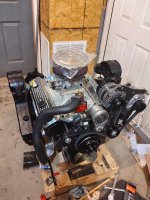
The boat is powered by a Volvo Penta 280 I/O twin prop with a 350 V8 small block Chevy. The engine is locked up. I have purchased a 383 ATK HP90 crate engine to repower it. The cam provided had too much duration and too much valve overlap so I have replaced the cam with a 254/246 duration cam designed for good fuel economy and high torque, producing 300 HP at about 3800 RPM. I am using an Edelbrock 1409 600 CFM marine carburetor with a dual plane manifold and I intend to run a lean 17:1 AFR below 1/2 load for better cruising fuel economy. My goal is to produce 15 BHPH per gallon when cruising on plane at 16 knots, and 600 NM range during low speed operations at 5-8 MPH. I have been using Performance Trends Engine Analyzer computer engine simulator and the formulas from the Propeller Handbook by Dave Gerr and have been able to meet all of these goals on paper anyway.
The boat is not here yet. I am waiting for the upper deck to be completed before taking delivery so I have been thing out the power problems in my mind. I have the engine here and have been working on that, but there are many unanswered questions. Here are some:
The previous engine locked up. It was not the original, but an LS replacement. It bothers me that at least 2 engines have failed. Perhaps not installed properly or improper cooling? What is the best cooling set up for the engine of this type?
I am intending to use water cooled headers so that I can get AFR and EGT sensors installed properly to meet my monitoring needs for lean operation tuning. This is not easily done on cast iron watercooled manifolds, but it can be done on a set of headers. This leads me to the outlet exhaust system. Exhausting through the outdrive is quiet, but can be highly restrictive, some readings indicate over 6 PSI of back pressure. Restrictions like that can be engine killers, but I like the quiet operation of below the waterline exhaust outlets. I came across a company called Fresh Air Exhaust. They make a below the waterline exhaust outlet that uses water speed to suck the air right out of the exhaust. Does anyone have experience with them or something similar?
I want two alternators mounted on the engine. One for 12 VDC and the other 24VDC for a set of house batteries. Is there a company that can help me get the mounting and belt drives for such a system?
The engine I am building will have higher torque at lower RPM and I may need a larger prop and/or taller gears for the outdrive. I figure to get the machine working and get some seatrials done before changing props or gears, but where do I find what is available? Where do I send the drive for rebuild or refit if it is needed? You can easily find lots of stuff for mercruisers but the Volvo stuff is harder to find.
I have more questions but I can't think of any right now. Thank you for accepting me and to your group.
My reply? I am buying a trailer boat cabin cruiser and my plan is to cruise the Great Loop in sections, one week per month, while keeping my business going and restoring my boat the other three weeks. It'll give me something to do and some adventures to have, and I can keep working as long as I feel like it.
I have found and purchased a 1978 30ft Cargile Cutter single engine cabin cruiser. Allen Cargile was building these boats in Nashville. In July 1977 he took one across the Atlantic to Paris France, the same month I started Classes at Nashville Auto Diesel College. The boat is highly versatile and checks a lot of boxes for me. The boat is in rough shape and needs a new top deck, a new engine, and the interior redone. The seller has 4 of them and redone the upper deck on his first boat by using honeycomb core Fiberglass and has agreed to do mine the same way.
The boat is powered by a Volvo Penta 280 I/O twin prop with a 350 V8 small block Chevy. The engine is locked up. I have purchased a 383 ATK HP90 crate engine to repower it. The cam provided had too much duration and too much valve overlap so I have replaced the cam with a 254/246 duration cam designed for good fuel economy and high torque, producing 300 HP at about 3800 RPM. I am using an Edelbrock 1409 600 CFM marine carburetor with a dual plane manifold and I intend to run a lean 17:1 AFR below 1/2 load for better cruising fuel economy. My goal is to produce 15 BHPH per gallon when cruising on plane at 16 knots, and 600 NM range during low speed operations at 5-8 MPH. I have been using Performance Trends Engine Analyzer computer engine simulator and the formulas from the Propeller Handbook by Dave Gerr and have been able to meet all of these goals on paper anyway.
The boat is not here yet. I am waiting for the upper deck to be completed before taking delivery so I have been thing out the power problems in my mind. I have the engine here and have been working on that, but there are many unanswered questions. Here are some:
The previous engine locked up. It was not the original, but an LS replacement. It bothers me that at least 2 engines have failed. Perhaps not installed properly or improper cooling? What is the best cooling set up for the engine of this type?
I am intending to use water cooled headers so that I can get AFR and EGT sensors installed properly to meet my monitoring needs for lean operation tuning. This is not easily done on cast iron watercooled manifolds, but it can be done on a set of headers. This leads me to the outlet exhaust system. Exhausting through the outdrive is quiet, but can be highly restrictive, some readings indicate over 6 PSI of back pressure. Restrictions like that can be engine killers, but I like the quiet operation of below the waterline exhaust outlets. I came across a company called Fresh Air Exhaust. They make a below the waterline exhaust outlet that uses water speed to suck the air right out of the exhaust. Does anyone have experience with them or something similar?
I want two alternators mounted on the engine. One for 12 VDC and the other 24VDC for a set of house batteries. Is there a company that can help me get the mounting and belt drives for such a system?
The engine I am building will have higher torque at lower RPM and I may need a larger prop and/or taller gears for the outdrive. I figure to get the machine working and get some seatrials done before changing props or gears, but where do I find what is available? Where do I send the drive for rebuild or refit if it is needed? You can easily find lots of stuff for mercruisers but the Volvo stuff is harder to find.
I have more questions but I can't think of any right now. Thank you for accepting me and to your group.
Last edited: