Logo

New owner of a 2004 BF225

Mheltun

Regular Contributor
Hello everyone and thanks for accepting me to your forum. I’m a new owner of a 2004 BF225. I recently purchased a Parker boat and this is the motor that came with it. All of my previous vessels have been I/O’s so this is new to me. Unfortunately I do not know the maintenance history of the motor. It is setup with all Honda gauges and an hour meter showing 640 hours. I’ve been prepping the vessel for the upcoming season and I’m curious; due to my lack of knowledge regarding the motors history what are a list of things I should check and change? I also am looking for a shop manual for this motor. Any help is greatly appreciated.

thanks,
Mark
 
Mark,
Welcome aboard! No pun intended! This is a great site and a lot of great folks out there dishing out help. I left you a link below for Boats.net i get all my parts from them, i think a lot of fellow members do too. As far as things you should check it depends on how your motor is running? I assume you are looking for seasonal maintenance. I typically complete the following.

Change T’stats
Chage Oil & filter
Change plugs (or remove and check)
Change HP & LP fuel filter
Check / clean water seperator
Clean VST screens
Change lower unit oil
Replace water impellar
Grease all fittings
I have additional water separator / fuel filter inline between gas tank and engine. I replace these each year as well.

In my younger days Ive had a lot of boating days ruined by batteries, fuel filters, impellars. I keep a spare set of the items listed above on the boat. Then when i do maintence i rotate the new set in, keeping my old ones for spares. Knowing i took them out when everything was functioning well. They’ll work in a pinch.

Good luck to you!
 
Mark,
Welcome aboard! No pun intended! This is a great site and a lot of great folks out there dishing out help. I left you a link below for Boats.net i get all my parts from them, i think a lot of fellow members do too. As far as things you should check it depends on how your motor is running? I assume you are looking for seasonal maintenance. I typically complete the following.

Change T’stats
Chage Oil & filter
Change plugs (or remove and check)
Change HP & LP fuel filter
Check / clean water seperator
Clean VST screens
Change lower unit oil
Replace water impellar
Grease all fittings
I have additional water separator / fuel filter inline between gas tank and engine. I replace these each year as well.

In my younger days Ive had a lot of boating days ruined by batteries, fuel filters, impellars. I keep a spare set of the items listed above on the boat. Then when i do maintence i rotate the new set in, keeping my old ones for spares. Knowing i took them out when everything was functioning well. They’ll work in a pinch.

Good luck to you!


Thanks! As spring approaches I will work thru that list . I will need to find a shop manual in the meantime.
 
Welcome to this forum. You can learn a lot about your BF 225 here. These are great engines and will serve a long time if properly maintained. I have over 2100 hours on my 2007 and it still runs great.

In addition to all of the recommendations from Everglades260...

The first thing I would do is check for fault codes. The procedure has been posted many times on this forum. It's simple to do and only takes a paper clip. If you need directions, send an e-mail to me at [email protected].

Download the owners manual from: http://marine.honda.com/support
There you will see the basic maintenance schedule. A couple of changes and additions...

* Be religious about changing the oil AND filter every 100 hours. (The maintenance schedule says every 200 hours on the filter - forget that.)

* Every 100 hours pull and inspect plugs to make sure you are getting a good burn. They should be milk chocolate brown. Then lightly coat the threads with high temperature grease when you re-install.

* Thoroughly grease the throttle wheels - there are two - one on the starboard side where the throttle cable connects and a second on on top od the engine.

* Drain the VST.

* When you pull the t-stats, carefully check down in the well where they sit and clean out any corrosive build-up. If it's bad, use white vinegar or CLR to clean it out more.

* That year engine often has a problem with the mid-shaft bearing/bushing failing. When you change the impeller, look and feel up the main shaft at the bushing and make sure it is tight and not distorted. If it fails, it can eat right through the cowling. There are several good videos on the Internet that show you how to change it and the parts numbers. Alternatively, you can send me an e-mail and I will return a link to one of the good, accurate videos.

* When you go to change the high pressure fuel filter, you must remove the intake air bypass (IAB) vacuum diaphragm. When you do that, use a pair of needle-nosed pliers and pull back on the arm that comes out of the diaphragm to make sure that the lever to the IAB moves all the way out to the stopper nut and snaps back into place. If it doesn't, send an e-mail to me and I will return a write up on how you may be able to repair that. (BTW - that is not discussed in either the owners manual or the Helm shop manual.) Also, do yourself a favor and replace those two Phillips-head screws that hold the diaphragm in place with hex-head bolts.

* When you change the HP fuel filter be sure to use a new O ring and be sure that you get the spring that sits on the bottom of the filter properly in place. After it has been changed, activate the key switch to pressurize the fuel system and inspect for leaks around the filter top. It's real easy to misalign that sealing O ring.

If you plan to do your own maintenance, diagnostics, or repairs, I highly recommend that purchase the official Helm shop manual. You can buy it on eBay or Amazon. Be sure to get one that covers your year engine. They are $116, but very quickly pay for themselves, especially Chapter 3 - detailed maintenance instructions.

 
Thanks for all the good advice. I’ll be sure to get a service manual ordered soon. One odd problem I’ve been having is the trim gauge has been acting oddly. The switch on the motor is moving freely and the harness connection is good. Behind the gauge when I move the “stud” that the signal wire is connected to the gauge moves up and down (both extremes). When I leave it alone the gauge will settle in in the middle and is unaffected by motor tilt location. I’ve removed all the connections looking for corrosion or a broken wire but everything seems to check out fine. My troubleshooting seems to indicate a problem with the gauge itself or rather the base of the stud perhaps making a bad connection inside the gauge itself. Perhaps someone has seen or delt with this problem before.
 
One other question. I plan on pulling and inspecting the spark plugs soon. Instead of high temp grease for coating the spark plug threads would anti seize be acceptable substitute? Reason being is I do have some available.
 
I did a search on amazon for a helm shop manual and came up empty. Looks like I have no choice but to check on eBay. Does the correct manual have a revision number or a part number I should look for? Or if anyone has a link to the correct I would sure appreciate it. Johnnygjr, was the yes it can response related to my anti sieze question? If so thanks, I appreciate the feedback.
 
Not sure I am agreement with using anti-seize on the plug threads. You certainly don't want one of those plugs backing out while running. Also, I'm not sure how well anti-seize holds up under high heat conditions. But that is just an opinion - not based on experience.

Here is the link to eBay for the manual. DO NOT get the manual with a "K" or "K1" on the front - they are for engines in the 160000 series and above.
https://www.ebay.com/itm/Honda-BF20...ash=item3d379013a2:g:D3gAAOSwL9paYSOi&vxp=mtr
 
Thanks chawk ! Wow, I am very impressed with this forum. It’s kind of like having customer support for a 15 y/o engine. Frankly its very comforting knowing I have place to turn to when problems do arise. Considering my motors history is unknown I will work thru the lists posted above.
 
Please forgive my ignorance for this next question. Before I ask though I will point out this is my first “large” outboard and have previously owned V8 equipped I/O’s. When running This engine what Rpms are best to run at? WOT in the past with v8’s scared me for more than 30 seconds or so. I don’t intend to run her wide open but sometime headed back to the barn I do like to crank it up a bit. I’ve read that cruise is about 4000-4400. If propped correctly it should be about 6000 at WOT. At this Rpms is it a bad thing to run for a sustained period of time or should it be limited to occasional bursts?
 
I don't agree with Johnny on this point.

The 225 should be run at WOT as often as safe. The only drawback is that your burn rate will be around 20 GPH, whereas cruising at, say, 4600 rpm will draw about 12 - 15 GPH depending on your hull and prop. Once I leave my dock, I will run at the highest speed that is safe and comfortable to the fishing grounds, then set up and troll, or drift. If the water is flat, that is at WOT. Returning to home port I do the same. This will keep your engine running well. These engines should not be "babied" but rather used often and run hard.

After I broke in my engine and took is through it's first major maintenance service, I took my boat out on a flat day at slack tide and made three measurements over a range of RPM's - RPM, GPS speed, and GPM. I entered those numbers in three columns in Excel and charted RPM's vs MPH and RPM's vs GPH. Those are very insightful charts and will show you where your optimal cruise speed is - that is, at what RPM's give you the best fuel burn rate and mph. For my old heavy, broad-beamed C-Hawk it is in the 4400 to 4600 RPM range.

If that Parker you have is the 2520 XL modified V or similar, then your hull and mine are exactly the same.
 
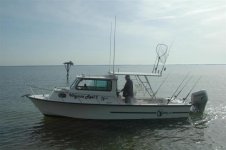
Will try to upload picture...

DSC_0020 (Large) (2).jpg
 
Very nice looking Parker Chawk. My Parker is a 1994 2320 extended cabin. I recently purchased a floscan to monitor fuel usage and find the optimal cruise fuel economy.
 
Last edited:
I would pretty much agree with Chawk, accept I'd say not 100% WOT, maybe at least low 5's. A nice hot run for 30 minutes plus after a bunch of low speed off plane running is great for keeping things hot and cleaned out in the fuel system. Try not to use ethanol fuel if you can avoid it.
 
Thanks guys. Moving forward She won’t see ethanol fuel again. I’m not sure about the previous owner though. Locally I have access to ethanol free fuel so that’s a huge plus. My current dilemma is my fuel tank has about 70 gallons of old fuel in it I need to evacuate somehow.
 
There's several ways of doing that. Assuming that the boat is on a trailer, here is the way I do it...

Raise the bow up above level and use a floor jack on one axle to tilt the boat slightly to one side. Purchase an aftermarket 12 V fuel pump from a local auto parts store and enough hose to get down inside the lowest corner of your fuel tank, and another piece long enough to go into a container set outside the boat - a 55 gallon drum would be best. Open the access cover to either your fuel level sending unit, or the fuel pickup. Snake the hose to the lowest corner, activate the fuel pump and stand by with a fire extinguisher, just in case. I would put the first couple of gallons in an open bucket and let it settle out to see how much water and debris are in there. 70 gallons will take several hours, depending on the pump rate of the fuel pump. You can purchase pumps specifically for this task off the Internet, but they tend to be more expensive, but they typically have a higher flow rate.

Every year or so, I use this set up to pump out a couple of gallons of fuel to get any water out that has settled in the bottom of the tank. Regardless of how careful you are about getting the good non-ethanol fuel in your tank, over time, condensation alone will put some water in there.

Smell the gas real well. If it's not too old or dirty, but the top 50 gallons or so in you POV. Save the rest for burning brush or priming a burn barrel. (Hope the EPA is not listening in!!!)
 
For hooking up the 12v fuel pump my plan is to either hook up to the pickup on the tank or directly after the primer bulb. I’ll then run the hose out to a shut off valve at the discharge end of the hose. That way I can transfer the flow to different gas cans
 
I don't think that will get all of the fuel out. If the boat is not perfectly level in both directions, some old fuel will remain in the tank. Even if it is perfectly level, many pick up tubes will not be resting on the very bottom of the tank. You want to get any water and accumulated debris out of the tank. The procedure I wrote previously will do that. If any of the old ethanol-laced fuel went through phase separation, it's very important to get it all out.
 
Well, $65.00 later I’m the proud owner of a Holley 12v fuel pump and 10’ of 3/8” hose and clamps. I’ll extend the wiring and add alligator clips to the end and mount on a piece of plywood. I may add a switch inline to shut the pump to transfer the output to different containers.
 
My “plan” is to pump out the majority of the fuel connected to the pickup. Then I’ll pull the sending unit off and drop the new suction hose into the tank as described by Chawk.
 
I siphoned mine out using the pickup and hooking on to the intake hose where it met the fuel water separator. I went into 4 liter jugs (bunch of windshield water jugs that are opaque, then put the clean stuff in red gas jugs) and could see any gas and water that had separated, then used the gas in my old truck which has no large number of sensors to foul up.
I had a hole in my tank and got about 12 liters of water. I only had about 20 gallons in the tank. I hooked up a shutoff to my siphon from a plumbing store to control flow. Then siphoned out the rest with a 3/8 line into the tank.
 
Here is a picture of my engine. Again I apologize for my ignorance but I’ve not been able to determine whether it’s a 25” or 30” model. BAGJ1200846 is the number I have for it.
F1A93480-C037-4B5C-857B-E19E4D3FF630.jpg
 
I finally had a chance to take a look and do some maintenance work today on the 225. I pulled the lower unit off and plan on changing the water pump and mid case bushing (on order). One of the bolts was siezed badly and snapped off (lower case bolts). What does everyone use to prevent this from happening again? I have antisieze on hand. All help is appreciated
 
Back
Top