Logo

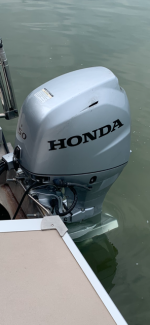
No power anywhere Avalon pontoon with Honda 50hp

tdadawa

New member
I don't have power anywhere to the dash or trim. I check the fuse box with all fuses testing good. This is with the battery load tested good and positive breaker jumped. Any thoughts would be appreciated.

Thanks, Tim
 
Hi Tim

What year? A model or D model?

I only have the D model wire diagram.

Most outboards with electric start have the main positive battery cable going to the starter and or starter solenoid then there are smaller wires (usually white) distributing the power from there. It's a good "area" to check for volts.

You also need to keep in mind that the NEGATIVE side is JUST as important as the positive side is. A bad neygative cable or connection can cause the "no power" symptom exactly the same as the positive. Find where the negative cable hooks to the engine and clean that connection. It's usually a real pain but it might pay off.

Also, you could have rotten battery cables. It happens more often on marine stuff than automotive.

If you suspect bad cables, you can run a smaller jumper wire in parallel with a cable to see if you can get a voltage reading as a test. Also, a technique called "VOLTAGE DROP TESTING" works GREAT for finding this type of problem BUT you have to make the effort to learn how it's done. Google it. Lots of videos and tutorials about it online.

Good luck.
 
Very confusing everything is switch on the negative side making things much harder to understand. Honda BF50D. All the fuses check good there is no battery switch and the kill switch has a negative to both sides of the wires without it being hooked up. I've been using a test light and should be using a volt meter to see the voltage. Boat is in the water making it that much harder.
 
The kill switch is just a ground path to "short out" the ignition. Don't focus on that or let it confuse you. It's NOT part of this issue.

Yes, you should probably be using a digital voltmeter if you are going to isolate the problem.

If you would take the time to look at and try to understand VOLTAGE DROP TESTING on the internet, there's a VERY good possibility of you figuring this out without taking things apart or trying to individually test components.

It works even for those of us that aren't electrical geniuses.

The secret to understanding how it's done is that you are testing the circuit AS IT IS WORKING or being switched on. Once I was able to grasp that, it became very easy.

Ok, that's it, I'll try not to mention it again because I know it's not for everyone.

In the meantime, I will look at the wire diagram and give you some ideas about where to look but it won't be right away.
 
The starter SOLENOID should have 5 wires on the power stud. The black with white line wire is battery positive. If there's no power on the stud, disconnect the battery, remove those wires from the stud and then test just the black with white stripe (bl/w) wire for power after reconnecting the battery.

CAUTION! make certain that wire CANNOT make contact with anything while doing this or it will short out!

Do that and post your results.

Thank you.
 
The wires are isolated now but the bl/w wire is not easy to contact. The bl/w wire goes to the green plug but I haven't been able to disconnect it yet.
IMG_8663.jpg
img_8661-jpg.35830
 

Attachments

  • IMG_8661.jpg
    IMG_8661.jpg
    451.9 KB · Views: 112
  • IMG_8659.PNG
    IMG_8659.PNG
    982.5 KB · Views: 34
I need to mention how this came about. Boat sat for a few weeks and when I went to use it I trimmed the motor down and it sounded like a lot of arcing and it went down slow before everything quit.
 

Attachments

  • IMG_8657.PNG
    IMG_8657.PNG
    910.7 KB · Views: 37
Yes, that little bit of information would have been useful at the start.
I will have to try and reevaluate how to proceed.

Meanwhile, it's obvious that the wiring diagram doesn't exactly match the outboard.
But, if the black with white stripe wire is isolated from all the others, you can now test it without disconnecting.

Just MAKE CERTAIN those wires you've removed from the stud don't get grounded. Temporarily tape off the ends for safety.

It sounds like you already have a short somewhere so you don't want to cause another and have a fire.
 
Okay I've checked the power at the bl/w wire which is a negative 12.76 volts. This is what I think is funny that this boat will key switch the negative but in the helm all the fuses are positive and the fuse on the motor are negative.
 
If you find that you have power on the Black with white stripe wire (positive battery cable) at the starter solenoid, then I think that there may be a problem with the White with black stripe wire that feeds power to both trim switches.

That wire is one of the wires you took off of the stud. It supplies power to both trim switches AND to the ignition switch. So, if it parted or went to ground, it would stop the starting and running of the engine.

You said all fuses are good but I would go back and check the #5
(10 amp) fuse for any signs of damage.

Based on your hearing arcing when the outboard was trimming down, I suspect that where that wire goes out the outboard and up to the console is where it may have failed.

Check very carefully where the wiring from the remote control enters the outboard for any signs of chafing or cracking.


That wiring harness goes through a grommet where it enters and the issue might be hidden from view due to the grommet or the insulation of the harness.

Keep in mind though that, when an outboard trims up and down and, in addition, turns left and right, there are MANY places that the wiring harness will flex.

Look with that knowledge for signs of deterioration in any place you suspect that could be happening. It's surprising where a "stress point" will be sometimes.

Good luck.
 
Well, I don't know. You're confusing me.
You said you only had a test light. Is it a light that has a polarity sensor built in? Did you start using a meter?

When I see a polarity "mix up" like that it usually turns out someone has connected the battery backwards.
 
Did you recently buy this outboard or has anyone else worked on it recently?
Because, it seems SOMETHING is connected backwards!
 
I started using a meter. I could be wrong but to me the boat is USA made with positive being fused and mated with a Japanese motor which fuses and switches the negative side. Do you take it that way.
 
You are absolutely correct the battery was hooked up wrong. There are four large battery cables and two of them were switched. I have the boat winterized by someone else and I remove the battery and drop it off to them in the spring. I used the boat one time and it worked fine but the second time I went to use it is when all the problems happened. That is why I had different positive and negative readings from the helm to the motor. Thanks for all the help I really appreciate it.
 
I know nothing about the Japanese market outboards. But, I owned a Triumph motorcycle and it was "positive earth" or ground so I guess anything is possible.

It is interesting though that the wiring diagram doesn't specify battery polarity and only shows stacked battery plates in the depiction. It doesn't sound "right" but maybe it is. So, I just don't know.


You don't answer my questions about history or ownership and there's really only so much I can do to help from these so many hundreds of miles away.
I think that you should probably try to get a good mechanic to take a look at it for you because you don't want to mess around and start a fire.
Share ALL the information with him/her before they start though.

Good luck.
 
I just hope it didn't hurt the charging system. Make sure it charges properly after you put everything back correctly.

Good luck.
 
Back
Top