

Logo

No spark on Johnson 1976 115hp

cshanno199

New member
Hello

I recently purchased a boat with a Johnson 1976 115hp engine model#115ETL76G. It sat outside without a tarp on it for about 2 years. I had it cranking but when I check to see if it was getting spark, I had no spark on all 4 cylinders. I already checked the rectifier to see if that may have been it that test out good. Not sure where to go next. I am used to working on trucks and diesels so i'm not to knowledgeable when it comes to outboard ignition systems.

Any help would be greatly appreciated.
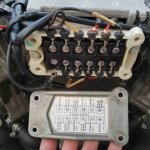
 
First, the rectifier is for charging the battery and has nothing to do with spark. So that ain't it.

Do you have spark with the plugs out? It has to crank at least 200 RPM to make a spark, and will crank faster with plugs out.

Disconnect the black/yellow stripe wire from power pack. Spark now? If yes, a problem with the kill circuit

Look under flywheel area for goo leaking from charge coils. Should not be any. ("Charge coils" refer to charging the ignition system, not battery charge)
 
I cranked it will all 4 plugs out it cranked fast. Still no spark. I will try disconnecting the black and yellow wire when I get off work.
 
So i disconnected that black/yellow wire and the engine still had no spark. How would you go about determining if it was the power pack that was the issue? klk jkljkljkljkl.jpg
 
Last edited:
That is a simple system. There are two sensors that tell it when to fire. If one of them is bad, it will kill the spark on two cylinders. It is pretty unlikely that both would go bad at the same time unless there were a "train wreck" under the flywheel. Likewise, all four coils aren't going to fail at the same time. You ruled out the kill circuit. So what's left? The charge coils and power pack. You can do more sophisticated tests or you can guess and replace and take your chances. Without proper testers, I'd do a resistance test across the two disconnected brown wires (charge coils). But that isn't a reliable test because you are only applying a low test voltage to them, while they produce 300 Volts if working. How's your luck at guessing?
 
Back
Top