Logo

OMC Cobra won’t shift out of gear

67-LS1

Member

​

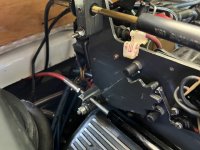
I had the outdrive off my daughter’s boat and used the cable alignment tools to set the intermediate cable position and length. The pull on the cable was approx. 1.5 lbs using my fish scale. I then reinstalled the outdrive and went through the shift cable adjustment procedure.
Both of the switches in the shift interrupt system work and seem to be adjusted correctly.
The only deviation I needed in the whole scenario is that when attaching the intermediate cable end to the bell crank, the cable I had previously adjusted using the OMC tool would not go into the trunnion. Not even close. So I had to adjust the swivel on the cable to get it to fit the trunnion.
I’m 100% sure I’ve missed something. i think the cable length should have been correct once I set it with the outdrive off. Why would someone need to make such specific cable adjustments using such specific tools if they were going to have to readjust it freehand a few steps later?
Help !!!
 

Attachments

  • IMG_0414.jpeg
    IMG_0414.jpeg
    124.4 KB · Views: 542
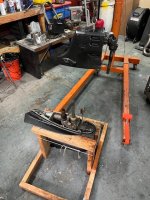
  • IMG_0455.jpeg
    IMG_0455.jpeg
    119 KB · Views: 342
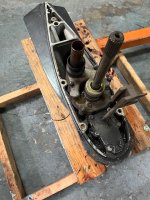
  • IMG_0454.jpeg
    IMG_0454.jpeg
    116.7 KB · Views: 218
What were you doing with the outdrive off? Just curious what was serviced. Was the shifting rod inside the outdrive allowed to spin? after it was removed? If so then it will have changed the length of that shift rod and you will have to remove the outdrive to tighten that shift rod into place. The shift rod should only be allowed to rotate 90 degrees when separating upper and lower units of the outdrive. Just one place of curiosity to start with.
 
I actually swapped the drive for another (used) drive. The old one burned up the gears in the upper case.
I didn’t know about the shift rod alignment in the outdrive. So I guess I need to pull the drive, split the top from the bottom, perform the centering procedure then reinstall/resdjust the shift cables?
Anything else I’ll need to do while it’s off?
 
If the gears burned up I am curious I assume it was run with low/ old oil? Just curiosity.

Did you keep that old outdrive or exchange for core on this one? Also is this a rebuilt or simply used. Huge difference. If it was rebuilt I can assume that the shift rod was not messed with. The shift rod is not the only potential point of issue that could be the cause of your problem, just the first place my mind went to if you have already covered the common issues and also recently had the outdrive off.

As far as what you can do while it is off I'd refer back to whether that is a rebuilt unit or used. Lot more you can do to a used unit if it hasn't been rebuilt. I assume you did the normal things like check / replace the bellows etc. when this current unit was attached?

Is the transom wood in good shape?

For fun what boat, engine size and year are we looking at here?
 
It’s a 1989 Sanger TX that we bought new. It’s our daughter’s boat now. The engine is a 350 Cobra (Chevy based).
The boat has been kept on a hydro-hoist in a covered berth since new. It’s the driest boat I’ve ever owned and the bilge actually gets dusty. The transom is solid as it was the day it was made. Likewise for the stringers and the front engine mounts.

The old drive burned up because of low oil. I still have it. I’ve only removed the top cover, saw the damage and went shopping for a used drive. The replacement drive is the exact model number as the original.
The replacement drive was used, not rebuilt. I just swapped it over to the original transom assembly.

I also replaced the drive coupler on the flywheel) which tore when the drive seized), both u-joints, the gimble bearing, both bellows and rebuilt the water pump.

I aligned the engine with an OEM alignment tool and when done I could rotate it easily with just two fingers. The splined shaft of the outdrive went in smoothly. I replaced gaskets, seals and rings where required for the work that I did.

What else is recommended while I have the drive off? Again. :(
 
OK I have one of these and the last time I had to adjust the cable was about 11 years ago so this is from memory
The very first thing is to check the shift rod height, if this is off all your other adjustments will be wrong. And, you should check to see if it will shift from neutral to FWD and REV by having someone turn the driveshaft clockwise and you work the shift rod. Watch the prop shaft to see what it does. This is just a basic test on the integrity of the lower unit shifting mechanism
Next, when setting up that shift cable, the drive is still off and you have the bracket (orange in your pic) holding the bell crank in the pivot housing at 90*. First make sure that bell crank moves easily and is lubed with grease. Next go up on the engine side and set the length of the cable with the
other special tool, using the barrel to change the length if necessary. Now secure the cable in the bracket up top. Then go to the bottom and tighten the retainer on the shift guide holding the shift cable. This basically sets how far the cable moves in each gear. What you want is equal throw on either side of neutral. If you don't get equal throw, it will go into one gear but grind or grrrr---CLUNK going into the other. A good test is this: look at where the shift cable goes into the red jacket you can see if move if someone works the shifter while you watch. When it's in neutral mark that spot with a sharpie. Then have someone shift it to REV, and make another mark, measure how far it is from N to Rev. Now do the same thing with FWD. These measurements should be equal or at least very close. Now you can install the drive. Next thing to check is the remote control cable adjustment. This also has to be adjusted remember the Cobra is a 2 cable system. Now you need a helper. Install the drive with the prop on. MAKE SURE THE KEY is not in the ignition!!! OK have your helper spin the prop and shift to fwd. It should lock in both ways (try to turn prop)
then shift to neutral, and have helper spin the prop, and shift to rev, same thing, it should lock in if you try to turn prop either way. If it ratchets you aren't right yet. If it locks in you're good. Check the factory manual for the adjustment of the remote cable.

Cobra shift adjustment.jpg
 
Thank you for this. I had bought a new intermediate cable but did not install it because A) the new cable looked really cheap and B) the old cable was smooth and easy to pull. However, it is over 10 years old. I could buck up and buy a better, OEM cable if you think it would make a difference.
I’m bring the boat back to my shop early next week and will keep you posted on my progress.
Again, thanks for all the detail. They can’t print “experience” in a manual.
 
67, it sounds like you have really taken excellent care of this boat and that it is mostly in good shape minus the outdrive being run without oil. Out of curiosity had you considered putting some fresh gears in your old outdrive? Personally if I had an outdrive from brand new and I knew its history and had taken good care of it I feel like I would prefer the original drive. The reason why is not knowing the condition of the dog clutch, other gears, or how dirty the previous owner let the oil become. If I were going to run with the used one I would at least crack it open to check out the dog clutch while I have it off. Then again I have a tendency to go the extra mile because a mechanical failure could leave me stranded in the Pacific Ocean. You could also just take the gears from your newly purchased used outdrive and move those to your original one. The gears on these things are known for being really good, even if they have been used. You just need to make sure you get them in matched sets. I found a little company right here in the good ol' USA that is still turning brand new gears for these and they are affordable. I am currently in the process of rebuilding one of these cobras that had the same problem which was also caused by previous owner not keeping enough oil in it. It's a slow process, especially waiting for parts to come in the mail but for the peace of mind of knowing that everything was done perfectly is worth it.

If you decide to rebuild here are some things to be aware of and some tips for the process:
  • Not every bearing will need to be replaced. You can replace every bearing if you want like I did, or you can check them for smoothness and re-use them.
  • Bottom side requires no shims but the top side will require special tools to measure for shimming. The tools are expensive and hard to find. Easiest thing to do is get everything assembled and ready to go then take it to some old timer at a marine shop somewhere who still has the tools and they will measure it out for you and tell you the correct shim sizes for a couple hundred bucks. If they have them in stock they will probably sell them to you. If there are no marine mechanics in your area you can always ship to another part of the country like Florida, there are a ton of marine mechanics down there. They can measure it and send it back to you.
  • Be aware that your shim measurement will just get you close. You will then assemble and test with a dial indicator that measures in thousands of an inch. After you take the measurement you will likely need to re-shim. It is most common to need to go through assembling process twice, and sometimes three times.
  • You will need a shop press (arbor press). Even if you need to buy one, and the special tools you will still be paying $400-500 less than a rebuild and you get to keep all of the tools.
  • You do not need every special tool the manual calls out. Some are necessary others are not. Here is a video you can check out about the specialty tools.
    . If the cost of special tools bother you remember you can always sell them on Ebay afterward.
  • If you don't want the headache you can ship this to a marine mechanic to be rebuilt which should run around $1500-1800.
 
Then again, who am I kidding? Nobody wants to come to the dumpster fire that California has become. I am sure you would prefer ship it to California and avoid setting foot in this state.
 
Thank you for this. I had bought a new intermediate cable but did not install it because A) the new cable looked really cheap and B) the old cable was smooth and easy to pull. However, it is over 10 years old. I could buck up and buy a better, OEM cable if you think it would make a difference.
I’m bring the boat back to my shop early next week and will keep you posted on my progress.
Again, thanks for all the detail. They can’t print “experience” in a manual.
If your cable drag is 2.5 lbs or less keep what you have. I have owned my boat for 22 years and it still has the same cable on it. Never had a reason to change it.
 
I got the boat back to my shop today. My plan is to remove the outdrive, split the upper from the lower section, adjust the shift rod height, put the upper/lower back together and reinstall the outdrive tomorrow. I need to get the boat fixed and back to her berth ASAP because I’m having shop/garage/mancave sale at my shop next Saturday and the boat will be in the way big time.
 
I read that the shift rod height is to be set at 7 13/64”. This is from the gasket surface, not the top of the shift housing. What has anyone used to make such an exacting measurement? I’ve got a set of calipers with a depth gauge but they only go to 6”.
 
OMC actually made a tool to easily measure this, you can probably do it with a ruler and a straight edge
Mine was off slightly when I last had to set up the cable about 11 years ago.
OMC shift rod adjustment 1.jpg
 
I got the drive off and the shift ro was not even close to 7 13/64. It appears to be approx 6 7/8 in what feels like neutral.
But…
I cannot get forward or referees to engage by moving the shift rod up or down.
I did catch the rod while splitting the case but not too bad (I hope).
 

Attachments

  • IMG_0549.jpeg
    IMG_0549.jpeg
    179 KB · Views: 109
  • IMG_0550.jpeg
    IMG_0550.jpeg
    168 KB · Views: 106
  • IMG_0552.jpeg
    IMG_0552.jpeg
    150.6 KB · Views: 169
Never mind about it not going in-out of gear. I was not turning the right shaft enough.
But the shift rod height was still WAY off.
Is it normal to find one so far out of adjustment?
 
I bought it used and so no clue who might have been in there. Can the shaft spin without splitting the upper from the lower?
I’m encouraged by the fact that after correcting the height of the shift rod I did not have to adjust the intermediate cable to fit after I had pre-adjusted it with the OMC tools. Before, that step had been a waste.
So it’s off to the water tomorrow AM to give it another try.
 
Mine was only off by a little bit, but I guess with an outdrive as old as ours who knows who worked on it in the past. Hopefully putting this dimension right will get you smooth shifting.
 
With the almost 3/8” correction I made, the lower cable just slipped right into the trunion so that’s already a big change. We’re going to sea trial (delta trial?) the boat tomorrow so I’ll report back.
 
OK, I took it for a sea trial and at first everything seemed perfect. In and out of gear with ease. Then we went for about a 20 minute ride and when coming into the marina it would not come out of gear easy. I got it out but it wasn’t right. After that the only way to get it out of gear was to shut it off.
So I looked at the shift actuator while my wife worked the shifter and noticed that the actuator rocks enough to trip the micro switch when going IN toforward or reverse but not when coming OUT of forward or reverse. So I’m not getting any engine RPM reduction coming out of gear which I assume is why the gears won’t disengage.
Any ideas as to why the action of shifting out is not rocking the shift actuator enough but it works going in to gear? Cable slack? I don’t feel any.
Stiction somewhere? Everything seems to slide smoothly.
I’m running out of ideas.
 
Ok so what you’re saying is the ESA engages when going into gear but not when going from in gear to neutral; which is the opposite of how it should work.
Question…what is your idle speed? If it’s too high the ESA won’t be able to lower the idle speed. It should not be more than 600 rpm in gear in the water. The ESA when triggered should lower it to 450 rpm. The other thing is if the throttle cable adjustment is off even if you set it right it can drift up higher & you’ll have stiff shifting out of gear….
 
Based on the tach on the dash, the idle OUT of gear is around 600. I honestly didn’t look to see what is was in gear.
The only cable on the boat I haven’t adjusted is the throttle cable. I’ll pay attention to the in-gear idle speed and also look to make sure the throttle cable setting isn’t keeping the RPM high.
Thanks for the guidance.
 
When you manually trigger the ESA lever with it idling in neutral does the rpm drop?
Should drop from 600 to about 450
 
Yes, the switch works. I don’t have a manual tach with enough resolution to tell the difference between 600 and 450 but the tach on the dash does drop some and it’s an audible change too.
 
I have a digital tach on the boat. My dash tach (original from 1988) reads about 150 rpm too high. At some point see if you can video your shift linkage when you’re shifting N-F-N and a same for reverse
 
Back
Top