Logo

Starter plunger

hcccs

Member
plunger.jpg


This a starter plunger for a Yamaha 4-stroke 9.9 outboarder (6G81410A0100). I have taken mine apart thinking I could fix it but I can't really understand how it works Does anyone know how they work?
 
It has wax inside. When the motor is started electrical power is fed to that device. Heating the wax. Wax expands and forces the pin to move outward. Pin moving outward reduces the extra amount of fuel flow that is allowed when the pin plunger is retracted.
 
It has wax inside. When the motor is started electrical power is fed to that device. Heating the wax. Wax expands and forces the pin to move outward. Pin moving outward reduces the extra amount of fuel flow that is allowed when the pin plunger is retracted.
Thanks boscoe! Most helpful.
 
It has wax inside. When the motor is started electrical power is fed to that device. Heating the wax. Wax expands and forces the pin to move outward. Pin moving outward reduces the extra amount of fuel flow that is allowed when the pin plunger is retracted.
I tested the heating element inside with 12V and it got hot right away. Then I reassembled it tested again to se if the needle would move but it didn't. It was difficult to sense any heat from the ouside of the plastic body. There is a rod inside the "wax" chamber and when I pulled it out I saw a grove and it looks like a grove where a circlip could have been. Is something missing here. I can't figure out how a circlip could have come loose. Anyway, is the engine feeding the heater with 12V or higher? If there is something missing in the grove could that be the reason why nothing moves?

plunger2.jpg
 
Hello,
I might be able to help you.
I wasn't sure if the cold start aid on my outboard motor would work.
Thanks to your pictures, I was able to figure it out:
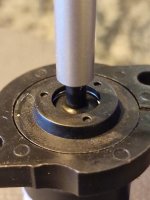
The aluminum part is always pushed all the way to the front of the plastic tube by a spring. Nothing changes here.
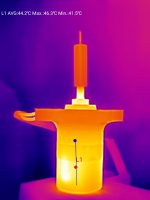
When the cold start aid is powered, the interior heats up to around 50 degrees Celsius.
When the brass part heats up, the wax inside expands and pushes the small stainless steel or aluminum rod forward.
This pushes the entire plastic core, including the spring and aluminum part, forward.
The test is shown very simply in the official maintenance manual;
The coil’s resistance must be between 4.8 and 7.2 ohms at 20 degrees Celsius,
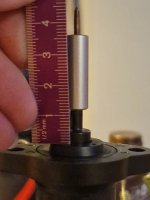
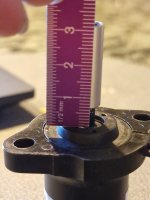
The height of the aluminum part must change relative to the housing when it is powered by 12 volts for several minutes.
In my case, the plastic core is recessed into the housing when cold and protrudes about 4 mm when warm.
I hope I was able to help you as much as you’ve already helped me with this post.
 

Attachments

  • P3_260527_214932_570.jpg
    P3_260527_214932_570.jpg
    93.2 KB · Views: 4
  • 20260527_214623 2.jpg
    20260527_214623 2.jpg
    402.2 KB · Views: 3
  • 20260527_222610.jpg
    20260527_222610.jpg
    423.3 KB · Views: 3
  • 20260527_222318.jpg
    20260527_222318.jpg
    415.1 KB · Views: 4
Back
Top