Logo

Tohatsu MFS30B 2010 water blockage

CarolinaDory

New member
Hoping I can find some help with a 2010 Tohatsu four stroke MFS30B that does not appear to have water flowing through the cooling system. My dad just gifted me his boat (beautiful handmade 20' wooden boat) and it had unfortunately been sitting for a year or two without running prior to that (in coastal SC - operated exclusively in salt water but flushed with freshwater through motor earmuffs after each use). Just before sending it (to me in TX), he started up the motor (with water and muffs attached) and noted that it starts and runs but is not expelling water from the check port.

The owners manual mentions flushing water through a flushing attachment which appears to insert into a water plug hole on the engine block (inside the upper cover), but the diagram is not detailed and I cannot figure out the actual location of this plug.


I found this old post which does mention flushing water through the flushing attachment, indicating that it is indeed possible: https://www.marineengine.com/boat-forum/threads/tohatsu-mfs30b-with-water-blockage.408822/ . I was hopeful I would have the same issue as the OP on that thread, and that by just removing the water lines from the fuel cooling assembly and blowing air in I would discover and relieve a blockage, but air flows freely through that assembly and yet when I tried again to run the motor no water was flowing. I didn't try to run it for very long for fear of overheating, etc. I can blow air through the water outflow line from the fuel cooling assembly and that appears to be clear. So the blockage is either upstream from the cooling assembly or the water pump itself is at fault.

Any advice for other easy things I can check before moving to water pump replacement? Is it worth finding the flush port and attempting to flush that way? And is water pump replacement relatively straightforward or really better left to a professional? I am mechanically inclined but don't have experience working on outboard motors. We don't appear to have a good outboard shop in town, but if this is something I shouldn't mess around with without more knowledge I can definitely look into trailering it to a shop in the surrounding area.
 
I have a MFS30 B, but it's 2014, and it has the garden hose connector on the side. I don't know what year they started with the 'flush port', but have you checked for that larger plastic cap on one of the sides, where the garden hose attachment is located?

Probably you have, I just wanted to mention the attachment is a bit hidden behind a large plastic cap...
 
You can also use your handy IR thermometer to see if it's overheating, or just some crud in the check line.
 
I have a MFS30 B, but it's 2014, and it has the garden hose connector on the side. I don't know what year they started with the 'flush port', but have you checked for that larger plastic cap on one of the sides, where the garden hose attachment is located?

Probably you have, I just wanted to mention the attachment is a bit hidden behind a large plastic cap...
Thanks but this one does not have a flush port on the outside. The user manual really makes it look like it is inside the case on the engine block somewhere. I dunno. The check line is clear from the fuel cooler assembly all the way out so if something is blocked it appears to be upstream from there.
 
I have a 2010 as well, granted with the Mercury name on it. While mine was peeing water at lower RPMs, at high RPM it would slow to a trickle. If you have no flow at all, it could just be a clogged telltale line, or worse, a full clog under the powerhead (the water passages under the powerhead pass water to the head, and the telltale, so one could be worse than the other).

On mine, I pulled the powerhead and found the water passages under the powerhead almost completely clogged, and the grommet/seal at the top of the water tube (that goes from the water pump in the lower unit up to the base of the powerhead on the adapter plate) to be swollen and blocking the water passages. I ran it tonight and it was perfect (that was at least, this engine has other issues). I also do not have the water flushing port you were looking for.

Before I decided it was a blockage under the powerhead, I would make sure the water could flow through the fuel cooler, and out, unobstructed. On the right side of motor, down deep near the lower cowling, on the base of the powerhead, you will see a gray water house. If you follow that hose and it goes to the other side of the engine to fuel pump, and then back to the right side to the discharge port, that's what you can try to clear. I would pull it off and blow some compressed air through it. If you find that is clear, you could have a water pump issue (easy to do), or the worst case, like me, clogged passages under the powerhead. The motor uses a lot more water at higher RPMs, which is why I had good flow in a bucket, or on muffs, or at slower speeds, but when I gave it the beans, the water flow would slow to a trickle and the engine would get hot.

If you have zero water coming out though, my first thing to do would be to blow out the lines like I mentioned above, and if that is clear, then check the water pump/impeller. By check I mean replace. The impeller, plates, and housing if it looks scored at all. Careful of the little wedge/keyway when reassembling. Since it's been sitting, it's good measure to make sure the pump is new.

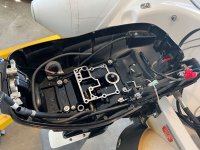
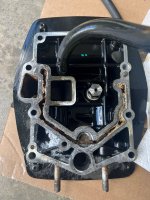
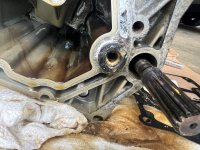
If you get the impeller changed and you still don't have flow, I hate to say it, but you could have a complete clog under the head. Here's what that looks like. One pic is the engine base plate with powerhead removed. The water passages are under that, so that also comes off. Then you are looking at the underside of that adapter plate, and you can see all the crud in the water passages. Lastly, that rubber grommet is the grommet on top of the water tube and it's VERY swollen, and you can see how it left indents from it pressing into the water passages, blocking flow, so only enough water was getting through for lower speed use. When the impeller was really turning at high RPM, it couldn't pass enough water.
 

Attachments

  • IMG_8030_small.jpg
    IMG_8030_small.jpg
    391.3 KB · Views: 138
  • IMG_8045_small.jpg
    IMG_8045_small.jpg
    558.9 KB · Views: 139
  • IMG_8047_small.jpg
    IMG_8047_small.jpg
    476.2 KB · Views: 142
I have a 2010 as well, granted with the Mercury name on it. While mine was peeing water at lower RPMs, at high RPM it would slow to a trickle. If you have no flow at all, it could just be a clogged telltale line, or worse, a full clog under the powerhead (the water passages under the powerhead pass water to the head, and the telltale, so one could be worse than the other).

On mine, I pulled the powerhead and found the water passages under the powerhead almost completely clogged, and the grommet/seal at the top of the water tube (that goes from the water pump in the lower unit up to the base of the powerhead on the adapter plate) to be swollen and blocking the water passages. I ran it tonight and it was perfect (that was at least, this engine has other issues). I also do not have the water flushing port you were looking for.

Before I decided it was a blockage under the powerhead, I would make sure the water could flow through the fuel cooler, and out, unobstructed. On the right side of motor, down deep near the lower cowling, on the base of the powerhead, you will see a gray water house. If you follow that hose and it goes to the other side of the engine to fuel pump, and then back to the right side to the discharge port, that's what you can try to clear. I would pull it off and blow some compressed air through it. If you find that is clear, you could have a water pump issue (easy to do), or the worst case, like me, clogged passages under the powerhead. The motor uses a lot more water at higher RPMs, which is why I had good flow in a bucket, or on muffs, or at slower speeds, but when I gave it the beans, the water flow would slow to a trickle and the engine would get hot.

If you have zero water coming out though, my first thing to do would be to blow out the lines like I mentioned above, and if that is clear, then check the water pump/impeller. By check I mean replace. The impeller, plates, and housing if it looks scored at all. Careful of the little wedge/keyway when reassembling. Since it's been sitting, it's good measure to make sure the pump is new.

If you get the impeller changed and you still don't have flow, I hate to say it, but you could have a complete clog under the head. Here's what that looks like. One pic is the engine base plate with powerhead removed. The water passages are under that, so that also comes off. Then you are looking at the underside of that adapter plate, and you can see all the crud in the water passages. Lastly, that rubber grommet is the grommet on top of the water tube and it's VERY swollen, and you can see how it left indents from it pressing into the water passages, blocking flow, so only enough water was getting through for lower speed use. When the impeller was really turning at high RPM, it couldn't pass enough water.
Hi Steve, i am running into what I believe is the same issue you have. Blowing air through the thermostat port does not cause any air flow to come out through the bottom of the engine. (water pickup)

How hard is it to pull the powerhead?
 
Oh man, I had such a detailed reply typed up and then the lady in front of me on a plane slammed her seat back and I lost it. :(

Anyway, I had never removed a powerhead before, but am pretty mechanically inclined. I had the service manual which detailed it very well, and I took lots of pictures and labelled everything very well. As I recall, I still had water flowing out of my thermostat housing with it removed. With the swollen grommet at the top of the water tube, or clogged passages, you would still get some flow. It is a the higher RPMs that the flow can't keep up so it starts to overheat. You could have a crushed tube. Regardless though, you should see it once you get in there. But you have to remove the powerhead and then keep going, as what you need to get to is under the base plate that the powerhead sits on. This plate separates the powerhead from the water channels, the oil reservoir etc. It took me about 90 min to remove the powerhead, and then another hour or so to continue and get the mid section removed, and the base plate and everything removed. You will basically only have the bracket on the transom when you have it where you need it. Scary to look at but pretty rewarding to know it's done right. I did have access to an engine hoist and that really helped with lifting the power head off and putting it back on so I cold suspend it while I hooked stuff up. You will want the two new metal gaskets that go above and below the base plate. I've since sold that boat and engine, and was very happy to see it go. I got it all solved, and it didn't overheat again, but that engine is just a PITA.
 
Back
Top