Logo

Valve adjustment

troym

Advanced Contributor
5.7L reman long block. Just had the heads done, and have it back together.
Cold compression test on all cylinders good enough (150 was the lowest, 165 the highest). Looks like I'm back to having 8 functional cylinders again. Will recheck compression and do a vacuum test after I have it running.
Getting ready to run it for the first time since completing all the work.
Merc manual gives two procedures for adjusting the valve rockers:
Engine stopped, easy enough and done, but last sentance in the section states "no further adjustment necessary."
Next section in the book is "Valve Adjustment, Engine Running".
...perfect example of why engineers should not write books.
So is no further adjustment necessary after completing the Engine Stopped adjustment, or do I readjust the valves after I have the engine running and warmed up?
 
I prefer to do the running adjustment. It is a bit messy but gives the best results.

That bieng said, Perform the non running adjustmet proceedure as stated in the manual. After This but befor installing I would say run the engine OUTSIDE the boat first. Set it up on blocks, attach water, connect power to ignition, attach fuel source to pump. Start it and set the base timing, make basic adjustmet to carb if needed. (you want the motor to be idleing ~ 650-750 rpms)
Have valve covers off and let block warm up for a couple of minutes. Once warmed up and oil is comming out of the push rods and rocker arms start your adjustments to the rockers. Of course you can leave the other valve cover sitting on the other head to keep oil from spraying all over the place.

What to do, lossen each rocker nut untill a clacking is heard. Tighten until the clack is gone, SLOWLY!!. Once the clacking is gone tighten 90 degrees at a time and let the lifter pump back up and engine smooth out before doing second or third adjustment until 1/2 to 3/4 total turn. ( 1/2 would be two 90 degree turns, 3/4 would be three 90 degree turns)

Repeat this for each rocker arm. Once done that is it!!! reinstall the valve covers and install. Once in make all final timimg and carb if equipped adjustments then.

This is my method. If you feel confident enough to do JUST the cold set up as in the manual that will work as well.
 
Can you elaborate on the Merc Static procedure, as to which one your manual recommended? There is a 2 and 3 stop. I'm curious if your manual mentions the more accurate 8 stop procedure! The 8 stop may be the procedure that Merc is referring to as: "no further adjustment necessary." I would agree if the 8 stop procedure had been used, and used correctly. We rarely have to go back through these.

The 2 or 3 stop????? I would go back through them dynamically to avoid any error!

So is no further adjustment necessary after completing the Engine Stopped adjustment, or do I readjust the valves after I have the engine running and warmed up?
Again, and without knowing exactly which static procedure was used....... your best bet would be the dynamic procedure........ it's pretty Goof Proof when done correctly. Messy..... but Goof Proof. The clicking or clacking sound indicates rocker arm/valve stem lash. Absence of the clicking/clacking sound, indicates ZERO valve stem/rocker arm lash. All must be at ZERO to begin with..... or you won't be able to delineate between one clicking/clacking from another.
This is where the adjustment begins (see your OEM instructions re; this).

Forgive the verboseness here.... but this may help you better understand what is being done when this adjustment is being made.
NOTE: We are not adjusting a Valve, or a Push Rod, or a Rocker Arm per se'...... Ultimately we are setting the depth of the cam follower's internal hydraulic plunger/piston travel (approximate .080" to .100" dry travel), often referred to as "Pre-Load"! Adjustments to the rocker arm stud nut changes this geometry.... thus the position of the cam follower's plunger/piston. The stud nut adjustment (thread pitch x's revolution), via the rocker arm ratio, against valve spring tension, ultimately positions the cam follower "No Load" hydraulic plunger/piston depth.


Here's a neat little .GIF file....... Click here!
Note the travel of the green plunger/piston within the red follower body.
This is the approximate .080" to .100" total "uncushioned" no-load plunger/piston travel range.
Note that this follower makes 2 cycles prior to any oil pressure.... this is for demonstration ONLY.
Note as the oil finally enters the system (shown in yellow) and how the hydraulics come into play.
Note that the plunger/piston is now short by XXX" dimension of "topping out" in the body.
This is our goal!

Here's a good cut-a-way view of a hydraulic cam follower.

139_0412_cam_5_z.jpg


Bottom line...... if the 2 or 3 stop was used, and/or if you are questioning your procedure, best to go back through these dynamically, IMO.

Again..... all must be initially at ZERO lash, in order to hear positive lash (clicking/clacking) individually, in order to adjust idividually from there!
As kghost says....... it is messy.... but pretty easy to do!

.
 
Last edited:
Here's the procedure from my manual:

Valve Adjustment
Engine Stopped
With valve cover removed, adjust valves when lifter
is on low part of camshaft lobe, as follows:
1. Crank engine with starter or turn over in normal
direction of rotation until mark on torsional damper
lines up with center “0” mark on timing tab, and
engine is in No. 1 firing position. This may be determined
by placing fingers on No. 1 valve as
mark on torsional damper comes near “0” mark
on timing mark. If valves move as mark comes up
to timing tab, engine is in No. 6 firing position and
should be turned over one more time to reach No.
1 position.
2. With engine in No. 1 firing position as determined
above, the following valves may be adjusted.
3. MCM and MIE Left-Hand (Standard) Rotation
Engines: Exhaust - 1-3-4-8 Intake - 1-2-5-7
4. Back out adjusting nut until lash is felt at push rod,
then turn in adjusting nut until all lash is removed.
This can be determined by moving push rod up
and down while turning adjusting nut until all play
is removed.
5. Hydraulic lifters now can be adjusted by tightening
adjustment nut an additional one turn. No other
adjustment is required.
6. Crank engine one revolution until pointer “0”
mark and torsional damper mark are again in
alignment. This is No.6 firing position. With engine
in this position, the following valves may be
adjusted as previously outlined.
7. MCM and MIE Left-hand (Standard Rotation
Engines: Exhaust - 2-5-6-7 Intake - 3-4-6-8

Wouldn't know whether to call this the 2, 3 or 8 stop method.
Also, the manaul specifies a full turn from zero lash under the "Engine Running" procedure vice the 1/2 to 3/4 Kgohst stated... any additional thoughts?
 
Quick and easy, Turn crank while pushing lightly on the push rod side of the rocker arm. When the lifter stops moving downward, tighten the rocker stud nut until there is zero lash and then tighten 3/4 of a turn. Do the same procedure for the rest and it's ready to go.

You will need to install a few feet of exhaust hose on both risers if you run this engine on the ground. It will pull water back into the exhaust manifold if you don't.
 
Tyrom, you have described the 2 stop procedure. I will NOT, and have NEVER used the 2 stop!
To correctly statically set the cam follower plunger/piston position, I want the cam follower to be as close to center bottom of lobe as possible.

The forgiveness with the 2 stop, is within the generous .080" to .100" plunger/piston "No-Load" travel, that I mentioned earlier.
The risks in setting, and then walking away, are IMO two-fold:
* bottoming out, or being close to bottoming out of the plunger/piston.
* topping out, or being close to topping out of the plunger/piston.

The mild wear that will occur from the time that these adjustments have been made, may not factor in with this rather "crude" procedure..... especially re; "topping out"!
Worst case.... we end up re-adjusting them.
Again..... JMHOO.

Tyrom, the 8 stop procedure begins just as the 2 stop does. i.e., #1 cylinder, TDC, C/S only!
However, we rotate the engine 8 X's, stopping at each cylinder (90* crank rotation) right down the firing order, and while @ TDC C/S only.
We set both Int/Exh at same time.

The time required to do this, is minimal! 6 more stops @ 90* each.... done!
For me, it's a No Brainer!
It may not be for everyone! :D


There is an even more accurate procedure when done prior to oil priming and intake manifold installation on a fresh engine.
Different story, for a different day! :cool:

.
 
Also, the manaul specifies a full turn from zero lash under the "Engine Running" procedure vice the 1/2 to 3/4 Kgohst stated... any additional thoughts?
This is entirely a result of the geometry.

Rocker arm ratio = 1.5:1 if OEM..... 1.6:1 if modified.
Stud thread siz/pitch = 3/8" 24 if OEM...... 7/16" 20 if modified.
If using 1.5:1 OEM ratio:
One full turn of 24 pitch = 1/24" ... or .041" multiplied X's rocker arm ratio in favor of the valve tip = approx .027" plunger/piston set.
One full turn of 20 pitch = 1/20" ... or .050" multiplied X's rocker arm ratio in favor of the valve tip = approx .033" plunger/piston set.
Both give you the additional push rod depression from beginning ZERO lash.
IOW, beginning ZERO lash is also when the plunger/piston would be at the extreme top of it's travel.
We want to adjust this so that it will NOT top out, and will utilize the designed portion of the plunger/piston travel!

Total average cam follower plunger/piston travel = .080" to .100" (this may vary depending on manufacturer)
You can see that we have some latitude.... but OEM wants us to favor upper travel.

For the novice, adjusting via the dynamic method may be more accurate.

.
 
Last edited:
Originally Posted by troym
Also, the manaul specifies a full turn from zero lash under the "Engine Running" procedure vice the 1/2 to 3/4 Kgohst stated... any additional thoughts?

Stock OEM specs for max RPM of our engine in question with our lifters and cams in question and also based on a lot of test engineering state 1 full turn.

From experience and reading a lot of technical articals on valve train adjustment again for our engine combo in question, 1/2 to 3/4 turns is the prefered amount of preload. This will allow better higher rpm controll to avoid valve float.

This is based on my reading of this material which if you were to simply google these days would give you the same information. Also if you were to buy a small block rebiuld book from a reconized engine builder it would also show this.

I believe in essence what less preload does is gives less chance for the plunger in the lifter to bottom out which would reduce the lift (opening of the valve) at higher rpms.

If the numbers reflecting total plunger travel 0f .080" to .100" are true Idealy you want to be between .040" and .050" for nominal settings. ( motor type and lifter type are not all the same values, some have a max travel of almost .200") .

As far as the math above.............maybe this works easier........max plunger travel = .080", One full turn with a 24 pitch thread gives you .041" penetration of the push rod into the lifter (from zero lash to begin with) this would put you right in the middle..........080"- .041" = .039"...

so less adjustment, (1/2-3/4) from zero pushes the push rod less into the lifter. Thus more oil cushion and less chance of the plunger to bottom out in the lifter.

Hope this makes a bit more sense.......
 
kghost said:
Hope this makes a bit more sense.......
Well, I hope this is to not imply that I haven't made sense! :D

Kg, I've personally measured plunger travel on an array of GM followers. I've found that .080" to .100" is very average and common! At least with the GM followers.

BTW, the actual distance caused by one full nut rotation, does not necessarily equate to the same distance of push rod travel!
We have to factor in rocker arm ratio.

Which leads me to a confession here: I may have done my quick math incorrectly!
While the rocker arm ratio plays a role in the travel applied via nut adjustment, I may have reversed my thinking re; the ratio.
A rocker arm ratio of 1.5:1 is a cam lift muliltplier.
Conversely, when doing the math (pertaining to the stud nut adjustment and change to push rod), the 1.5:1 ratio would appear to work as a divider.
So my; "one full turn of 24 pitch = 1/24" ... or .041" multiplied X's rocker arm ratio in favor of the valve tip = approx .027" plunger/piston" ....... may not be accurate.

I need to oil up a few more brain cells, and revisit this.


None-the-less (and I'm not letting myself off the hook here), this should sure help someone understand that we're NOT adjusting valves, per se'........, not in terms of what is so commonly heard of as "Valve" adjustment!
We are actually setting plunger/piston depth.


More later. :)

.
 
Last edited:
Rick

No matter what your math, if they say 1 full turn (oem) they are shotting for the middle of the plunger travel? agreed?
Thus one full turn would be ~ ,040" for a .080" and for .100" that is within ten % above middle? Agreed?
All is good.

So without exact specifics on formula's we can just agree to simple math for this until either you or I find the full calculation...
 
Wow! Lot's of great gouge... thanks.

So, according to Rick's explination, I did the 2 stop, engine stopped adjustment, with a little more intuition than what's written exactly in the book, with the little bit I could remember from Engines 101 I had about 30 years ago.
I made sure for each rocker I adjusted, the follower was at the bottom of its travel by rotating the crank back and forth, making sure there was no upward motion, then taking the lash out, then one additional turn to establish the preload on the lifter. What I did makes alot more sense to me now, thanks to all the input.

Got close to having the engine running last night. It fired, but wouldn't stay running. When I was reinstalling the carb, I asked myslef if I should have taken it appart and made sure it was clean since it sat dry and in my garage a for few months... well I should have. I think the jets are clogged. The only way I could get fuel in the engine was by stroking the accelerator pump. So a little more work to do there.
Gave up tinkering with it for the night as a result of the battery getting pretty well used up.
If the rain holds off, I should be able to get the carb pulled tonight, maybe tear into it a bit, and put the battery on the charger. Won't likely get to do anymore work until Saturday.

Sounds like the best thing to do is to do the dymanic adjustment, but at least I'm confident the adjustment is close enough now to run the engine, get the idle mixture and timing set and take care of all the other 'oh by the ways'.
 
If you have done the adjustment by the book, and you have confidence you did it right. You are done and button it up and fire it off.........If there is any clacking when running then you will have to do it again. Chances are you are good to go!!
 
Follower plunger/piston depth

Well, I agree that most of this info is over-kill for the average person..... just wanted to further explain as to how/what we are actully doing, and as to the importance of being accurate. Re-setting/re-adjusting on a car/truck is one thing...... but most marine applications cause this to be a bit more involved..... not to mention messy.
Your call!
Rick, No matter what your math, if they say 1 full turn (oem) they are shotting for the middle of the plunger travel? agreed?
Thus one full turn would be ~ ,040" for a .080" and for .100" that is within ten % above middle? Agreed?
All is good.
Again, I must respectfully disagree on the basis of the ",040" for a .080" and for .100" that is within ten % above middle"..... because, and only because, the rocker arm ratio must be factored in.
Otherwise..... yes..... I would agree.

What I am unclear on, is where the OEM wants the plunger/piston in it's potentail .080" to .100" range of travel.
If near the upper portion, then they (the OEM engineers) have considered this, and the subsiquent adjustment specification... I.E. the dimension effect of one full turn relative to plunger/piston depth.
As said, if the dimension is to be calculated (if only to further explain), the rocker arm ratio must be part of the equation.
(much more technical than need be)


  1. So, according to Rick's explination, I did the 2 stop, engine stopped adjustment,
  2. I made sure for each rocker I adjusted, the follower was at the bottom of its travel by rotating the crank back and forth, making sure there was no upward motion, then taking the lash out, then one additional turn to establish the preload on the lifter. What I did makes alot more sense to me now, thanks to all the input.
  3. Sounds like the best thing to do is to do the dymanic adjustment, but at least I'm confident the adjustment is close enough now to run the engine, get the idle mixture and timing set and take care of all the other 'oh by the ways'.

  1. correct.
  2. Well, it's an approximation that the follower was at the bottom of its travel. IMO, the 8 stop gets us closer. We must consider that a radial cam lobe (near bottom center lobe) ramps up on the perimeter of the follower's bottom circumferance.... not the center. (I know... more technical than need be!)
  3. Ditto.
If you have done the adjustment by the book, and you have confidence you did it right. You are done and button it up and fire it off......... If there is any clacking when running then you will have to do it again. Chances are you are good to go!!
Well, somewhat disagree again.
This is why the 8 stop works best, IMO. We seldom need to go back through them when the 8 stop is used. And who wants to do this twice? :mad:

I've been working with/on the SBC since the mid 60's. Daily drivers and street performance. The 8 stop has always been my preference.

kghost, I hope that you understand that this is good conversation only.... no argument.... just good discussion. :)
 
Last edited:
I tried to find a more acurate calculation but could not, so using your math

1.5 x .041 = .062

Your original .041 / 1.5 = .027

So if the OEM were to look at the max plunger travel of ~ .100", adjusting the push rod depth into the plunger using one full turn would result in a ~ 10% + factor that the OEM added.

Maybe the .100" (even though you may have measured them) is not 100% true. Maybe they measured it at .120"

Could not find that info either. I did see some info regarding more than .100 in plunger depth. .120" was mentioned.

I will say this, I just redid my Harley motor, Bigger CI and more power.
I purchased new lifters and installed S&S travel limiters. These limiters measured ~ .112 thick and they cut the plunger movement by ~1/2 based on others knowledge (total plunger movement). I did not measure them myself. Mine are roller lifters if that matters.
 
Under construction.... (which is a chicken way of saying....... I'm working on it.)

Troy, we should have this all worked out in another 25-30 posts. Bear with us. :D :D


Kg, I think that we both agree that Thread Pitch dictates distance moved by quantity of nut revolutions, and at the threads ONLY.
We multiply or reduce via rocker arm ratio from there.

Meanwhile, I'm thinking about this plunger travel, ratio, thread pitch, etc. You may be correct re; .062".
More later...........................
 
Last edited:
I found two web sites, chevy type billboard sites such as this site. This subjuct was also being discussed and they both had one post (by the same person) saying his experience since the mid '80's is "(plunger travel = .140" +/- .010")".

I am not saying this to be fact, Just some additional info.........

I may have to look in my basement and see if I have any lifters and take one apart just for the hell of it.....
 
I found two web sites, chevy type billboard sites such as this site. This subjuct was also being discussed and they both had one post (by the same person) saying his experience since the mid '80's is "(plunger travel = .140" +/- .010")".

I may have to look in my basement and see if I have any lifters and take one apart just for the hell of it.....
Please do! I'm going to test several more sometime today, just out of curiosity.

KG, by now Troy must think that we're suffering from "CAM FOLLOWER OCD"! :D
 
I think if we use your oringinal math and the .062" calculation, It would make sense that the travel is around .120" as the OEM spec of 1 full turn will put the lifter in the middle of the range. Exactly where they want it for a motor running less than 5500 rpms.....

More to do here to unravel this .......
 
Rick

I posted this question on the HarleyDavidson web site I participate on and here is a answer that maybe can answer the question on plunger total travel of a standard chevy lifter.

""""I just happened to have a dry set of chevy lifters out on the bench. I measure .148 pretty consistant through all 16. These are stock replacement lifters for the 2 pc. style rear main chevys. Hope it helps."""""

As the OEM 1 turn spec has not changed even with the roller cams I would suspect that this still holds true.

From what I have read there are some changes with the LS checy motor to much less plunger travel but it may be LS engine specific. ( LS 3 vs LS 7) or something to that effect.
 
Troy, by now you're probably laughing at this verbose explaination, you have your engine running, and have returned to this thread for amusement purposes only! :D Can't say as I blame you!

Kg... thanks for the plunger travel update. I still have not checked again.... but will take your word on that.

BTW, I have not forgotten about this re; distance of push rod/pluger travel, per one turn, per thread pitch, per rocker ratio, yada yada yada and so on!
I'm hung up on one aspect of the ratio, but I will get back to this.
I'm too stubborn not to. :D

.
 
Last edited:
I'm still keeping an eye on this one.
I have not had a chance to get back to the engine since last week. The weather hasn't been the greatest, and the inside honey-do list needed some attention anyway.

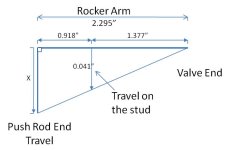
As far as the rocker ratio goes, I don't think it's going to be a direct correlation to the 1.5:1. All that is telling us is that push rod end of the rocker as measured from the fulcrum (center of the stud) to the center of the push rod is 1.5 times longer than the valve end (center of the stud to the center of the valve stem). The Problem is when the rocker nut is tightened, the effective fulcrum shifts to valve stem end during the adjustment.
We'd need the overall length of the rocker (center of pushrod to center of valve stem) and the one of above lengths to figure out the distance of push rod end travel for each turn of the nut on the stud.
If anyone has a rocker arm off and can measure it then post, I can work the geometry problem.
 
As far as the rocker ratio goes, I don't think it's going to be a direct correlation to the 1.5:1. All that is telling us is that push rod end of the rocker as measured from the fulcrum (center of the stud) to the center of the push rod is 1.5 times longer than the valve end (center of the stud to the center of the valve stem).
A) Troy, it would be just oposite from this.


The Problem is when the rocker nut is tightened, the effective fulcrum shifts to valve stem end during the adjustment.
B) Agreed!


We'd need the overall length of the rocker (center of pushrod to center of valve stem) and the one of above lengths to figure out the distance of push rod end travel for each turn of the nut on the stud.
C) I'd have to disagree! (respectively, of course!)
A) Actually, the leverage advantage is in favor of Valve (if reverse engineering leverage)..... disadvantage being that of the push rod.... with push rod's travel being multiplied at the valve stem.
IOW, Push Rod offers 1 X.... Valves receives 1.5 X.
You can see it here.
images

images


B) You are correct in that the valve stem end now must be thought of as "stationary"..... and the stud nut/ball swivel as the "work force", and the push rod as the "work load".... but in terms of travel.... because that's what I'm after.... travel, as in plunger/piston travel or depth!

C) I do not think that we need the over-all length of the rocker in my way of thinking.... all we need to know is the ratio, of which is 1.5:1.


I've got a post Q'd up and ready to go... and with a leverage image......, but won't post until I have this ratio thing worked out. Dang it!
Troy, if you can make the math work, and explain it..... that would be great.

For a 3/8" 24p rocker stud/nut....., 1 full turn 24 thread pitch = 1/24" ... or .041" at the stud.

What/how that affects the push rod (in distance) is what I'm after.
Again.... the valve stem for the purpose of this discussion, would be "stationary".... Non-Moveable.

"I'm not a smart man, Jenny, or I could figure this out!"
images


.
 
Last edited:
I gooned up again. I swear, if I could have 2 minutes to concentrate on any one given thing before somebody comes in my cube with a question they already know the answer to, this world would be a wonderful place.

Anyway, the last "Solve for X" should be:

X = 0.0298 x 2.295 = 0.068"
 
OK the math is settled!!

Thus a lifter with ~.140" +/- .010" and a one turn down on the 3/8-24 thread = .041" at rocker which gives a .066" pushrod movement ends up putting the plunger down in the hole (lifter) at a hieght of .080"

In other words after adjusting the rocker 1 turn (.041") you end up with ~ .080" +/- of plunger travel remaining in the lifter.

If you only go 1/2 turn you end up with ~ .100" of plunger travel remaining. ( this is for higher reving engines but will work fine for non high revving engines).

I believe i read somewhere that a minimum of .020" (cushion) must exist with a hydrualic lifter for it to actually act as such........

Obviuosly there is a TON of margin biult into the design.......
 
Had a few spare minutes last night before it got dark to do a little tinkering.
Got the engine running and it ran great! The one wire for the inturupt switch was grounded out. I left it disconnected since I haven't remounted the shift plate yet... it'd be in the way when it comes time to do the running valve (rocker) adjustments.
Once I got the timing and idle close to right, it smoothed right down and purred like a kitten.
I don't remember it ever idling as smoothly.
One minor leak at the front of the intake manifold to fix. I apparently didn't get enough RTV in the joint, but that should be no big deal.
Now if the weather would cooperate, I might just get that thing in the water by the time the spades start showing up.
 
Thanks, Troy. That puts the math portion to rest.
KG, I agree with your thoughts as to where this places the plunger/piston, and it would appear to offer a "TON of margin biult into the design", as you said.

*****************************

KG and Troy....... FYI.... here's where I got hung up earlier, and where Troy became the expert!
This is what I had intended to post prior to seeing that Troy was able to do the correct math: I'll put this in quotes:

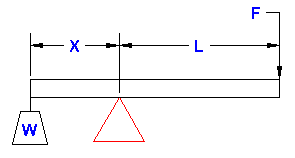
In the normal usage, and in terms of leverage and ratio;
the push rod end would be the effort arm, or input force....
and the valve stem end would be the resistance arm or output force.


The red triangle could represent the ball swivel, stud and adjustment nut.... agreed?
W could represent push rod side I.E., effort arm, or input force
F could represent valve stem end I.E., resistance arm or output force

X could represent the 1 of the 1.5:1 ratio.
L could represent the 1.5 of the 1.5:1 ratio.

lever_case1.gif


In this particular scenario, we'd be considering that F would not move (not for what we are doing), any change to the adjustment nut height, would affect W's travel. Make sense?
IOW, it would not be multiplied by 1.5 ...... it would be on the other side of the ratio!

So in effect, the red triangle now becomes the effort arm, or input force.
And W now becomes the resistance arm or output force.

Here's where I get hung up:
So if one full turn of the adjustment nut = .041"..... then what effect does this have at W..... given the rocker arm ratio of 1.5:1 .... with 1.5 not necessarily being the multiplier at W?
There must be a formula for this side of the ratio!
That's where I was not understanding the ratio influence (and the math) at this end.

Again....... Thanks, Troy! :D
 
Last edited:
Back
Top