Logo

Hooking up a mechanical Water Pressure gauge for testing

William Miller

New member
Mercruiser 350 MAG MPI* Bravo 3 , Gen3 Cool Fuel, Raw Water Cooled, 3 point drain

I am in the process of tracking down a over heating issue on my Starboard engine.
I have replaced the impeller and thermostat
I have the smart craft (System view) which show water pressure on both engines side by side.
The readings have been low since I bought the boat 2006 new.
They do fluctuate as expected, but are off by a factor of 10.* (I believe as I watch the readings go from about .05 at idle to about 1.5-2.0 at cruising speed.
The overheating issues is new this spring. At this point I believe there is a blockage in one riser.

The readings never bothered me untill now that they would be usefull.

What I have learned:* The water pressure sensor is on the power steering cooling tube on the back of the engine.* I can feel it, but cant see it.
The wiring diagram indicates that it is 5 volts and wired directly to the ECM
The original part number has been superceeded (Thus I wonder if there was something wrong with the original batch.
Earlier engines had a sensor located on the output tube of the raw water pump.
My raw water pump has blue drain plugs in both the inlet and outlet side. (It's a brass pump)
The plugs are very difficult to get to due to the engine mount stringer and the Cool Fuel Box.
In the mercruiser parts diagram it indicates the the blue plugs are 0.5"-13 which I assume means 1/2" with 13 threads per inch.

This is a very strange pipe size.
So, how do I find a adapter to plumb this to a 0-30 psi mechanical gauge?

Thanks for any help and suggestions.

Anyone know how I can get the specifications for the old and new water pressure sender?* It would be nice to test the output.

I have ordered the mercruiser engine manual, but somehow I doubt they have such detailed info.
Does Mercruiser send out Techmical service bulitens like car manufacturers do?
Thanks again!
 
Disclaimer: I am not familiar with this system but have several uneducated comments and questions that I'll just throw into the mix here!

Mercruiser 350 MAG MPI* Bravo 3 engine mounted sea water pump!

If the pressure sensor is installed at/near the p/s fluid cooler, this would be on the suction side... not the pressure side... Yes/No?
IOW, this instrument/system is reading Negative pressure...., not Positive pressure... correct?
If so, then the less pressue (vacuum) the better! (i.e., no restrictions)

If the sensor was reading pressure AFTER the sea water pump, then this would be Positive pressure...., correct?
If so, then again the less pressure would show a lessor resistance in the cooling water path.......... Yes/No?

Ideally we want good strong cooling water flow with little resistance.... of which should equal little pressure (neg or pos).

An increase in Neg pressure on the suction side of the sea water pump, would appear to indicate resistance of some sort.
An increase in Pos pressure on the out-put side of the sea water pump, would appear to indicate restriction of some sort.

Does that make sense?

.
 
Last edited:
Welcome aboard !

Raw water cooled, 2006 boat if you boat in saltwater your due for new elbows / risers. Double and triple check the flappers / shutters, make sure they are there and if one is not find it, or you will forever be chasing down a overheat condition.

Bravos are known for corrosion in the area of the water pickup.

Just went thru this with my friends bbc bravo 3. Exact same stuff. We had to pull the drive but we also at my urging installed another pickup.

Curious he has a 2006 also... Crownline not that it matters the boat maker.

Now he draws raw water from 2 sources. And has new risers. We also boiled out his power steering exchanger.

The pipe thread we took the pump down to the local plumbing supply house and they matched it up.
 
One other very important place to look,

On bravo transom assemblies where the water hose that comes from the outdrive and goes into and then thru the transom assembly and then connects to the incomming water hose. The connection point of the hoses is done with a "screw in type" of expansion fitting. it basically pinches the tubing. Why they did not use a simple tube I will never know......

This area gets very corroded as it is all aluminium and oxidised material "grows" and the hose inside diameter can and will shrink to 1/3 it's normal diameter by this growth. This will restrict over all water flow to the entire system.

I am not sure if this can be reached in your boat from the inside but I would suggest at a minimum to remove the suspect engine's outdrive and gimbal housing and carefully check the water hose connections.

Of course of you have thru hull water pick ups disregard all above...........
 
Last edited:
He states in his first post a NEW impellor was installed and in another post he says the housing is brass.....I would think this is sufficient.

This sounds to me like a lack of incoming or outgoing water flow, (incoming restriction or out going restriction)........everything else seems to have been replaced and this would also explain the desire to install a water pressure/flow monitor device........??????
 
8 replys and some good info in less than 6 hours.
I'm glad I joined the fourm!:eek:

When I wrote my first post I was in somewhat of a hurry, thus I missed some info.
I'll reply here trying to better define the issue in t he order that the questions were asked.

First the Boat is a 2006 Sea RAY 290 Amberjack.
I am located in the upper Chesapeke bay (4 miles below Kent Narrows Bridge)
The water is brakish and salinity varies greatly with annual rainfall. (Last year= no Jelly fish because of the snowmelt, this year they are out big time already!)
I keep the boat on a lift except for when I use it.
Except for Warantee issues, I have done all the maintence and repairs on all my boats for 30+ years. (Man, I'm feeling old now!)
This is my first boat with twins and also BIII drives.


Twin engine so I have the other engine for bench marking.
Engine SN: OW634287 and .........288

Ricardo...
On this boat the raw water comes from the outdrive thru the transom and directly to the engine mounted raw water pump.
(kghost,...I have heard about the corrosion issue at the transom plate conection)
I replaced both impellers. (First time since the boat was new.) They were in good shape. One had a tiney nick in one blade. (less than a 1/8" chunk)
This brass pump is in two pieces only. The front half holds the impeller and the shaft with the pulley. The back half only has the inlet and outlet fittings along with two blue plugs. There is no wear plate next to the impeller. The back half had some circular scratches but they looke like they could have beem some original machining. (Maybe to allow some slight leakage to get the pump to prime. (I haven't seen a new pump so I didn't knoiw what to expect.

The water pressure sensor is mounted on the power steering cooler mounted on the back of the engine just above the bell housing. This sensor is on the pressure side of the raw water pump.

Per my discussion with a technical guy at mercruiser last week, Normal pressure is 1-2 psi at idle and 15-20 psi at 4000 rpm. On the smart craft screen it indicates the value in digital (numbers) and it displays a gauge indicating that what I am seeing is at the very bottom of the scale. I have read that a mechanical gauge would be a 0-30 psi range which would put normal pressure at cruising RPM right about at the middle. The dosplay also indicates "OK" which I assume is OK. Since I have owned the boat, I have always wondered about this but never had a concern because the temp gauges were always hovering near 160 deg.

When I bough the boat, I had problems with the fuel sending units. Ultimately they resolved that after installing first the wrong ultrasonic senders and later the correct senders.
I view this as the Boat manufacturer's issue as they sized the tanks. Mercruiser was very helpful at the time helping me get this resolved.

The water pressure sensors have been know to have had problems. They have superceeded the part number so I wonder why. Old part number= 8818793 New part number = 8M6000623. I wonder what and why it was changed. I ave also heard that sometimes the orifice in the sensor gets clogged.
As I mentioned before the wiring diagram (From Sea Ray) shows the sensor is a 5 volt sensor wired directly to the ECM. I am hoping to find some bench test info in the shop manual that I just ordered from Mercruiser. I can't find anything in the Seloc manual about this sensor. (Maybe someone has some insight?)

So as you mentioned a low value on the output side would apear good, but that's only if the sensors are working correctly. They are very simular on both port ans starboard engines. One is running warm and the other is normal as always.

Following the replacement of the impellers, I removed the blue vent plug on the thermostat housing to see what kind of water flow I was getting. It took about 30 seconds to fill up the block and it squirted pretty hard from that hole. (Both engines the same.) Same situation at the drain manifold at the bottom front right of the engines. (Below outdrive oil monitor.) This manifold is plummed right after the power steering cooler. (3 point drain system has 4 blue plugs. One at this manifold, 2 at the raw water pump and then the vent at the thermostat housing.
I have yet to do the recommended flow test. 1 because of time and 2nd because I have to remove the raw water pump to install the test hose.
Just for now I think the flow out of the pump is pretty good.

Yes, after replacing the impeller and the t-stat the next item is the risers and elbows. I just got a set of gaskets so I could take a look. Just didn't yet have the time.
I live about 1-1/2 hr. from the boat so it's not that easy to just go for the evening.

Thus is why I am looking into making up a mechanical test gauge to test both the water pump pressure and determine the accuracy of the pressure sensors that were instaled.
If the sensors are working correctly, I must have had a restricted intake to the pump since the boat was new.
My bet is that they are off (Based on what I saw last weekend I really suspect that they are off by a factor of 10) (Maybe someone pulled the wrong sensors off the shelf?)
I have read that most of the sensor failures have caused the warning system to beep. I have had none of that.

So... does anyone have some detailed info on the normal output of the sensors? How about the connection point for a mechanical gauge?

The blue plugs have an O-ring to seal them. It doesn't look like a tapered pipe thread. The parts diagram/list shows them as .05 - 13. I think this indicates straight threads with 13 threads per inch. Like a 1/2-13 bolt.


Oh, by the way.... Can someone tell me why Mercruiser uses some metric hardware and some SAE or whatever its called.
Is there a rhyme or a reason to which fasteners are used where?

Thanks for all the replys..... I really hope it's not the manifolds or risers yet. Those Dry Joint risers are easily twice the cost of the old type.
 
Metric is here to stay, i had a complete set of sae, now i'm almost complete down to allen head sets for metric. It ain't cheap. Why they go with some of metric and some sae got me maybe it's the supplier and who kicks back more that week .

Again the way i would go is take the pump with you.
 
Yup, but often a 13mm will round off a 1/2" head.
The other complication is that the parts and fastners are often painted!!

Are there any Mercruiser trained Techs on the fourm?
I wonder if the info that I'm looking for is only avalible to trained techs?
Thanks again!
 
The easiest way to bench test the sensor is to use air to pressurize it. hook up the +5VDC and ground and measure the output (referenced to the ground side). what i have in my reference says expect < 5 psi at idle and as much as 17 psi at 4000.

As far as adding a mechanical gauge, we always used a stand-alone T and a short piece of hose...pull the hose of interest, slide it over the T, and connect the other side of the T, via the hose 'stub' (& another hose clamp) and you are done. When I was at the shop, we had these already made up with the gauges installed in the T.

As far as the mix of fasteners - its the lowest bidder wins approach...btw 1/2" isn't 13mm but there are others where there is a 'close enough' match.

The 1/2" x 13 isn't a pipe thread, it is a coarse thread bolt - straight threads....that's why the o-ring is there.
 
ck this chart

Wrench Conversion Table - Equivalent Sizes
[SIZE=-2]Difference[/SIZE][SIZE=-1] in 1/1000s of an inch[/SIZE]Size
in
Inches
[SIZE=-2]Standard[/SIZE][SIZE=-1]
SAE
Wrench Size (inches)
[/SIZE]
[SIZE=-1]Metric Wrench Size (mm)[/SIZE][SIZE=-1]Notes - compares Standard and Metric wrench sizes(where they MATCH, and where they don't - wrench equivalence)[/SIZE]
1
0.1565/32
Close enough (5/32 and 4mm)
300.157
4
90.1883/16
220.197
5
170.2197/32
140.236
6
260.2501/4

60.276
7
310.2819/32

2
0.3135/16
Close enough (5/16 and 8mm)
290.315
8
110.34411/32

210.354
9
190.3753/8

130.394
10
270.40613/32

4
0.43311Close enough (7/16 and 11mm)
310.4387/16
4
0.46915/32
Close enough (15/32 and 12mm)
280.472
12
120.5001/2

190.512
13
200.53117/32

110.551
14
280.5639/16

3
0.591
15Close enough (19/32 and 15mm)
310.59419/32[SIZE=-1] Bicycle[/SIZE]
50.6255/8
?
260.630
Bicycle​
16
130.65621/32

180.669
17
210.68811/16

100.709
18
290.71923/32

2
0.748
19Close enough (3/4 and 19mm)
310.7503/4
60.78125/32

250.787
20
140.81313/16

170.827
21
220.84427/32

90.866
22
310.8757/8

1
0.9055
23Close enough (29/32 and 23mm)
310.906329/32
70.93815/16

550.945
24

1.0001

50
60​
50​
40​
250 - 450
 
Many here including myself are EX certified marine technicians. Myself I stopped doing it proffessionaly in the late 90's. I continued to work on boats but stuck with NON EFI as I had no formal training with it or any test equipment. There are a whole LOT of early 80's to early 2000's carbed boats out there and believe me there is NO shortage of work.......

There are a couple of members I believe who still carry up to date certs........you will realize who they are in short time.
 
Thanks guys.
The chart is a great reference..... but I don't have any wrenches in 32's increments:(

When I was looking at some of the parts diagrams and lists they display many of the bolt sizes.
It seams that most of the stuff bolted to the block are SAE and much of the other stuff is metric.
Maybe it's just that they can't control how the blocks come from GM?

MakoMark
Say I test the sensor with compressed air...

Is the value returned to the ECM a variable voltage like I've seen on many other sensors?

I like the idea of using a T. I'm just wondering where it would be easiest to attach the gauge.
I was originally thinking of attaching the gauge to a hose. (Like a compression tester.)
If I can get (Or make a fitting) 1/2-13 and adapt it to 1/8 npt I could use a hose from a grease gun.
Then I could screw it in any location where there is a blue plug.

I saw an earlier version where it was screwed into the output side of the Raw water pump.
I also have that weird drain manifold that is in the same stream that is really easy to get to.

I've been trying to find a photograph of both the old and new sensors. But I cant find one anywhere.
I have yet to actually see mine because it's burried. I need mirror, or I need to remove all my batteries to get back there.

Thanks again!
 
kghost
Never been a certified technician.
I've restored and worked on a lot of european cars.
Several of them have forced me to learn Fuel injection (Mostly Bosch)
Earlier versions of K-Jetronics which is all based on pressures.
Later Montronics which is their version of MFI.
Montronics and most of the newer OBDII are easier to diagnose issues, but you have to have the code readers.
My OBDII reader also shows values for most sensors that you can see in real time. Really its 1996 technology.
I think it only cost about $150.

The ECM has a sticker on it that says "Motorolla"
Does that mean our boating future is in the hands of Google?
 
short answer is Yes, almost all the sensors used with that ECM return a voltage that varies with the input being sensed. Most every one uses a 5VDC reference. FWIW, I got out the Delphi MEFI reference books...the newer ones, 4 and up, have various optional inputs. None had specific values given for the raw water pump specified. even went thru the 555 ECM manuals and nothing in terms of the transfer function of the sensor. One inference was that the sensor behaves very similar to the EOP sensor but the expected values will be less. My gut says they didn't scale the sensor's output, to may full use of the dynamic rnge of the converter.

Motorola just made the computer board.

Rinda makes the 'industry standard' marine scan tool - money well spent, especially if you are in the boondocks.

Also, I never went to Fond-du-lac or East Brunswick but I'd expect to pass the basic cert test on the first time. I worked under a guy that was cert'ed as both a Mercrusier and a Mercury Master mechanic...sad to say, he passed away a few years ago. great experiences in his shops
 
I understand about 3/4 of your post.....
I came upon the Rinda scan tool on the internet yesterday.
Would it show the voltage output of the sensor?

The Smart Craft display does show psi in numbers and on a guage.

I saw in the Rinda manual that the Trim and Trailer stops can be modified using the tool.
I have weird things going on with my trim as well.

Based on the display, the trim buttons are extremly sensitive.
It's very difficult to get both engines trimmed the same.
Hold the button for more than a second and it's at the trim limit.
Something I was going to look into when I had the chance.
Is this something that the boat manufacturer set after installation?


Makomark
Where are you in Maryland
I live west of DC, but the boat is in Grasonville (Near Kent Island)

Thanks again for your help!
 
The rinda tools will show you whatever is available - for most sensors, that means the raw voltage as well as the 'units', PSI, Deg F, etc.

Never tried to modify any stored values - that would be in the ECU manual. If it is a field modifiable parameter, I'm sure the rinda tool can do it.

I'm south of you, down on the Patuxent.
 
FWIW, I got out the Delphi MEFI reference books...the newer ones, 4 and up, have various optional inputs. None had specific values given for the raw water pump specified. even went thru the 555 ECM manuals and nothing in terms of the transfer function of the sensor. One inference was that the sensor behaves very similar to the EOP sensor but the expected values will be less. My gut says they didn't scale the sensor's output, to may full use of the dynamic rnge of the converter.

I worked under a guy that was cert'ed as both a Mercrusier and a Mercury Master mechanic...sad to say, he passed away a few years ago. great experiences in his shops
Mark, Sorry to hear of the loss of your boating friend.:(

You're right, there's not much information out there on the sea pump sensor, Below is all the information i could really find about the sea pump sensor as well. I came across it in the big block (496) diagnostics service manual number 33. Could not seem to find it in the small block diagnostics service manual number 36.

Reference Charts​
8.1 LITER/496 CID RESISTANCE READINGS AT 70 DEGREES F (21 DEGREES C)​
Sensor Pinout Value.​
SEA PUMP, OIL, PITOT PRESSURE,
Pinout A-B, Value 31.5 kohms.
Pinout A-C, Value 42.9 kohms.

MAT, A-B, 3.14 ohms
ECT, A-B, 3.12 kohms
EMCT, A-B, 11.01 kohms
MAP,
A-B, 9.33 kohms
A-C, 3.89 ohms
B-C, 5.44 kohms
CAMSHAFT SENSOR,
A-B, 24.04 mohms
B-C, 24.5 mohms
CRANKSHAFT SENSOR,
A-B, 23.30 mohms
B-C, 23.21 mohms
IAC, 1-2, 10.1 ohms
FUEL INJECTOR, A-B, 12 ohms
TRIM SENDER, A-B, 0.614 mohms. Set to index mark.​
All values have a range of +/- 2 percent.

The seapump sensor measures water inlet pressure or water block pressure. It is located at the seapump inlet hose. Normal diagnostic tool ranges are 1-5 psi (7-34 kPa) at idle and 7-17 psi (48-117 kPa) at WOT. To check if sensor is within range, the diagnostic tool reading with key ON should be approximately zero. The normal resistance value for the oil pressure sensor at 70 degrees F (21 degrees C) is A to B 31.5 kohms and A to C 42.9 kohms. A malfunction of the seapump sensor will set the fault of Seapump CKT Hi, Seapump CKT Lo or Seapump PSI Lo.

William, You're seapump sensor is measured after the sea pump impeller. This is an older book and on the 496 engine the sensor was mounted on the sea pump assembly, now it's on the power steering cooler like yours is. I posted this to try and help give you an idea. Hope this helps, Good luck.:)

 
Thanks!

My paper manuals arrived today.
Way ahead of the 4-6 weeks promised.
I can imagine things are a little slow at the plant?

I have about 6-8" of paper to skim now...

Back to you later.
Unfortunately I can't get down to my boat for a week.
Hopefully I'll have my homework done!

Thanks again!
 
1-2 lbs of water pressure at idle is fine. Anymore pressure at idle would indicate a blockage. You can have a blocked manifold and have a high speed over heat. (over heat in the 3500 rpm range) with normal water pressure.

If the cover on your raw water pump looks like a bad brake rotor, you will need to sand it smooth or the pump will cavitate and not pump any water. Photo340.jpgPhoto340.jpg
 
1-2 lbs of water pressure at idle is fine. Anymore pressure at idle would indicate a blockage. You can have a blocked manifold and have a high speed over heat. (over heat in the 3500 rpm range) with normal water pressure.

If the cover on your raw water pump looks like a bad brake rotor, you will need to sand it smooth or the pump will cavitate and not pump any water.View attachment 5073View attachment 5073

BTW, The picture is of a 2007 Mercruiser Transom Assembly. I replaced the Transom Assembly. Drilling holes in the bottom of your boat is not the way to correct this problem.
 
concur with Boat_tech - what was posted was about the extent of the readily available info....due to the Delphi manuals' lack of anything specific regarding those sensors, I have to think those inputs feed a 'standard interface'.
 
BTW, The picture is of a 2007 Mercruiser Transom Assembly. I replaced the Transom Assembly. Drilling holes in the bottom of your boat is not the way to correct this problem.


Is that the water pass thru that I described earlier in this post? Difficult to tell from the pics...looks like a melted mess!!
 
2012-07-17_18-47-51_83.jpg


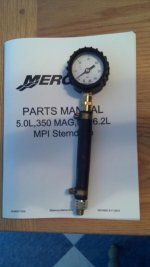
My new pressure gauge.

I found a 1/2 -13 brass stud 3" long. Drilled the center out about 1/8". Installed 1/2" nylon lock washer.
0-30 psi gauge with 1/4" pipe fitting, coupler, 4" nipple.
The two connected together with 1/2" id hose and clamps.

This should screw into anyplace there is a blue plug.


Will test this comming weekend.
What I need now is a long thin handled gizmo to grab to unscrew the blue plug that on the side of the water pump.
There's about 1-1/2" between the stringer and the cool fuel block.
Maybe my long handle hood remover will reach?
Any ideas?


I saw some posts on the sea ray fourm about a new water pump with a replaceable wear plate on the cover.
Anyone seen one yet?

Thanks again!
 
Last weekend I hooked up the mechanical gauge and was reading 5 psi at about 3000 rpm. Limited in neutral by the computer.
I removed one of the psi sensors and there didn't seem to be any blockage at the little hole at the tip.
Is it possible they upgraded the sensor because it wasn't correct?

Rebuilding the pump this weekend with the new composit cover and wear plate.
Also removed the exhaust to clean inspect and repaint. I don't see any restrictions or excessive rust.
It could have something to do with the check valve on the bottom of the manifolds.

How do I get that apart to clean without breaking it?

Thanks!
 
Last weekend I hooked up the mechanical gauge and was reading 5 psi at about 3000 rpm. Limited in neutral by the computer.
I removed one of the psi sensors and there didn't seem to be any blockage at the little hole at the tip.
Is it possible they upgraded the sensor because it wasn't correct?

Rebuilding the pump this weekend with the new composit cover and wear plate.
Also removed the exhaust to clean inspect and repaint. I don't see any restrictions or excessive rust.
It could have something to do with the check valve on the bottom of the manifolds.

How do I get that apart to clean without breaking it?

Thanks!

I have a water pressure gauge plumbed into the thermostat housing of my 7.4 L Raw Water cooled engine. Drilled and tapped an 1/8" NPT port into the housing body where the raw water enters from the hose. When running on the garden hose (I don't use muffs), I get below 2 psi of pressure sensed there, at idle. When in the water, the back pressure of the water makes the pressure go between 4 and 5 psi, at idle. At 3000 RPM, it's 9-10 psi. On the hose, my stbd riser runs a little warmer than the port, but in the water, they are the same. Perhaps the added back pressure of being in the water levels the playing field a bit. And my manifolds are clean as can be expected.
 
Back
Top