Logo

MERCRUISER 3.0L BOGGING ISSUES

JJ Smitty

New member
Hello,
Looking for some help/suggestions. I put a new head on my Mercruiser 3.0 (had a hole in the head on #2 Cylinder). block is fine and all cylinders have compression.

Timed it with ear muffs in the driveway to +1 degree at TDC in base timing mode, removed it from base timing mode -now it's +12 degrees and sounds good on earmuffs. -per internet and my Seloc book....

Took it out on the water (2x now) for a test under load and it bogs down and won't get up on a plane. I took it home, retimed it and checked for anything else I could have missed and can't figure out anything else it could be. lifters are tightened down about 1/2 turn past lash - was afraid i'd over tighten them so i went to lash then 1/2 turn more.

All 4 cylinders have spark and compression...
Didn't remove distributor during swap out
Replaced distributor and points 2 years ago still looks good and no visible cracks.

Hoping someone has a thought I could try.

Thanks for looking.

Jeff
 
You don't give us any data regarding year. So, I assume since you refer to it as 3.0L it's mid 80s or newer.
*Shift mechanism is bolted to valve cover?YES/NO
*IF yes above then you most likely tampered with it during your head work.
I'd verify the shift interruptor switch is not being depressed when shifted into forward gear. If it is, you probably stuck in base timing of approx 1 degree ATDC vs the 20 plus BTDC you should be running during normal operation.
 
You state above:
"Didn't remove distributor during swap out." *There would be no reason to remove the distributor to pull the head. So OK here.

"Replaced distributor and points 2 years ago still looks good and no visible cracks." *You replaced what 2 years ago?

I assume you mean DISTRIBUTOR CAP & ROTOR. I do not believe conventional points & condenser ignition system ever used a BASE TIMING mode. I don't even see how it could be possible to alter the timing from normal to base. These old units just shorted the ignition to ground to momentary shut it off & cause a drop of RPM.
Anyone correct me if I'm wrong.
 
Not worth guessing until he fills in all the blanks he missed in his post.

1. What year is your boat.
2. What is the serial number of the engine. Is engine the original to boat?
3. If SN is unknown, what ignition is used? Points and Electronic are different and there are a few Different 4 cyl electronic ignitions used.

So START OVER TO MINIMIZE UNEEDED QUESTIONS
 
You state above:
"Didn't remove distributor during swap out." *There would be no reason to remove the distributor to pull the head. So OK here.

"Replaced distributor and points 2 years ago still looks good and no visible cracks." *You replaced what 2 years ago?

I assume you mean DISTRIBUTOR CAP & ROTOR. I do not believe conventional points & condenser ignition system ever used a BASE TIMING mode. I don't even see how it could be possible to alter the timing from normal to base. These old units just shorted the ignition to ground to momentary shut it off & cause a drop of RPM.
Anyone correct me if I'm wrong.
Sorry. Its a 2003 3.0 mercruiser. I’ll add some pictures tomorrow. They are too big on my phone to upload.its got two white wires out of the distributor to put it in base timing mode. You are incorrect and correct. It also has a shift interruptor. You disconnect that as well when setting the timing.
 
All Mercruiser #1 drives from 1965 EZ Shift models thru current day Alpha gen2 use a shift interrupting system. Earlier systems used a system that shorted the coil negative momentarily to ground to cause a misfire. Later systems used a system that retards the ignition timing to briefly slow the engine.

Net result is the same, engine briefly slows, reducing the force required to pull the shift clutch apart from the corresponding gear.

However with the early system, if the lower cable is bad or too much travel is adjusted into system, engine dies instead of misfiring.

With the later system the same faults will cause the ignition to stay on base timing with a huge reduction of power. But the engine will run & get you home slowly.

Also with the later system, if the interruptor switch fails, sometimes engine vibration causes it to randomly make contact & cause engine to surge even if cable adjustment is perfect.
 
Below are images
1. Is this your distributor? If so it is called the DELCO EST Ignition. Now you know.
2. This image is the Advance curve in graph form for this ignition with 3 notes based on engine serial number for Base timing settings with 3 Notes for 1* BTDC, 1*ATDC and 2 *ATDC

If you look at the graph, It shows normal operation including "base" timing of ~ 12 * BTDC which you report as true. If you rev engine in neural with a timing light connected to 3000 RPM, You should see the timing advance to between 21* and 26* BTDC depending on what your Jumpered base timing was set to. For you , you said 1* BTDC so 23* +/- 2* BTDC.
One image shows the three different base settings and advance specs based on ****serial number.

If the timing does not advance, Then the Ignition control module may be the fault. One of the images shows which part the module is and where it is located.

4 cyl Delco EST elctronic ignition.jpg


EST PARTS Identification.png


EST descrition of operation.png


4 cyl EST timing advance info and graph.png


Timing addvance specification.png
 
Last edited:
0M645030 Is the serial number.
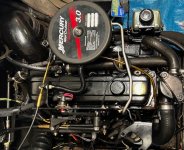
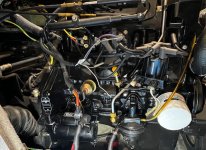
2003 motor. pics of it are attached
Hello,
Looking for some help/suggestions. I put a new head on my Mercruiser 3.0 (had a hole in the head on #2 Cylinder). block is fine and all cylinders have compression.

Timed it with ear muffs in the driveway to +1 degree at TDC in base timing mode, removed it from base timing mode -now it's +12 degrees and sounds good on earmuffs. -per internet and my Seloc book....

Took it out on the water (2x now) for a test under load and it bogs down and won't get up on a plane. I took it home, retimed it and checked for anything else I could have missed and can't figure out anything else it could be. lifters are tightened down about 1/2 turn past lash - was afraid i'd over tighten them so i went to lash then 1/2 turn more.

All 4 cylinders have spark and compression...
Didn't remove distributor during swap out
Replaced distributor and points 2 years ago still looks good and no visible cracks.

Hoping someone has a thought I could try.

Thanks for looking.

Jeff
Additional info and photos of the engine for reference.
-Tried to answer all questions below.
Droids posts answers - and Kghost for year and model info
-Serial # is 0M645030
-2003 Bayliner 195
-Replaced head, timed the motor as described above. +1 degrees is what i timed it to. After taking out of base timing mode timing adjusts itself to +12 degrees (as stated it would be plus or minus 2 degrees) in SELOC book.
-shift mechanism is bolted to valve cover
-I misread night about verifying the shift interrupter switch not being depressed and manually moved the shift interrupt switch and didn’t use the shifter -will check that and update. *i bought a new interrupter switch and will check for voltage to see existing one is working*.
-on idle at 750 rpm its +12 degrees so its not stuck in base timing.
-Seloc book said not to remove distributor from block-I didn’t so i thought I’d mention it.
-Sorry my nomenclature is off. Rotor and cap.

-images post from kghost
-yes it is the distributor
-diagram with curve info Serial # break is #3 0L341000 and above.
-timing did indeed advance
 

Attachments

  • IMG_3440.jpeg
    IMG_3440.jpeg
    150.2 KB · Views: 3
  • IMG_3435.jpeg
    IMG_3435.jpeg
    216.9 KB · Views: 3
  • IMG_5967.jpeg
    IMG_5967.jpeg
    256.8 KB · Views: 4
  • IMG_5888.jpeg
    IMG_5888.jpeg
    168.2 KB · Views: 4
Below are images
1. Is this your distributor? If so it is called the DELCO EST Ignition. Now you know.
2. This image is the Advance curve in graph form for this ignition with 3 notes based on engine serial number for Base timing settings with 3 Notes for 1* BTDC, 1*ATDC and 2 *ATDC

If you look at the graph, It shows normal operation including "base" timing of ~ 12 * BTDC which you report as true. If you rev engine in neural with a timing light connected to 3000 RPM, You should see the timing advance to between 21* and 26* BTDC depending on what your Jumpered base timing was set to. For you , you said 1* BTDC so 23* +/- 2* BTDC.
One image shows the three different base settings and advance specs based on ****serial number.

If the timing does not advance, Then the Ignition control module may be the fault. One of the images shows which part the module is and where it is located.

View attachment 37405

View attachment 37406


View attachment 37407


View attachment 37408


View attachment 37409
replied with info
Not worth guessing until he fills in all the blanks he missed in his post.

1. What year is your boat.
2. What is the serial number of the engine. Is engine the original to boat?
3. If SN is unknown, what ignition is used? Points and Electronic are different and there are a few Different 4 cyl electronic ignitions used.

So START OVER TO MINIMIZE UNEEDED QUESTIONS
added info and pictures -not sure if you get a notice if I don't reply directly to your reply.
thanks,
JJ
 
Sorry. Its a 2003 3.0 mercruiser. I’ll add some pictures tomorrow. They are too big on my phone to upload.its got two white wires out of the distributor to put it in base timing mode. You are incorrect and correct. It also has a shift interruptor. You disconnect that as well when setting the timing.
added pictures and replied to your questions on the post with the pics i added. Thanks for taking the time. I do appreciate it.
 
Its not the 12* thats the issue. The issue is, Does it advance to 23*+/- at 3000 rpm????

If that does not happen you wont get over 2000- 2400 rpm
 
Your timing goes to 12 BTDC because you are checking it in NEUTRAL. If your shift cables are misadjusted or the lower cable is binding then when you shift into gear the interruptor switch is being depressed & putting you back into base timing.
 
Your timing goes to 12 BTDC because you are checking it in NEUTRAL. If your shift cables are misadjusted or the lower cable is binding then when you shift into gear the interruptor switch is being depressed & putting you back into base timing.

Are you sure of this for a carbed engine?
 
I'm having to dig into the archives of my old days brain, but I am virtually certain.

Regardless, easy to check. With engine OFF and an assistant at the prop, shift into full forward gear while the assistant rotates prop counterclockwise until it locks. Visually check shift interruptor switch to see if it is depressed.
 
I will be home in a bit and will pull it out and run thru all of these. Thanks for the suggestions. I have a shift interrupter from amazon that should be there when i get home too.
 
The shift interrupter controlling B+ to the EST module has been the process for over 30 years...pretty sure it goes back further than that if you look at the original DELCO installation guide...
 
I'm having to dig into the archives of my old days brain, but I am virtually certain.

Regardless, easy to check. With engine OFF and an assistant at the prop, shift into full forward gear while the assistant rotates prop counterclockwise until it locks. Visually check shift interruptor switch to see if it is depressed.
Put it in forward all the way down, turned propeller counter clockwise about 4 inches. It was already locked. Checked interruptor and its in the center not depressed. Put it in reverse and the interruptor went up and depressed in. Put it in forward and it went to the middle only - not depressed again.
 
Oh those Amazonian parts will most likely add to your problems.

Checked the voltage to the existing shift interruptor and its getting power, disconnected and depressed the interruptor with a voltage meter for continuity and power was flowing thru it… sticking with the existing one.
 
The shift interrupter controlling B+ to the EST module has been the process for over 30 years...pretty sure it goes back further than that if you look at the original DELCO installation guide...
I want to be clear and fully understand because even for me there is confusion being added here.

Going back to Points and Thunderbolt IV, V. The shift interrupter switch either shorted the Coil - to ground or the White with Green stripe going to Sensor/ICM to ground, to interrupt the ignition to allow shifting OUT of gear.

What is this B+ to the EST module and how does it work/function? Please be specific and direct. I cannot find a description of operation for the shift interrupt.

The schematic shows at the shift interrupt switch when the switch is engaged the Purple (IGN ON) gets connected to the White with Green stripe but it dos not detail what it is doing to the Purple (IGN ON) circuit?????


Screenshot 2026-07-03 015106.jpg
 
JJ, by shifting into fwd gear you have verified that you are not "over stroking" & causing the interruptor to operate.

However reverse is another story....
So let's start there. To do the same check in reverse you must lock the prop by turning clockwise. THE INTERRUPTOR SHOULD BE CENTERED, NOT DEPRESSED IN REVERSE EITHER.

Now that I have stated the above, this would only put it in base timing when in reverse, NOT FORWARD. Regardless, while not your immediate issue it needs to be fixed.

How to fix it is confusing to type & confusing to read. If I was there showing you the how & why of the initial 6" starting point, the push lower cable in while pulling remote cable out to set fwd, the adjusting stud up the slot to find reverse.......but I'm not.

If you adjust the stud down in the slot you will pull less reverse. Will it correct your over stroke? Maybe, most likely probably. BUT reverse adjustment by moving the stud is the last step in the procedure. And I'm hesitant to just say do it because if any other part of the procedure was done incorrectly moving the stud may screw up forward. There is a geometry between the lever & slot. There is also a range of neutral unlike fwd & reverse which have a closer tolerance.

Now you say you have tested the switch with a meter & it tests good. Go back & read the last paragraph in post #6. I failed to say in that paragraph that the switch can test good statically with a meter but induce a failure when vibrating.

Take your assistant & timing light for a test drive. Hook up the light & watch your timing in real time as you accelerate. Does it advance up into the 20+ degrees BTDC range as expected?
 
First, If the interrupter switch is thought to be an issue with bogging, temporarIly disconnect it or jump it depending on if the switch is NO or NC. If the bogging goes away then your issue is answered. If not follow my information regarding timing full advance.....

No need to go down a ahift cable adjustment issue. He is not having a shift related or reverse issue...at least it should not be involved while in forward gear and bogging.....
 
I understand his perceived lack of power is in forward. Obviously he doesn't come close to reaching full power.
BUT if he is correct & the switch is depressed in reverse then there is a cable or adjustment problem that eventually should be fixed. I'd say almost no one would realise if they had a reduction of power in reverse.

Read this link from 2 years ago, you, alldodge & I were in it....In particular, start at post #24

 
Ya but that was an EFI engine. I am questioning whether the interrupt switch works the same for this carbed engine. Thats why I asked for an explanation in my earlier post with the schematic.
 
Jack - the following applies to an engine with an EST distributor running in stand-alone (no ECU) mode driving an mercruiser

the Shift interrupter switch functions as on the old (points) version but instead of momemtarily GROUNDING the POINTS lead, it momemtarily applies B+ (+12VDC) to the R terminal of the EST module. The application of +12VDC to the R terminal of a running EST module causing any module generating ignition advance to be reset to ZERO.

FWIW, those EST modules can be rather complex to understand due to multiple functions assigned to any given pin. This allows the module to run in stand-alone mode as well as having the same module work with an ECU setting the timing...
 
Jack - the following applies to an engine with an EST distributor running in stand-alone (no ECU) mode driving an mercruiser

the Shift interrupter switch functions as on the old (points) version but instead of momemtarily GROUNDING the POINTS lead, it momemtarily applies B+ (+12VDC) to the R terminal of the EST module. The application of +12VDC to the R terminal of a running EST module causing any module generating ignition advance to be reset to ZERO.

FWIW, those EST modules can be rather complex to understand due to multiple functions assigned to any given pin. This allows the module to run in stand-alone mode as well as having the same module work with an ECU setting the timing...

So the sudden drop in timing equates to the momentary shorting Coil - to ground.

If that is the case, Now I understand!!
 
how long has the fuel been sitting in the boat? was fuel stabilizer added when the boat went dormant?

An outboard (portable) fuel tank can be a great asset when troubleshooting fuel system concerns...
 
Back
Top