Logo

1976 Ford 302 Lower Re-build

Hi Driod, the new gasket was referring to the 6" $60 round exhaust seal. By "open side up", are you referring to the lower housing being right side up, and the upper housing being slid down into the exhaust housing and onto the 6" gasket? Or the other way around, which would be hard, as the bolts are on the top. I wanted to do it vertically, like that, but had some problem with doing that, and put it on sideways, but had it aligned well, I thought.
 
Assume for a minute the upper housing is still attached to the boat.....

Slide the seal onto the bottom flange of upper housing with the wider side 1st. By wider side, I am referring to the fact the seal has some flex to it because it is sort of "V" shaped. So, installed with the open side of the V up. This will put a slight tapered shape narrow point down. Now the lower with the exhaust housing will slip on.

If the entire unit is off boat, with the lower unit & exhaust housing assembly assembled as 1 piece & placed in a stand......
You still install the seal onto the flange of the upper housing as above but now lower the upper unit into place.

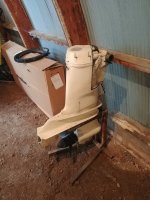
You need a stand like this.
 

Attachments

  • 1010191341d.jpg
    1010191341d.jpg
    622.9 KB · Views: 28
Looking at the table top you are working on - that won't be beneficial to work on, for a shimming exercise....at a minimum I'd suggest getting a piece of plate at least 1/4" thick. Using a drill press table may be another alternative.

Never having done a drive of your type, this is just a WAG...my gut suggest the gauge provides the idea reference height for the stack of parts + normal shim. The caliper, as shown, will introduce a lot of variation in the measurement (due to its tilt). There is also that 'ideal height' and without a lot more precision on the caliper, you will never know where you get there, assuming you can determine that value.
 
It is a bit hard to duplicate what is going on here, so let me try to illustrate and explain. The hub is the only part that is touching the tabletop, so any imperfections in the tabletop does not affect the measurement above, which is the difference between the cup and the bearing and hub, measured by a straight edge, in this case. In this picture, I took the existing .002 circular shim and put it in the area that the shim is to occupy, and it raised the straight edge leaving a space between the bearing, cup and the strait edge, when it should be level, if it is the correct shim. The measurement needed is between the cup and the shimming tool, which I do not have and is not available, so I am showing it with the straight edge. The manual shows a picture of the shimming tool in a similar set-up to the caliper, if you reference my previous picture, and you will also see that the straight edge is level across the three items, which indicates that it shouldn't have any shim, as you use the shim to make it level. The manual also says that you need a minimum of one shim, and not more than two. So, my choice seems to be between using no shim and having the three level; or putting the smallest one available, which is a .002, which I have in my possession, as it says that you should have a minimum of one shim.
So, neither option seems correct, but I have to do one or the other.
Or the levelness may indicate the bearing or the cup is worn down a bit, as the bearing and cup are angled; and I should get new ones, although they appear to be okay. This is probably the only logical explanation, and it's only $30, so I guess that us what I will do, and maybe order an extra .002 shim, in case it comes out with a bigger space. Seem right?


shimming2.jpg
 
I got the new bearing and cup, and they are almost identical to the old - pretty level across them all. I made a mistake on saying the hub is the inside ring, the bearing is the inside two and the cup is on the outside. They are just sitting on top of the hub, which makes me question why they want them placed on top of the hub, unless there is some significance to the measurement of the caliper. But I have no idea what this measurement should be. Does anyone have the old shimming tool or know anything about this. I have a digital caliper that would be more accurate, but it doesn't help if I don't know what the measurement should be. It is reading about 71mm or 2.8 inches

shimming4.jpg
 
Here is the picture from the manual, showing the shimming gauge and the feeler gauge to determine the space between the shim and the bearing cup, and says this space is the thickness of the shims needed. I have no space there using a straight edge, which seems very similar - it looks like the top of the shimming gauge is about level.
So I have the same problem: do I use no shim or use the smallest one because it says to use a minimum of one shim.
Any ideas? My guess is to use no shim.
shimming5.jpg
 
Not having any better data, I think that I should put the pieces together on the drive shaft and see how they align with the housing, taking some measurements on the housing and see if it all seems to fit snuggly. Probably can't get it accurate to a thousandth of an inch, though.
 
I tried putting the pieces together and got nothing conclusive. I guess nobody has any experience with my shimming problem. I realized I was missing a part and ordered it. I guess I will just put it together with no shim???
While waiting I reinstalled the outdrive boot. I checked for any signs of transom rot and found none. The boot was good. Hopefully it doesn't leak this time.
 
My parts came in, so I started reassembling the beast. Not knowing exactly what to do on the shimming, I put in a new .002 shim for the forward gear, like it was before, and banged the rest of the forward pieces in place. I got to the driveshaft and pinion gear and have a problem with the threads on the bottom of the shaft from removing that pinion nut. Having destroyed the previous driveshaft from removing the nut, I was more careful with this one, but I still messed it up a bit. There isn't a new one available on this website, and I tried other sites to no avail. I found one on Ebay for $30, which looks the same, but has a close number, which this website says is not a valid part number. I messaged the sellers to get more specific measurements, and if it looks the same, I will buy it. Otherwise perhaps I can buy a dye and try to rethread it. It only has two or three threads, so there is not any room for error, and I may just destroy it. If anyone has one, part #0980097, let me know.
 
The measurements checked out well on the used driveshaft on Ebay, and it did come off of a 1976 Ford 302 190 hp, same as mine, so it should be a perfect fit, and I ordered it.
 
The driveshaft came in, and it is the correct size, however, it came without the bearing. On the website, the shaft, bearing and cup is shown as one part. I had to buy a bearing separator and a bolt style wheel puller to get the bearing off my old shaft. There was a thin spacer between the bearing and the stop on the shaft that was damaged in pulling, and there is not a separate spacer on the website, and it is smaller than all the other spacers in the lower. It is probably about .002 - .004 thick with a 1" hole and is 1-5/8" wide. I am not sure I have any other choice than to skip it.
The spacers on the website never have the dimensions of the inside or outside, so don't know how I could order one that would fit without a part number.
If anyone has a spacer of those dimensions, let me know, or I may be forced to not use a spacer. Or try to flatten out the damaged one may be the best bet.
 
Let me do some investigating when I get home. I assume OMC shimmed the assembly & sold it as such. I'll measure some shims to get you going in the right direction. Problem is each shaft & bearing is going to be a touch different.
 
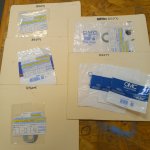
313273 thru 313277 is .003 thru .007
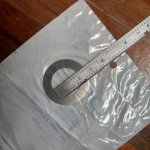
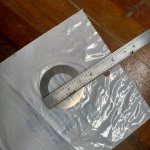
1" ID
1.6" OD
 

Attachments

  • 20251024_032727.jpg
    20251024_032727.jpg
    779 KB · Views: 17
  • 20251024_032622.jpg
    20251024_032622.jpg
    840.7 KB · Views: 19
  • 20251024_032640.jpg
    20251024_032640.jpg
    950.2 KB · Views: 18
  • 20251024_032838.jpg
    20251024_032838.jpg
    954.8 KB · Views: 19
Thanks for the shim, Droid, it fit perfectly! So, I got a chance to bang most of the lower together but am missing a few seals and things. I bought a seal and gasket kit, but it didn't have everything in it. So, another order, another week and I may have it back together and then I will need the new 14-pitch propeller. It is the only reason that I can think of why I destroyed three lowers in about 20 hours of run time. Too high a pitch prop, along with my engine modifications, which according to Grok, may have boosted my horsepower from 190 hp to 239 to 270 hp! It is an interesting read, if you missed it. It is on #12 of this thread on the first page.
The first two broke the forward clutch springs with a 16-pitch prop. And the third was a 17-pitch prop, I haven't opened that lower up yet, but the symptoms are the same - lost forward gear. And the RPMs only got up to about 4200 at WOT, so it was essentially in overdrive and stressed. The 14-pitch prop will shift it into a lower gear and will increase my RPMs, and hopefully not stress the system as bad, and prevent another failure. I'll know for sure when I open it up after my current re-build.
So, I believe it was just too much torque for the system and broke the weakest link. Any other ideas?
 
I got the lower together and filled it with new type C lower gear oil. I also switched the whale tail stabilizer from the broken drive and put it on the re-built lower. Next, I have to take the upper off of the other drive and mount it to the re-built drive. I should also check that grounding spring in the upper, per Droid.
 
I took the upper off of the injured lower drive and I found that the shift cord came apart right above the exhaust housing - two pieces! So that may be my problem there, and not my clutch spring! I did have reverse, so it may have come apart in phases. Those are really hard to find, they are not available on this website, so I may have to see if I can repair it. I saw one, one time on eBay, but not sure if any are still there. I will take off the exhaust housing and see if I can repair it. If I solder the connection and insulate it well with silicon RTV caulk and shrink tubing, then test out the drive to see if the forward and reverse engage, it may be okay!
 
The shift cable is now available on this website, and I found some on eBay, too. They start at $200, so I will finish off my rebuild and get it on my boat and then experiment with a repair of the cable and see if the lower functions.
 
I finished mating the upper and the lower and touched up the paint and it is pretty ready to go back to work. I need to get the 14x14 prop, so the unit isn't stressed. I did check the grounding spring, and it was there and followed Droids directions to mate the upper to the lower, so hopefully will not have an exhaust leak between them. With the whale tail stabilizer, I was able to keep the unit fairly upright through this procedure.
I need to finish off a few projects on the boat that I started, so will be a few weeks until I can take it out.
 
Just an update: I mounted the outdrive back onto intermediate drive and got a new beautiful 14x14 Michigan Wheel prop from Droid's inventory. After putting the boot back on, I decided to test it out by putting some water in the bilge - big mistake! I must have gotten too much water in there as the starter and the tilt motor now don't work - probably flooded. So, today, I took off the outdrive and boot to get the tilt motor out. It is also easier to take out the starter and pulled both of those and cleaned them up. The tilt motor was wet on the inside, as I opened it a bit to vent it. I cleaned up the connections on the starter, and I tested them both in the shop and not an inkling of movement. I kind of expected the solenoid on the PGMR starter to click, but it didn't.
So, a new starter is about $175, and the tilt motor is about $225. This will be my 4th new starter and my 3ed new tilt motor, with very few hours on them.
My plan is to first see if I can dry out both of them by putting them in the oven on warm for a few hours and then re-test them in the shop. If no joy, the I fork out the $400 for new ones. I have tried auto electric shops, but they don't re-build starters any more. Maybe check around for some old school shop that still may rebuild it - only has a couple hours on it.
The moral of the story is: Keep your boat as dry as possible.
 
I understand you put water in hoping to find the leak but....
Depending on how deep your boat sits, the electric shift harness where it passes thru the intermediate drive may be under water. The ribs are supposed to snap it into place but typically old cables become loose. It's never been an issue for me because I have a High Profile drive. So it's 4" higher. You may need some silicone smeared onto it as you pull the last rib in.
 
I had them both in the oven at 250 degrees for three hours and hooked them up to a battery and got nothing. I tried the ground in several places.
So, on the new ones, I am going with DB Electrical at half the cost, as the last two of both were Arco and didn't have that good of a result, and I'm bit short on cash. $200 sounds a lot better than $400 - probably made in China.
 
You just can't catch a break. I think IF the shift harness is leaking it will run down right onto the trim motor.

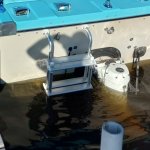
This is the depth mine sits at.
 

Attachments

  • 20240614_175734.jpg
    20240614_175734.jpg
    163.2 KB · Views: 13
Back
Top