Logo

2007 F115 starter relay position and how do you "jump it"?

The F115 starter motor can draw upwards of 260 amperes. If you are going to bypass the solenoid and power the motor directly you want to use a large cable to do so. Be prepared for some sparking. Possibly welding your cable to the terminal.

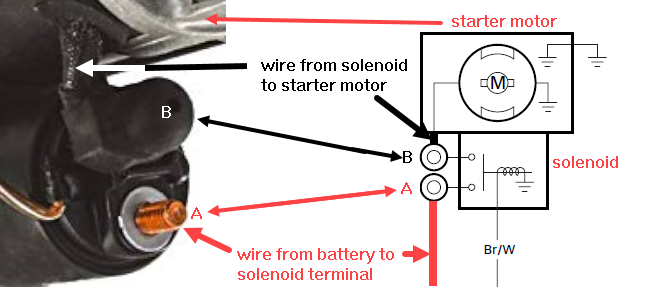
The large red wire to the solenoid is connected to the battery. You would apply battery power to the other solenoid connection. The one that runs over to the starter motor.
looks like you sent this when I was working on my last post with the pic of the starter/ large R wire. Why couldn't I just disconnect the large R wire and then apply 12v using jumper cables from one of my batteries? (this is assuming the other ways to test don't work, i.e. the relay is bad or the solenoid is bad)

I don't see the "other" solenoid connection only the large red one and a small red wire coming in from the right and looks to be attached underneath the large red wire connection.

it's late here and I think I'll hit the sack.

Thx again and I'll know more tomorrow if the rain stops.
 
I thought a short was a direct path for battery positive to a ground?
True, well short across solenoid to starter -- so short the solenoid to jump the starter?? Details often miss the page, I short myself, there is a shorthand version concocted by my brain for the fingers dictation, not to mention procedural stuff getting cannibalized by redneck colloquialisms burned to memory at my uncle's shop as a kid.
 
I completely understand the difficulty of reading wiring diagrams. Or trying to correlate a diagram with the wiring on an actual motor where stuff is hidden and not what it seems to be.

And it is even more difficult reading and understand written words. You to me. Me to you.

Certainly you can power the starter motor directly. But you don't apply it to large R point on the solenoid. If you measure that point there is already battery voltage there. When the solenoid is activated the battery power from the R point side of the solenoid goes over to the other side. And then it goes on to the starter motor itself.

Apply the power just long enough to make the starter motor turn. A nanosecond or two.

 
True, well short across solenoid to starter -- so short the solenoid to jump the starter?? Details often miss the page, I short myself, there is a shorthand version concocted by my brain for the fingers dictation, not to mention procedural stuff getting cannibalized by redneck colloquialisms burned to memory at my uncle's shop as a kid.
A short to me indicates that a ground is involved some way some how.

In the case of the starter motor it has a ground by virtue of being connected to the block with the block being connected to the battery negative post.

Jumpering battery positive to the starter motor is how I would describe what the OP is thinking of doing.

The solenoid is doing more than just energizing the starter motor however. It also activates the Bendix drive. Applying power (battery positive) directly to the starter motor will not be testing everything that might need to be tested.

Test procedures are usually set up in a sequence for a reason. But there are many different ways to go about it. Some will just remove and replace the starter motor assembly. Splattergunning it is known as. They often wind up with many perfectly good spare parts.
 
The F115 starter motor can draw upwards of 260 amperes. If you are going to bypass the solenoid and power the motor directly you want to use a large cable to do so. Be prepared for some sparking. Possibly welding your cable to the terminal.

The large red wire to the solenoid is connected to the battery. You would apply battery power to the other solenoid connection. The one that runs over to the starter motor.
"to the other solenoid".
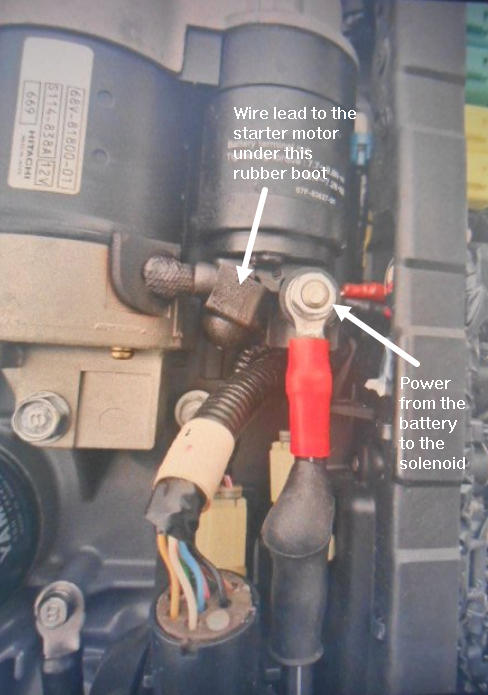
are you talking about the acorn looking "nut" just to the left of the large R wire on the solenoid?
 
"to the other solenoid".
are you talking about the acorn looking "nut" just to the left of the large R wire on the solenoid?
so I went out to see what the "acorn" looking part was and it's a rubber boot over another electrical connection on the solenoid. I think this is the other solenoid connection you were sying to apply pwr to instead of to the large R (batt) wire). Yes?
 

Attachments

  • DSCN0913.JPG
    DSCN0913.JPG
    124.6 KB · Views: 85
so I went out to see what the "acorn" looking part was and it's a rubber boot over another electrical connection on the solenoid. I think this is the other solenoid connection you were sying to apply pwr to instead of to the large R (batt) wire). Yes?
I am not saying for you to apply power directly to the starter motor. That seems to be what it is that you want to do.

I am just telling you how to do what I think it is that you want to do.

That is not what I would be doing.
 
no, not really. I'm trying to figure out the best way to see if the starter or the solenoid or the relay is the problem. I was just thinking if using the br/wt wire jump test doesn't work what else can I do. I'm not experienced in this as obviously you are. However I am mechanically inclined and work on my cars, mowers, etc w/i my ability and avail tools. I'm not going to go out and purchase a $500+ tool that I'll only use once for example. In that case I would bring the problem item to someone who has them.

I think i can figure this out, I just need to know what/how to do it and want to understand the starting system. I don't want to start the engine, I just want to see if the starter works.

Now that I know that the large red wire on the solenoid is 12v from the battery, I could test it with my multimeter and see if pwr is getting to that point. if not then I would think it's downstream (relay, corrosion, etc)? if yes then it would seem the solenoid is faulty?

This post has gotten long ( a good thing for me) but my original issue was the starter wouldn't activate when I tried to turn the eng. over to distribute the fogging oil I put into the cylinders because it has sat for yrs. (I did it by turning the flywheel by hand with the plugs out)

All I heard was a short "clunk" then next attempt a short "buzz" from somewhere on the engine. I found that the bendix was stuck up on the flywheel and I had to tap it free/down with a rubber mallet. No telling how long the bendix was stuck up. Maybe the starter was being turned by the eng. for quite some time when dad had it before i got it from him.....


thx again, and i do appreciate your patience.
 
I would start by applying battery + to the brown/white wire. The solenoid should close. The Bendix drive gear should jump up. The starter motor should turn the flywheel.

If not, come back and let's talk.
 
been a few days since last post, weather and a medical procedure got in the way.....So today I went out and removed the br/wt wire from the relay.
Using my car jumper cables I connected my fully charged battery to the wire. The bendix jumped up and "stuck" in the flywheel. The engine did not turn over. I tapped the bendix down and tried 3 more times. Same thing. I then removed the spark plugs to eliminate any compresion and the same thing occured. It's not in gear or seized as I can turn the engine over by hand using the flywheel.

Sounds like a starter issue? The bendix was up when I started this whole post so it had to be stuck up when dad had it and maybe the engine was turning the starter for who knows how long? In any event, the engine didn't turn over and all the starter does is go "clunk" when the bendix goes up and sticks up on the flywheel
 
Now it is time to test the voltage at the starter motor when you jumper the solenoid.

Either the starter motor is defective (does not have the power to rotate the motor) or there could be a loss of voltage to the starter motor.

You could also use your battery and jumper cables to power the starter motor. Then jumper the solenoid. If the result is the same I would suspect the starter motor has failed.
 
I'll check voltage at the starter first when I jump the br/wt wire again. I check the voltage at the starter (selenoid) at the large red wire which comes from the battery, yes? (post#37, point "A") or check at "B"? Couldn't you check both? "A" to see if I'm getting voltage from battery and "B" to see if voltage is going from selenoid to starter.....?

If I try to power the starter using my jumper cables I would connect to the wire/connection that goes from the selenoid to the starter (post #37 pic, at point "B"?

thx again.
 
well I don't know if you gave up on me, on vacation, or sick but I think the starter is bad. I applied 12v to the br/wht wire and then checked all the leads (red) at the starter, solenoid and the one that goes from the selenoid to the starter. I got "OL" on my multimeter at all points. I only had power applied for maybe 30secs and the starter itself was warm and the solenoid was almost to hot to touch. The only thing I haven't done that I can think of is to check for continuity on the solenoid and starter tomorrow.
 
I'm going to try one more time but I have a feeling you gave up on me. I pulled the starter and tested it in my woodxxxx. When I apply voltage to the Br/W solenoid wire the bendix jumps up and retracts after removing power.
when I apply power to the wire that goes from the solenoid to the starter; the bendix gear turns quicky. so it seems to bench test ok but when on the engine won't turn it over. Maybe it doesn't have enough pwr to turn the engine over? i.e. it's basically failed?
 
Back
Top