

Logo

Aluminum Hull Repair - Preparing for Weld - Starcraft Islander

theydrewa31

Regular Contributor
Hello Gents,

Working on a full restoration on a Starcraft Islander 221V and I just want to make sure I am on the right track.

Bringing you up to speed. It is an 88, has the GM 4.3. Just about everything in the boat has been removed, deck, foam, seats & cushions, steering wheel. The transom has been dis-assembled, and the old wood has been removed for replacement, outdrive has been removed and engine as well.

So here is where the reason for question begins. The previous owner attempted to fix the problems he was having with the transom (weak and leaking) without addressing the cause of the issue. He welded up the cracks that had formed under the transom shield but did not replace the rotting and softened wood in the transom. It looks to me like the original weld failed and he tried to weld it again, this time adding two plates (shown in photos) over the old welds in hopes of adding some strength. That failed because again they did not fix the rotting wood in the transom. I assume the second weld was done by a different person because bead on the secondary weld looks much more uniform. Additionally some new smaller cracks began to form where the plate had been welded to the transom. I assume because without any wood behind the aluminum in that area it flexed tremendously, causing tearing of the aluminum. In what I assume must have been an act of desperation he smeared JB weld over everything and spray painted it.

Here are the original welds and plates that had been added.
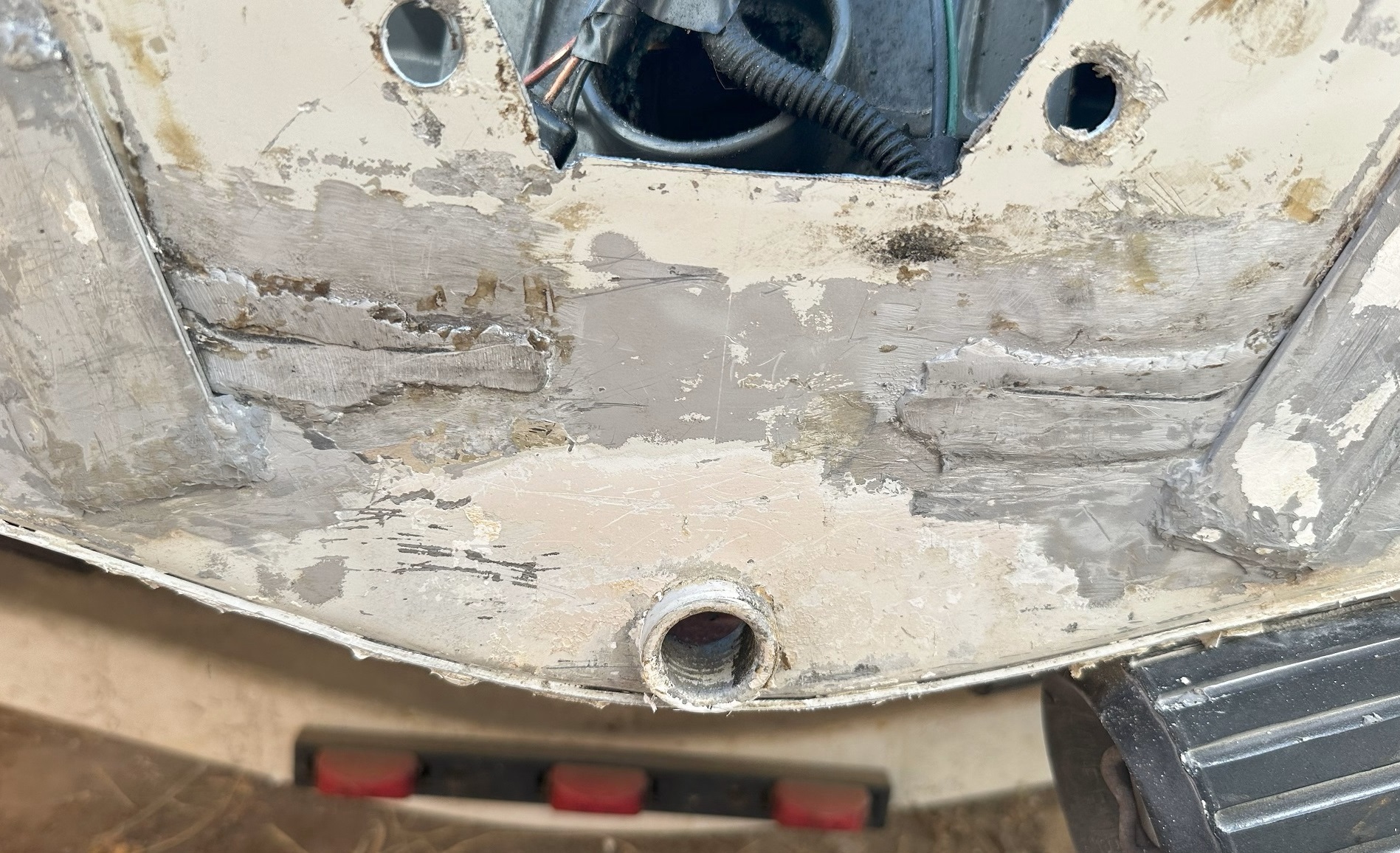
Plates1.jpg


This is going to take a few posts to get all of the pictures included, sorry fellas!
 
So I decided to move forward with the repair of the transom. I have a welder coming on Thursday. Here is the metal after it has been prepped. I highlighted the two smaller cracks that had started to form around the upper edges of the plates that had been welded over the cracks.
Cleaned Metal.jpg
 
Here is what the cracks looks like from inside the boat.
Crack Inside.jpg


And this one shows the same crack from a different angle so you can see how the cracking area is bent inward slightly.
Inside buldge.jpg
 
So here is my question and where I am looking for advice.

  • Am I on the right track with repairing this aluminum?
  • When I have the welder here is there anything that I need to special request?
    • Plates welded over top?
    • Cut out the old metal and weld in fresh?
    • Just weld up the cracks really good?
  • Am I correct in assuming that with the fresh transom wood, and a fresh weld that this shouldn't tear again?
  • After the old weld is completely removed can I tap the crack from the inside with a hammer to flatten it?

I have loads of experience with metal and mechanics and body work, but this is my first time working with aluminum like this. Any advice is greatly appreciated!! Thanks in advance Gents!


And for all of those people asking out there if you can use JB weld, or asking if you need to replace old transom wood? Well this is the photographic evidence that:
  1. Thou shalt not use JB weld on thy hull.
  2. Thou shalt replace thy rotted transom wood.
 
I am also curious about a similar topic. If you have holes in the hull from accessories that are no longer there (in my case they are from a swim deck that I removed) what is the preferred way to fill those on an aluminum hull? I have seen that some people rivet a plate over the hole and seal it with 5200? Is it preferable to weld a plate over the holes? Does the method change based on the size of the hole?

Also, does Starcraft use 5052 aluminum?
 
If the transom is flat, I'd be inclined to weld in a new panel...that said, if you trust the welder then go with his suggestions. I think you have a good handle on the problem.

I would also suggest using a piece of marine grade plywood for the replacement...and to laminate it with epoxy as required. I would also ensure the seams of the plywood are epoxied. Its more work but any bolt holes going thru the plywood would benefit from a swab of epoxy to keep any water out of the wood. anything you can do to keep the plywood-aluminum joint together will go a long way to preserving the repair.

for filling the unneeded small holes, rivets are easy and fast as long as you have access for installation....I've also seen truss head screws and nuts used with 5200...welding should work but will take more work to finish. I'd think any large holes have structural impact would require a plate to maintain the integrity of the panel...i can't imagine anything with a swim platform fitting into that category...
 
If I was the welder I would cut out the old and weld new piece in if good u can make it look factory as for hole a plate will do but for me I'd fill in hole while welder is there he can build it up then grind down flush where r u located I'm in Nampa idaho
 
If the transom is flat, I'd be inclined to weld in a new panel...that said, if you trust the welder then go with his suggestions. I think you have a good handle on the problem.
It is flat. I will ask his suggestions. I just wanted to get some input from you guys first because he does not know very much about boats. I am sure he can tell me what he thinks is strongest. I just want to make sure I am doing things in line with common practice if you know what I mean. I am definitely leaning towards a fresh plate being welded in.

I would also suggest using a piece of marine grade plywood for the replacement...and to laminate it with epoxy as required. I would also ensure the seams of the plywood are epoxied. Its more work but any bolt holes going thru the plywood would benefit from a swab of epoxy to keep any water out of the wood. anything you can do to keep the plywood-aluminum joint together will go a long way to preserving the repair.
I already have the epoxy in the shop ready to go. As soon as the weld is done I am running to the lumber yard to pick up the ply. I was considering using Titebond III in between the sheets to try to get a little more mileage out of the epoxy. Is that a bad idea? I already have the Epoxy hardener to use it as a laminate, so that is not a problem. I just didn't know how much Epoxy I would need. I have 2 gallons on hand right now. Do you think that will be enough? I'll post a photo of the boat so you can see size and shape of transom. I'm doing 2x 1" sheets for a 2" thickness.

Good Idea about sealing the holes with epoxy. I am going to do that for sure!
for filling the unneeded small holes, rivets are easy and fast as long as you have access for installation....I've also seen truss head screws and nuts used with 5200...welding should work but will take more work to finish. I'd think any large holes have structural impact would require a plate to maintain the integrity of the panel...i can't imagine anything with a swim platform fitting into that category...
All of the holes I have are small. Some of them were plugged poorly with the dowel method before I got the boat. Ranging anywhere from 1/8" to penny size.

Thanks for your reply Mako!
 
If I was the welder I would cut out the old and weld new piece in if good u can make it look factory as for hole a plate will do but for me I'd fill in hole while welder is there he can build it up then grind down flush where r u located I'm in Nampa idaho
I think I am going to ask him to do a fresh plate and see what he says.

So you think I should prep all of the small holes for weld as well? Do welders usually charge a bunch for something like that? I would have everything immaculately prepped before he arrives. What is the limit to the size hole that can be filled and ground down before you would have to weld in a plate instead?

where r u located I'm in Nampa idaho

I am in San Diego currently but not sure where I will be living this time next year. San Diego was just ranked 11th most expensive city to live in the world. May family is in Eagle. I'll be in that area sometime in the next few months for a visit.

Thanks for your help Irie!
 
Depends on welder but for lil holes not to much aluminum is hard to weld can burn thru easy but good welder it will be fine u shouldn't have to prep anything the welder should do it
 
Depends on welder but for lil holes not to much aluminum is hard to weld can burn thru easy but good welder it will be fine u shouldn't have to prep anything the welder should do it
I just thought it might help me get the cost down. Do welders prefer to do the prep?
 
yes, in my experience....as soon as you abrade the surface, its starts to oxidize....it the surface is real ugly, you can do the bulk of it but always leave a little for them to make 'fresh' before they start...

your two gallons should be enough
 
yes, in my experience....as soon as you abrade the surface, its starts to oxidize....it the surface is real ugly, you can do the bulk of it but always leave a little for them to make 'fresh' before they start...

your two gallons should be enough

Thanks! I'll laminate them with the epoxy. Not worth taking chances!
 
I wish my welder mentioned when I said I was going to start grinding off the plates. Oh well! haha, can't go back in time but I won't grind, blast or sand anything else unless he asks me to. Honestly he strikes me as a younger fella.
 
Hopefully he is good I have a 25 yr old who's only been welding for 4 yrs and he's a badass got his 6g .. lol taught him everything he knows
 
The welder came today for quote. He was suggesting we hammer it flat, drill holes at the ends, bevel it out, weld the cracks, then weld a fresh plate over top everything on the outside for extra reinforcement. He seems to have an aversion to wanting to cut out a section and patch it. Does that seem right with you guys?
 
Also, he wants to charge $450.00 and is basically throwing in the half a dozen smaller holes that I need filled. Does that seem on par? To give you an idea of scale, in this state of California fast food workers make a minimum of $20 an hour.
 
I don't think his approach will have any issues...just make sure you understand the transom (physical) requirements for the drive you put back in there... nothing like a solid repair job that needs a do-over because something is too small/not wide enough/too thick/etc...

based on your location, I'd say that price is a steal...
 
Mako you are a life saver! Where he was going to put the plate would have made an uneven mating surface for the transom shield. I owe you big time!
 
I just got off the phone with the welder. I explained that the transom shield needs to mate to a flat surface and he said that adding the plates was a little on the overkill side anyways. A luxury but not necessary. He recommended that we flatten the area and we only fill in the cracks, then grind them flat. I feel like this particular transom gets most of its strength from the wood underneath the aluminum.

The aluminum has an insane amount of flex to it now that there isn't any wood in there. I feel like there is an inch of deflection or more if I push and pull on the aluminum sheet. My logic says that with the amount of flex there is in the aluminum, it's there as a nice strong skin, and the transom wood bears the force of the outdrive. All of that said, should I worry about the crack opening back up? Or do we think that having a nice solid wood backing in there will stop that from happening again? Keep in mind that the wood on the other side of these cracks had completely rotted away and there was literally no wood in that area on the inside of the transom. So the initial cause of the issue was a lack of support from the inside.

So to boil it down, my question is whether or not simply welding up the cracks seems like a reasonable solution? My initial thoughts are to trust the professional, I just want to make sure I'm not going to be kicking myself later on.

Another note: This boat is absolutely sucking my wallet dry. Cutting out the cracks and welding in a piece of fresh metal will be more expensive, so saving some coin by going with his recommendation would be nice for me if we think it will hold.

One final note: The welder worked for a short while on aluminum boats in Alaska. Aluminum boats are preferred up there because of the ice.

Thanks again guys! I really appreciate your help!
 
I would say as long as you can get the appropriate piece(s) of wood back in there and keep the bonded "sandwich" tight and dry, you should be ok...

Yes, restorations almost always cost more than the initial estimate due to the unknowns....
 
Hey him welding cracks and grinding them down is how I would do it the flatting out part don't understand does bottom of boat have some sort of grooves and price is good for where ur at
 
Back
Top