Logo

Mercruiser 120 lower unit

Ghg

Contributing Member
I have posted in the past regarding my 1967 Mercruiser 120 having a crack in the bottom of the outdrive, I have thought about repairing it but I have picked up a lower unit housing, what is all involved to change everything over from the damaged lower unit to the new housing? I understand there are special tools and shims that need to be used, I am pretty mechanical and was wondering if I can do this myself or leave it up to the ones that are more familiar with this procedure. How much would a shop generally charge to do so?
 
I have posted in the past regarding my 1967 Mercruiser 120 having a crack in the bottom of the outdrive, I have thought about repairing it but I have picked up a lower unit housing, what is all involved to change everything over from the damaged lower unit to the new housing? I understand there are special tools and shims that need to be used, I am pretty mechanical and was wondering if I can do this myself or leave it up to the ones that are more familiar with this procedure. How much would a shop generally charge to do so?
There are some expensive special tools required, which I am guessing might cost you as much as half of what you would pay a pro to just do the job. So there is that to consider.

The job itself is similar in difficulty to rebuilding a manual transmission for a car, if you have ever done that. Not as hard as rebuilding an automatic transmission.
 
Thanks for the reply, I have looked at the necessary tools, like you said, they aren’t cheap. I have rebuilt my Muncie M-20 trans, but didn’t really require as many special tools as it would take for a lower unit rebuild. The shimming part confuses me.There’s nothing like self gratification of doing something yourself though.
 
That’s what’s scares me, to have to do it all over again. Might cost me double the cost of having it done. lol
 
Figure three hours if the old stuff comes apart easy and is in good shape....you will also need seals and a water pump kit...and then there is the potential for worn parts that will need to be replaced...
 
Thanks for the reply, I have looked at the necessary tools, like you said, they aren’t cheap. I have rebuilt my Muncie M-20 trans, but didn’t really require as many special tools as it would take for a lower unit rebuild. The shimming part confuses me.There’s nothing like self gratification of doing something yourself though.
If you have done a Muncie or set up rear diff gears and you have the merc specific tools and factory manual you will have no issue.

I was able to find the tools used on ebay for about half cost. seemed like there were a few people who probably used the tools once or twice selling them...

As mako mentions getting it apart will be the issue. I had to use a lot of heat to get the bearing retainer nut out.

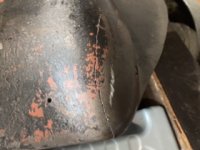
Where on the drive is the crack. On and old drive the water intake compartment had freeze cracked assume due to clogged drain hole, was able to JB weld it and worked for years since it wasnt in to the gear case.
 
I have the factory manuals, it looks like I only need a few tools to tear into it. I don’t think the drain hole was clogged, It was because of water entering and sitting over the winter and freezing. The crack appears pretty long.
 

Attachments

  • 09A78D3B-2162-465D-AE87-C6D1FDC8F1EF.jpeg
    09A78D3B-2162-465D-AE87-C6D1FDC8F1EF.jpeg
    34.8 KB · Views: 35
If it ran and then sat with the forward bearings in the water, I don't think I would use the internals...that said, if its only a 120 (4-cylinder) spinning the shaft, you may be able to get away with it...
 
I have the factory manuals, it looks like I only need a few tools to tear into it. I don’t think the drain hole was clogged, It was because of water entering and sitting over the winter and freezing. The crack appears pretty long.
no where I am talking about is up by the water inlet holes on the sides of the drive. I would agree with Makos comments if you got water inside the gear case your internals will probably be rusted. You can probably tear it down without too many tools but you may find the shafts are no good.

You may run up that the costs for parts starts tipping you into the same cost as a bolt on SEI lower. That assumes the upper doesnt have damage from water intrusion too.
 
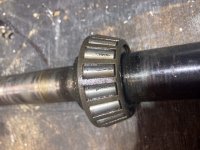
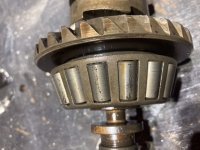
I have removed all the bearings and nothing seemed to be rusted, so I’m gonna go ahead and have the original outdrive welded. There are some stains on the bearings and cups though, wonder if I should be concerned.5519827F-592E-49DB-80AC-E82A90C64750.jpeg799DE9B6-147C-4738-82F4-BB5AFE96B811.jpeg28188330-5960-486D-947E-4DA3536466B7.jpegDA54388C-4216-4A66-974E-5166B420681C.jpeg
 
The bearings are junk. You will need the tools for pulling the races from the case, installing & shimming.
You don't show a picture of the pinion bearing & driveshaft lower surface.
 
Also, you don't show prop shaft & bearing just behind the prop seals. This picture would also show me if you are truly dealing with 1967 thru 1969 prop shaft & bearing carrier.

Show drive shaft splines too so I can identify better.

It is certainly possible the original unit was replaced with 1970 thru 82 model in the past 55 years.
 
Assuming you truly have a 1967 gearcase with interconnected oil chambers, you best better check upper end by at least removing the cover & inspecting what you can see from there.
 
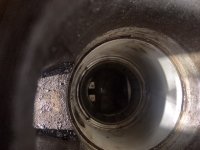
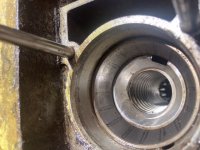
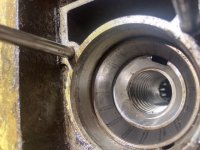
I know it’s the original unit, I’ve owned it since 1970. It has the 8 spline drive shaft and separate oil chambers, upper and lower. This picture shows the upper driveshaft bearing cup. Under the cup is what is described is a threaded sleeve, it needs a special tool other than the slide hammer to pull the cup. I can’t seem to locate that particular tool. 3DC480D2-F083-4B8E-867E-EC828855A774.jpeg
 

Attachments

  • 1EE9CAB8-2B5C-4960-98AB-B69EBEABCAFB.jpeg
    1EE9CAB8-2B5C-4960-98AB-B69EBEABCAFB.jpeg
    107.2 KB · Views: 32
An alternative strategy for going forward, so to speak, would be to put it back together with a seal kit after welding, and running it until it blows up. Might run forever behind a low-power 120 and with typical low annual running hours for a recreational boat. Only recommended in well-populated waters, good weather, and perhaps a prepaid tow-in plan.

Bearings that look like that would be reused in a rare antique tractor, or a show car that just needs to be driven around the block and on and off a trailer.
 
Ok, it must be a very early 67 because of the seperate oil chanbers and the sleeve. I believe its purpose of the sleeve is to act like an oil pump to help oil circulate to the bearing.
Look deep inside & you see a roller bearing just above the pinion gear & it rides directly on the shaft (just like the prop shaft bearing).

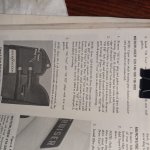
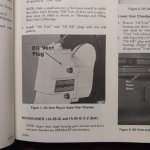
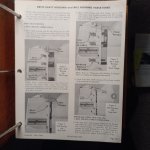
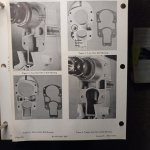
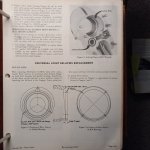
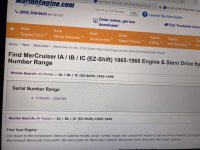
Attached are 2 pictures from MC service manual talking about interconnected & separate oil chambers. I cannot find a serial # breakdown of the change but 120 starts at 20621
 

Attachments

  • 20250113_201813.jpg
    20250113_201813.jpg
    531.6 KB · Views: 24
  • 20250113_201740.jpg
    20250113_201740.jpg
    483.4 KB · Views: 27
Since sometimes boat manufacturers have left over crated engines. I wonder if you have a 120 drive or a '66 120 EZ shift????

OR

I do know my '70 Searay (old man bought new), lower unit has 70 style trim lines (and related outer transom plate) 69 style lower unit & alternator that didn't charge when new. Turns out, engine had wire harness for single wire alternator with 2 wire alternator installed. MerCruiser warranty paid to put single wire alternator on.
So, my point here is maybe you have a Frankendrive that doesn't exactly match any parts book exactly?

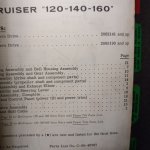
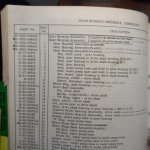
Here are pages from 120 (serial # 2062141 & up) parts book. ****note post above had incomplete serial number entered). Pay attention to items 5, 9 & 10
 

Attachments

  • 20250113_204551.jpg
    20250113_204551.jpg
    400 KB · Views: 28
  • 20250113_204703.jpg
    20250113_204703.jpg
    523.4 KB · Views: 24
  • 20250113_204725.jpg
    20250113_204725.jpg
    368.2 KB · Views: 27
If you do have an EZ shift, it uses a different bell housing gasket. Similar but different. See the following illustrations from vintage service manual.
Also note that gasket listed for 120-140-160 shows part number 27-45821 which supercedes to 27-64818.
EZ shift gasket is part number 27-35996
 

Attachments

  • 20250113_210017.jpg
    20250113_210017.jpg
    385.6 KB · Views: 20
  • 20250113_210029.jpg
    20250113_210029.jpg
    420 KB · Views: 23
  • 20250113_210045.jpg
    20250113_210045.jpg
    476.1 KB · Views: 30
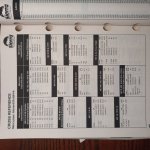
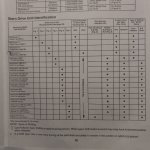
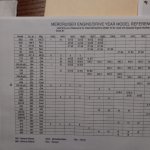
Additional references....
 

Attachments

  • 20250113_213819.jpg
    20250113_213819.jpg
    568.4 KB · Views: 22
  • 20250113_214331.jpg
    20250113_214331.jpg
    480.5 KB · Views: 26
  • 20250113_214338.jpg
    20250113_214338.jpg
    403.1 KB · Views: 27
  • 20250113_214425.jpg
    20250113_214425.jpg
    529.6 KB · Views: 26
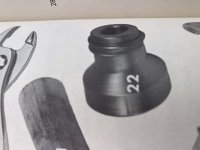
Thanks for the info, what you said about the dealer having left over crate engines is starting to make more sense. According to my serial number 2026323 it’s a 65-66 outdrive, maybe that explains why the outdrive was originally painted white. I’m still trying to figure out how to remove the sleeve. The manual shows a picture of the proper tool to remove it, I’ve looked on eBay and other sources to locate the tool but haven’t come up with anything yet. Sounds like a slide hammer is threaded onto the tool for removal.
 

Attachments

  • F6A02509-E34D-4FD1-A6E5-46DB8E1201D1.jpeg
    F6A02509-E34D-4FD1-A6E5-46DB8E1201D1.jpeg
    137.7 KB · Views: 29
  • D6DBC470-2145-4286-A6E7-51B8E29D2914.jpeg
    D6DBC470-2145-4286-A6E7-51B8E29D2914.jpeg
    96.4 KB · Views: 26
  • 825A0CF2-B600-4AB1-8168-F93D7A844899.jpeg
    825A0CF2-B600-4AB1-8168-F93D7A844899.jpeg
    61.8 KB · Views: 26
I might also add that the serial number on the transom is the model of the boat and number off the assembly line if this makes sense. Being it is stamped on the plate SS 165V C67006 must be the 6th boat built in the model year. 1967 Slickcraft
 

Attachments

  • 88302A82-9530-43C0-BFB8-3C967453CC87.jpeg
    88302A82-9530-43C0-BFB8-3C967453CC87.jpeg
    109.5 KB · Views: 23
Measure the studs as shown in the picture on post 21 above to verify.
I've never had to remove that sleeve, I don't have an answer.
 
you need to be aware that the drain hole is part of a cavity not connected to the internal casing. If the crack is in the internal side of the cavity it cant be repaired.
 
What sleve? Are you referring the the oil slinger sleve?
If so why remove it?

Or are you referring to the roller bearing at bootom of vertical shaft (pinion shaft)?
 
I want to remove the bearing cup that is above the oil slinger but the oil slinger is right up against the bottom of the cup hindering to get jaws of the slide hammer to grab it
 

Attachments

  • C8E41F81-F28A-4BE5-BAC2-4A76B19266F6.jpeg
    C8E41F81-F28A-4BE5-BAC2-4A76B19266F6.jpeg
    107.2 KB · Views: 23
Two jaw thin lip slide hammer,
It may appear there is no gap but there is.

Also, there will be shims under the bearing cup. Most likely they will get damaged. Make sure you get them all and measure each to get the stacked thickness.
 
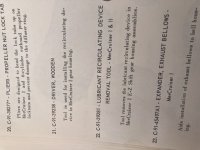
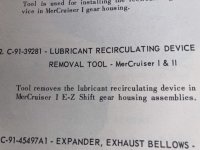
to pull the sleeve, you need mercruiser adapter #91-39281...it is the threaded adapter, with the LH thread, that goes into the sleeve and allows the slide hammer to pull the assembly... a used one off ebay is the mostly likely source...
 
to pull the sleeve, you need mercruiser adapter #91-39281...it is the threaded adapter, with the LH thread, that goes into the sleeve and allows the slide hammer to pull the assembly... a used one off ebay is the mostly likely source...
He is pulling the bearing race, is the tool you point to for that or the oil slinger sleeve?
 
Back
Top