Logo

Water in the cylinders - OMC 460

waterant

New member
Hi all. Does anyone know how water could get into the cylinders?

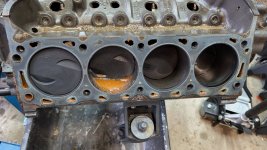
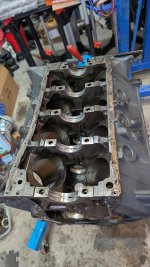
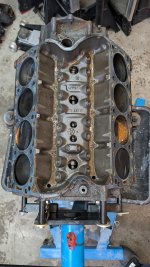
I removed the heads from OMC 460 7.5L Ford big block and cylinders 3 and 7 had water in them.

The last time the engine ran was in the boat in the water 3 months ago.

Cylinders are not corroded so the water probably didn't stay there too long.
The head gaskets look fine, with no breaks, but some water passages are completely blocked.

The engine didn't spend any time outside, I don't think the water could get from the top. The carburetor was on with the cover on the top.

The only thing I can think of is water from the wet exhaust while the engine was idling in the water. Is it possible?
How do I avoid it in the future?

Is there any other way the water can get into the cylinders?
 

Attachments

  • PXL_20260128_194640463.jpg
    PXL_20260128_194640463.jpg
    612.5 KB · Views: 40
  • 624207876_10214051588161698_8802146399329193948_n.jpg
    624207876_10214051588161698_8802146399329193948_n.jpg
    405.7 KB · Views: 36
I'm not an expert, but if you took off the intake manifold, water in the passages could perhaps leak in through the valves. I know I've found some on top of the block under the intake manifold.
 
The intake manifold is off and there was no water there or in the heads around valves
I guess it could be a crack in the block.
I'll be taking it all apart and see if I can find something.
Also, imy looking for some ways to check the block for leaks.
 
Opposite sides of engine. It would need 2 cracks in block, a cracked intake manifold or 2 bad exhaust manifolds or risers.
Salt water engine?
Has it been exposed to cold/freezing recently?
 
Maybe something was cracked from before.
This is my first season with this boat and I took the engine out and put it in the garage in October before any serious freeze.

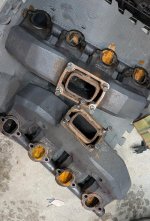
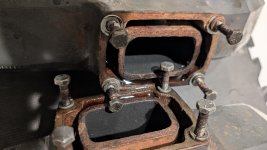
The manifolds had water in the exhoist ports. I guess the water should not be there.
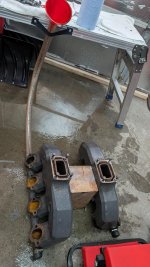
I'll see if i can test them for leaks somehow by plugging the suply end and filling outside jacket with water
 

Attachments

  • PXL_20260129_123900904.jpg
    PXL_20260129_123900904.jpg
    314.7 KB · Views: 35
Judging by the pix the water could have come from the manifolds but, you usually see leaks on the outside of the joint between the elbow and the manifold, and you will see rust in the bottom of the center exhaust passage inside. You can have the sealing surfaces re-surfaced by a machine shop and replace the gaskets and then test them with water. Use a heat gun to warm up the joint to simulate the heat of the engine running, you only need to warm it to about 140* or so because that's about how hot they get when you're running on plane.
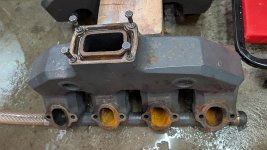
In your manifold pix I don't see evidence of it leaking on the outside, or even on the inside, of the exhaust passage, take another pic straight down to the bottom. If you got water in the cyls from a leaking head gasket, or cracked block or head, you will see rust in the exhaust ports of the manifolds but it didn't necessarily come FROM the manifolds.
BTW do not trash those manifolds, they are VERY hard to find, I'd strongly consider having the sealing surfaces re-surfaced and test them before reinstalling. Don't know if any aftermarket company makes replacements, those look like OMC original parts judging by the paint color.
I would:
take the cyl heads to an automotive machine shop and check for cracks
same with the block if you can, if not then check it very carefully after cleaning all the old gasket material off.
I'm not familiar with the intake on these Ford engines but if the intake gaskets on a GM small block leak, you will get water in the cam valley, but not in the cylinders. Very common on early Vortec engines due to bad intake gaskets.
 
in the pic of the exhaust manifolds, at the outlet to the elbows, the inner sealing surface looks pretty corroded to me...
 
thanks. I'm planning to take the block to the shop when i take everything apart. For now, I'm trying to find all possible ways the water gets there.
I tested the manifolds for leaks - they are holding water fine for 2 hours with no water showing up in exhoist passages.
In the photo is how i tested, and the exhoist ports are bone dry after 2 hours of water in the jacket.

Is this sufficient or I need to do this under pressure? I don't think the water there is under much pressure while running.

> in the pic of the exhaust manifolds, at the outlet to the elbows, the inner sealing surface looks pretty corroded to me...

Right, this is currently my main theory: new gaskets failed, and water was getting into the manifolds via those inner surfaces.
I'll get those resurfaced on both manifolds and risers.

Can I use high-temperature silicon on and under the gasket on those surfaces when I assemble everything back?
 

Attachments

  • PXL_20260129_135448602.jpg
    PXL_20260129_135448602.jpg
    335.8 KB · Views: 36
  • PXL_20260129_135456105.jpg
    PXL_20260129_135456105.jpg
    127.5 KB · Views: 39
...
Can I use high-temperature silicon on and under the gasket on those surfaces when I assemble everything back?
i would not...depending on the gaskets, I would consider Permatex #3...

make sure the elbows are in good shape before going to the machine shop...they typically have a five year service life but it varies with usage and the environment the boat is operated in..
 
Those are original manifolds from 1990, but they were used only in fresh water, and the boat stayed in the water for only a few weeks per year (it was dry-docked).
Am I testing them correctly? Is it enough for the water jacket to hold the water, or do they have to be tested under pressure?

I would just replace them, but unfortunately, no replacement manifolds for OMC 460s are available for sale anymore.
 
I think your method of testing the manifolds is ok. BUT with the risers installed, water will be a few inches above the gasket surface when the engine is shut down.
I don't see any riser pictures.....??????
I would resurface those manifolds and after a close visual inspection of the risers either replace or resurface them. New gaskets & retest as you did this time but fill until water flows out the risers.
Fresh water lasts a long time & I agree, risers typically fail 1st.
 
What I was going to say. I actually check mine by removing a plug on the top or side of the elbows & using an inspection camera to look inside!
 
Why did you take off the heads? Did you have a miss or a compression problem? Is your system raw water in the block or fresh water and antifreeze? Off hand my guess is there may be a crack in the head, especially if some of the water passages were blocked causing a hot spot. Another source could be pitting on the water side of the cylinder in the engine block. This is more common on diesel engines than on gasoline, but it could happen if the engine is high time. Years ago I put a bare block in 6.9L Ford Navistar engine in my pickup. International had six of them at the warehouse, so it was a common problem.
 
You can see the plugs on top of the elbows, these are for an exhaust overheat sensor that some Volvos use. OMC & Volvo used the same exhaust from 1994 and up. There are also plugs on the side of the elbow that can be used to view the exhaust passage with an inspection camera.
exhaust staboard side.jpg

here's a pic I took from the exhaust side of the elbow with the rubber hoses removed....
4.3 with new exhaust system.png
 
You can see the plugs on top of the elbows, these are for an exhaust overheat sensor that some Volvos use. OMC & Volvo used the same exhaust from 1994 and up. There are also plugs on the side of the elbow that can be used to view the exhaust passage with an inspection camera.
here's a pic I took from the exhaust side of the elbow with the rubber hoses removed....

thanks. It will be handy to check once in a while when I reinstall everything

Why did you take off the heads? Did you have a miss or a compression problem? Is your system raw water in the block or fresh water and antifreeze? Off hand my guess is there may be a crack in the head, especially if some of the water passages were blocked causing a hot spot. Another source could be pitting on the water side of the cylinder in the engine block. This is more common on diesel engines than on gasoline, but it could happen if the engine is high time. Years ago I put a bare block in 6.9L Ford Navistar engine in my pickup. International had six of them at the warehouse, so it was a common problem.

This is a raw water system. i pulled the engine out of the boat to fix the transom, which is leaking.
Because the engine is out, I decided to check inside. One screw after another, and I now have abare block and will do a full rebuild.
im glad i did before that water caused more damage.
The block looks fine so far, but some water passages looked blocked. I'll test it more.

It looks like the water was not in the cylinders for too long, as I do not see any rust damage.
My bet is on the failed riser gaskets, since I recently changed those, and the manifold flanges look very rough.
If I remember correctly, I did file them flat and put gasket compound on top and under the gasket, but I probably did something wrong.
I do have Permatex No. 3, but I used Permatex 80065 High Tack Spray-A-Gasket Sealant on the riser gasket - looks like that was a wrong choice.

If the block has no cracks, I'll go with the theory of failed gaskets and do it differently during assembly.
 

Attachments

  • PXL_20260131_163220908.jpg
    PXL_20260131_163220908.jpg
    210.6 KB · Views: 28
  • PXL_20260131_141427555.jpg
    PXL_20260131_141427555.jpg
    236.5 KB · Views: 31
Back
Top